

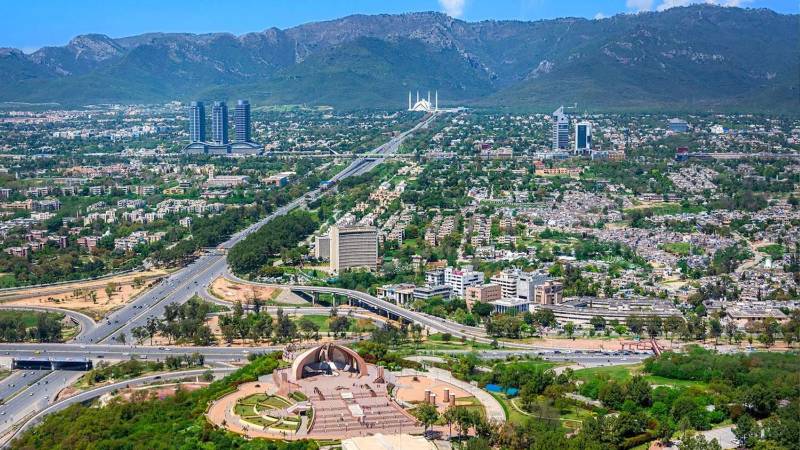
Islamabad was never meant to be this. When Greek architect Constantinos Doxiadis devised the master plan in the early 1960s, his vision wove a city of balance with wide avenues and green belts, hills preserved as guardians of peace. The concept was beauty, order and nature. Today, that vision lies buried beneath bulldozers, concrete and the calculated neglect of those in charge.
The Capital Development Authority, established in 1960 to protect the capital’s layout, has become its executioner. Between 2021 and 2024, Islamabad lost 14 hectares of tree cover, nearly half a percent of its original canopy, including four hectares of natural forest. Each of those hectares mattered for air, for shade, for identity.
In 2024, CDA removed over 5,000 mulberry trees in F 9 Park and planted some 10,000 replacements but many of these were non-native, raising concerns about ecological impact. In spring 2025, officials began large-scale removal of allergy-causing paper mulberry species from Shakarparian, targeting about 10,000 trees, while pledging to replace them with 50,000 indigenous saplings. Later plans included 57,000 replacements across other sectors. The scale of this arboreal turnover is staggering.
Despite plantation drives, the deeper reality remains grim. Between 2016 and 2022, the Ministry of Climate Change estimated that over 14,000 mature trees were sacrificed for roads, interchanges and commercial ventures. Trees that spent decades reaching maturity were felled in minutes.
This is not simply forestry management gone astray. It is corruption and policy cloaked in bureaucracy. A low-level record keeper admitted that unless bribes lubricated the system, nothing moved. That single line tells us more than volumes of official files.
Politicians and bureaucrats lecture the world about climate change while boxing in their capital’s lungs. Imran Khan preached a billion-tree tsunami but permitted tree cutting for interchange projects at Rawal Dam. Nawaz Sharif’s motorway schemes scarred orchards and farmland. Today’s coalition treats the Environment Ministry as a political favour, not a serious responsibility.
Other countries do not allow such indifference. In London, one mature tree’s removal can stall a project for weeks. Paris tracks annual tree planting with the seriousness of an economic index. In Delhi, citizens won a court battle in 2018 to stop the felling of 14,000 trees. In Islamabad, a city of under two million, green belts vanish without a hearing.
A ruling class that sees aesthetics as irrelevant will never create a civilisation worth memory
The cost is already evident. In July 2021, rains turned parts of Islamabad into a flood zone, killing residents in E 11. Experts pointed to construction on natural drainage channels. The Supreme Court’s 2019 ruling held CDA responsible for collusion with illegal housing societies that blocked drains and encroached on reserved land. Yet permits continue to be issued with impunity.
Pakistan ranks among the ten most climate-vulnerable nations in the world. The Global Climate Risk Index repeatedly places the country in that bracket between 2000 and 2019. Every cut tree makes the risks heavier. Islamabad’s Environmental Protection Agency notes that a mature tree absorbs up to 150 kilograms of carbon dioxide annually and cools the air as much as ten air conditioners. Removing thousands and replacing them with saplings is like swapping a shield for a blade of grass.
The issue is not only environmental but also social. The wealthy retreat to Raiwind and Chak Shehzad, where private lawns and orchards are protected by borewells and generators. The ordinary citizen cannot buy a farmhouse. His only refuge is in the parks and green belts of the capital. When these are bulldozed, he is left with dust. This is injustice dressed as development.
The silence of the judiciary and media is striking. Courts that take suo motu notice of sugar prices or TV dramas rarely intervene to stop the cutting of forests. Television anchors fill hours with political drama but leave the felling of Islamabad’s lungs off air. Perhaps trees do not bring ratings. Yet in the long run, their loss will cost more lives than any scandal of the day.
What should be done? Islamabad does not need slogans; it needs enforcement of the master plan. Every tree cut and every permit issued must be documented and published. Environmental impact assessments must be binding, not ceremonial. Citizens must be given the right to object to projects that threaten greenery. And the Ministry of Climate Change should be led by a professional, not a political leftover.
Expecting deep reform from a state addicted to shortcuts may be unrealistic. But at the very least there should be resistance from below. Civil society must treat every tree as a citizen. Each felling must be recorded, protested and challenged. If courts will not protect Islamabad, then history must mark down who destroyed it.
The larger lesson lies beyond this city. This is not only about trees but also about national priorities. We praise concrete more than canopy, we equate progress with dust and cement, and we discard the idea of harmony with nature. Then we wonder why our villages flood and our labourers collapse under heatwaves.
Islamabad’s tragedy is Pakistan’s tragedy. A nation that cannot respect trees cannot respect its own people. A state that kills forests for bribes will kill hope with the same ease. A ruling class that sees aesthetics as irrelevant will never create a civilisation worth memory. The bulldozers in F 9 Park are not just machines, they are metaphors for the state itself, loud, blind, destructive and indifferent to beauty.
The question is whether the people of Pakistan will continue to watch in silence or whether they will stand to save the green soul of their capital.