


Walking through the historic streets, alleys, and neighbourhoods of Shikarpur reveals impressive mansions that testify to the city's centuries-old cultural heritage. I have been observing these structures since 1998, and now I have decided to write a series of articles on the architectural features of these mansions that make them particularly noteworthy. Anyone who passes by a mansion cannot help but notice its marvellous decorations.
Among these, I have seen many magnificent mansions, or Maaris, known for their intricately carved wooden doors. In this article, I will focus on just one wooden door, although I have seen many over the past two decades in the historic neighbourhoods of Shikarpur. This door is notable for its unique motifs, which are not present on any other wooden door in Awan Mohallah. Any similar designs that once existed on other doors have been regrettably removed and sold.
Walking from the Alavi neighbourhood to the Shah Hussain locality, and continuing to Kakran Jo Thalo Street, Kath Madi, Juma Khan Madi, Awan Mohallah, and several other neighbourhoods in Shikarpur, one can't help but be amazed by the wooden doors of historic houses. While some of these historical homes are in disrepair, I noticed several beautifully carved wooden doors, particularly in Awan Mohallah and the surrounding areas.
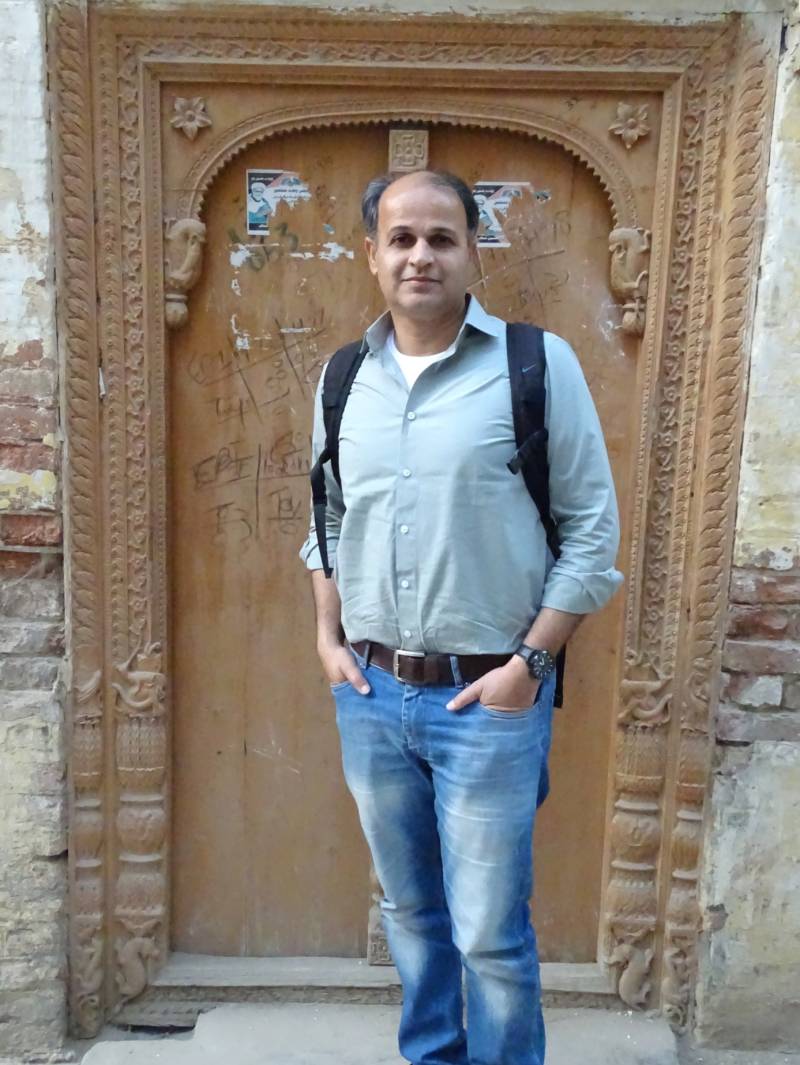
One of the most impressive doors is located in the Awan Mohallah, between Sheedki Khoi and the Bumbhu Shah shrine. This door is an excellent example of early 20th-century urban craftsmanship and serves as the main entrance to a historic house.
This door is set within a rectangular frame. The central vertical post, resembling a miniature column, divides the door into two plain wooden shutters, lacking any carvings. However, this central post is beautifully carved as a stylized column, complete with a base, shaft, and capital. Such decorative miniature posts are characteristic of many wooden doors found in Maaris (mansions) and religious buildings throughout Shikarpur. Unfortunately, many of these doors have been removed and sold off.
During my visits to the furniture market in Islamabad in 2012, 2015, and 2017, I observed that several wooden doors depicting Hindu deities and Sikh gurus had been removed from mansions in Shikarpur and brought to the market for sale.
At the bottom of the door of the historic house in the Awan Mohallah, the post begins with a slightly rounded, projecting pedestal that features articulated mouldings and layered ring carvings. The shaft, which forms the central body of the mullion, is carefully segmented into decorative bands instead of being left plain or smooth. It includes ring mouldings, subtle flutings, and carved medallion-like divisions, showcasing the craftsmanship of the wood carvers of Shikarpur. Near the top, the carving becomes more elaborate, with layered mouldings and simple floral designs creating a small capital-like crown. This upper section visually connects the central post to the arch above, resulting in a smooth, balanced line from the bottom of the door to the top. The central vertical post serves not only as a structural support but also carries symbolic meaning: the protection of the threshold.
Carvings of creatures such as the makara are designed to guard entrances and ward off negative forces
The arch in this doorway is one of the most striking and refined architectural features. It is set within a rectangular frame, creating a contrast between straight and curved lines. This is not just a simple curved opening; rather, it is a carefully carved and ornamented element that combines structural function with rich decoration and symbolic meaning. This is a cusped arch, characterized by an inner curve that is not smooth but formed by a series of small, rounded projections, known as cusps. The arch springs from side brackets that resemble stylized animals, likely makara. The carved figure represents a makara, a mythical aquatic creature often depicted holding or devouring fish. The makara's curved body, open mouth, and flowing form create a sense of movement.
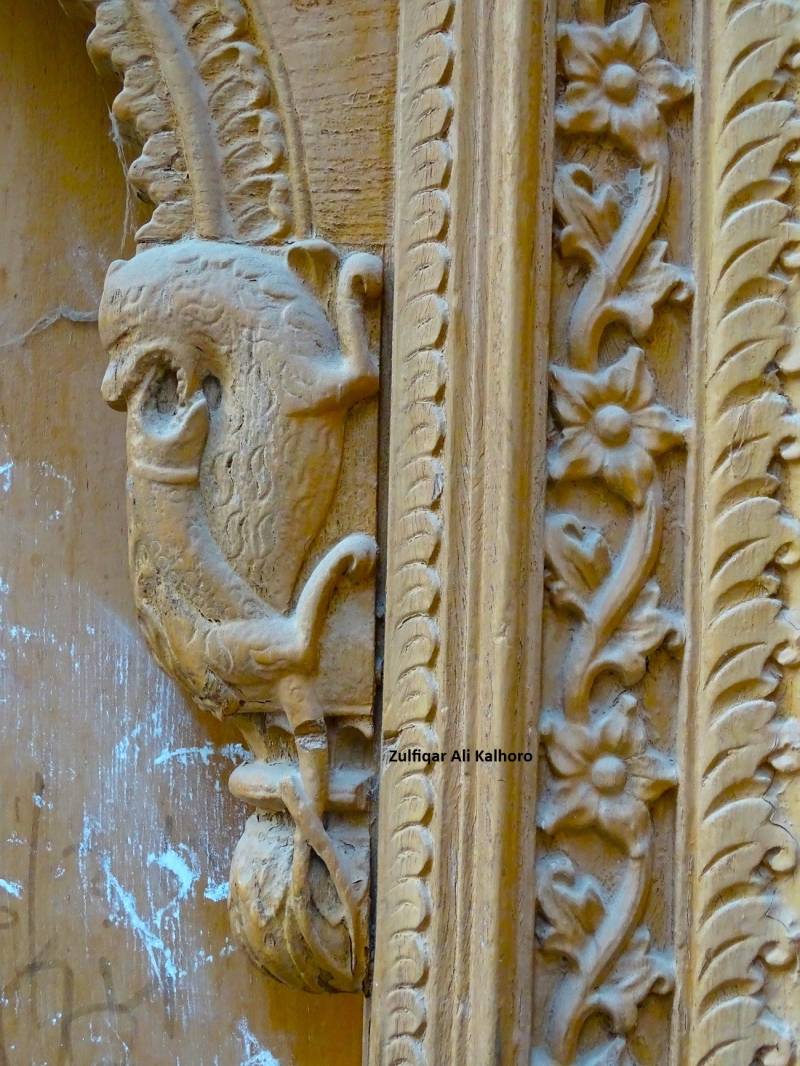
Makara is most frequently carved on wooden brackets found in the Maaris and havelis of Shikarpur. It also appears on the lower parts of door jambs, as seen in a door located in Awan Mohallah. However, it is most commonly found on wooden brackets, which I have seen in several mansions not only in Shikarpur but also in various other cities and towns in Sindh. Some of the most elaborately carved makara depictions can be seen in the havelis of Khaman village in the Shikarpur district.
In South Asian tradition, carvings of creatures such as the makara are designed to guard entrances and ward off negative forces. These carvings also showcase skilled craftsmanship, featuring meticulous attention to depth and detail. As part of the doorway's design, the makara adds vitality, symbolism, and cultural significance to the entrance. During the colonial era, entrances in Shikarpur and other cities in Sindh were given special attention. These symbols predominantly appear on the doorways of non-Muslim households.
A notable feature of the door jamb in the Awan Mohallah is the intricately carved animal scene on the left side. This door jamb incorporates figurative, animal, and vegetal motifs, with the most striking element being a lion gripping a mythical animal. From the animal's mouth springs a stylized floral scroll that runs the entire length of the door frame. Adjacent to this carving is a female figure with a pot balanced on her head. This motif is carved on both sides of the door. However, the carved female face on the left side of the door jamb shows signs of damage. The lion's face also appears to be damaged.
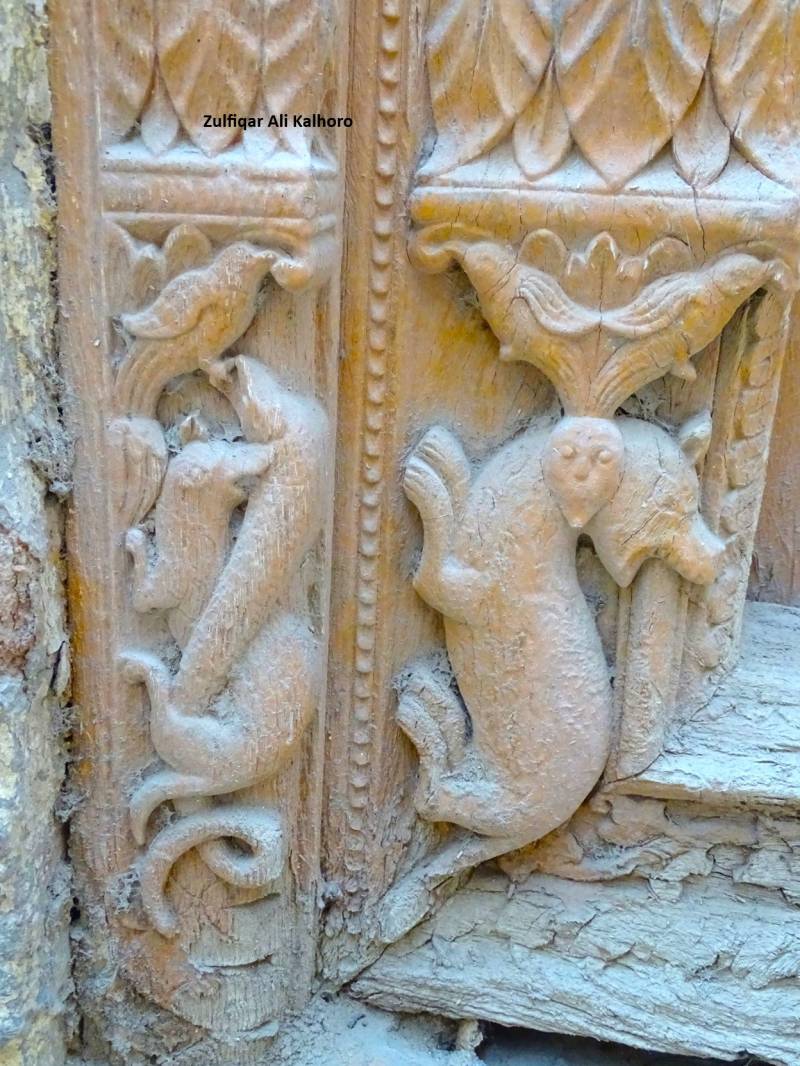
Below these prominent figures, additional beautiful motifs decorate the door jamb. On the left, a scene depicts a combat between a mongoose and a snake, topped with a bird carving. Next to this is a makara, its mouth open, also topped by a pair of birds. The same motifs are repeated on the right side of the door jamb.
These refined and elaborate animal and bird motifs are also found on many carved wooden doors in Shikarpur. However, the combination of the female figure with animals, birds, and floral scroll patterns is unique to this particular door in the Awan neighbourhood of Shikarpur. I have observed similar carved female figures with pots on their heads on several doors throughout Shikarpur. Furthermore, the mongoose-and-snake motif is commonly seen not only on wooden doors in Sindh but also in paintings. This recurring motif, like others, has likely inspired woodcarvers to translate those designs from paintings into the carved wooden doors of Shikarpur.