

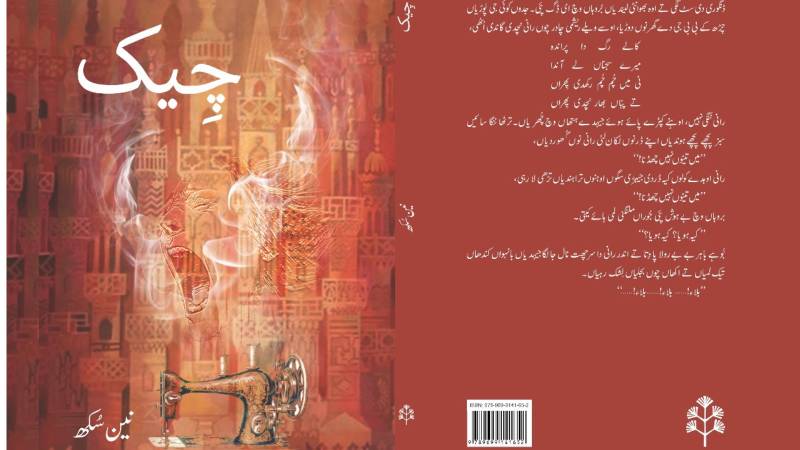
دھرتی --- ات سمندر کتاب
چن سورج جلد والی
پر خدایا اایہہ بُھک ننگ , سہم تے غلامی
"Cheek" (The Scream) is a reformist and thematic novel written by Khalid Mehmood (Advocate), known as Nain Sukh. Through this masterpiece, he explores the socio-economic, religious, and political divisions in society, incorporating historical references. Before this novel, he had already addressed many sensitive issues and harsh realities in his short stories and other novels.
He has authored five short story collections and four novels. A powerful narrator, he has created many characters who have had a strong impact both socially and personally. As a writer, he consistently explores poignant and thought-provoking themes in his work.
Cheek is a distinctive novel that powerfully exposes injustice, oppression, and exploitation—both among individuals and within institutions. With great skill, Nain Sukh chronicles the historical journey from 1942 to 1990 through a single, cohesive storyline, presenting rich and compelling subject matter.
His characters, whether central or secondary, leave a lasting impact on readers and compel them to keep reading. The way Nain Sukh captivates his audience through these characters is truly commendable.
A powerful outcry against an exploitative, materialistic society—‘Cheek’ challenges stifling religious dogma, hypocritical politics, so-called liberals, mercenaries, capitalists, and feudal lords. It is a scream against poverty, ignorance, and oppression.
Yes, it is the scream of a weak, oppressed woman forced by society to live under the shadow of fear. It is also the cry of an ordinary—yet symbolic—woman whose philosophy of life was shaped by the ideas of Subash Chandra Bose, nurtured in the lap of her progressive, outspoken, and truthful father.
Both Amin Tailor (the father) and Kaneez Fatima (the daughter), as Rani, come from a society where hypocrisy flourishes in the name of religion and spectacle prevails in the name of politics.
Rani is a courageous and outspoken girl who refuses to hide her physical disability in self-pity. Her dream of becoming a midwife stems from her desire to educate parents about the disabilities of their newborns. However, the cruel society constantly reminds her of her disability, repeatedly wounding her spirit and making her feel disappointed and miserable.
She is devastated to learn that her aunt and her son, Zaheer—who once claimed to love her—reject her because of her disability. The people she cherished the most, ridicule her, making their betrayal even more agonising. This torment from her loved ones is unbearable, yet she suppresses the pain within herself. It is a silent scream—one without noise, yet deeply piercing.
One is truely amazed by the craftsmanship of a male writer who so powerfully captures the depth of a woman's emotions—her love, pain, and hatred—with such authenticity and sensitivity
After marriage, she endures immense suffering but faces it with resilience. Her husband, Boota, though physically weak, embodies the typical mindset of male chauvinism, further adding to her misery and suffering.
In this hypocritical society, a man's weakness becomes a woman's humiliation. She cannot even express her legitimate desire for physical intimacy with her husband, as it is deemed a "sin" without reason. Her husband fails to understand her emotions and physical needs, instead mocking her—revealing the true face of an ignorant, male-dominated society.
One is truely amazed by the craftsmanship of a male writer who so powerfully captures the depth of a woman's emotions—her love, pain, and hatred—with such authenticity and sensitivity.
ایہ ہزار روپے دی وی واری وچ نہیں
Above mention line by the novel in which author highlights how women are often viewed as being of little worth, she is not merely child-bearing machines, and their worth is not defined by their ability to conceive. this criticism points to the society’ ignorance and poor mentality for those who are more than fifty percent of The population. Rani endures the cruel and demeaning attitudes of Zaheer, Boota, Shoka, and Saien Sabz, one after another. By suppressing the serpent of her sensual desires, she finds relief and solace—not because she has been heard, but because she realises that society is filled with indifferent bystanders who neither feel her pain nor acknowledge her silent screams. Accepting this harsh truth, she finally chooses to silence her cries against the cruelty around her.
It seems that Rani has transformed into a fearless and empowered woman, breaking free from societal fears and limitations. She now knows her rights, refuses to be controlled by superstition, and confidently stands up for herself. No longer tolerating unwanted suitors, she understands her legal entitlements under Sharia and is prepared to fight for custody of her children after divorce.
رانی نوں روٹی تے ملدی رہوے گی
It’s a tragic reflection of a broken system when a father, instead of standing tall with dignity, is forced to beg for his daughter's survival. His helplessness is not just his own—it is an indictment of those in power who were entrusted to uphold justice and equality but instead exploit and abandon the vulnerable. This moment of desperation is a stark reminder that in an unjust or corrupt society, the true measure of its failure lies in the suffering of its most defenseless citizens.
It’s a sharp critique of extremism on both ends—where rigid religious dogmatism suffocates progress, and so-called liberals, instead of fostering genuine freedom, impose their ideological barriers. The real tragedy lies in how both factions, in their ways hinder the common people from embracing a balanced, enlightened path. True progress is neither in blind adherence nor in forced secularism but in a space where faith and reason co-exist without oppression from either side.
The writer paints a grim yet honest picture of the country's turbulent political history, where each era—whether democratic or dictatorial—left its scars. Instead of stability and prosperity, these regimes birthed deep-rooted issues like the Kalashnikov culture, the heroin trade, and sectarian violence. Through the novel, these harsh realities are laid bare, exposing how power struggles and selfish political interests have shaped the nation's destiny, often at the cost of its people. It’s a powerful commentary on how governance, regardless of its form, has repeatedly failed to bring real progress.
If the novel captures such strong, thought-provoking ideas through Rani’s journey, it must serve as a powerful reflection on both individual and collective struggles for justice
That’s a powerful takeaway. No matter the political landscape—be it dictatorship or so-called democracy—women’s empowerment has always been resisted. The novel’s central theme highlights how, despite changing regimes, societal structures remain rigid, refusing to grant women their rightful place. It sounds like Rani is a strong, rebellious character who refuses to conform to societal norms and religious restrictions that she sees as oppressive. Her realisation about why women in her village cannot drive a tractor suggests a deeper awareness of systemic barriers imposed by tradition and hypocrisy. This transformation from "notorious rebel" to "Hajjin" is a powerful arc, highlighting a journey of defiance, struggle, and eventual recognition. It suggests deep themes of personal growth, societal change, and the complex relationship between rebellion and faith.
This dream sequence is incredibly symbolic, reflecting Rani’s internal struggle and the weight of societal oppression. Seeing herself as weak and pleading for protection suggests a subconscious fear—perhaps a remnant of the very society she fights against. But her realisation that women must become powerful to protect themselves transforms that fear into determination.
Sabz Sain, likely a revered figure, could represent the system—whether religious, cultural, or patriarchal.
Rani’s shift in thinking is both powerful and poignant. Her journey from a rebellious individual fighting for her own freedom to a leader who uplifts the weak and deprived reflects a deepening understanding of true power and justice. It’s no longer just about breaking free from oppression—it’s about empowering others who remain trapped within the same systems.
Her new mission—supporting the weak—could reshape her entire approach to life.
This moment could be a pivotal one in Rani’s transformation. By joining the procession, she takes a public stand, aligning herself with the oppressed and using her voice to call out injustice. The fact that she protests for a woman deposed on charges of corruption suggests that Rani sees beyond surface issues—she recognises the layers of oppression, whether it's about corruption or the systemic silencing of women. It also hints at the complex relationship between power, gender, and social justice in her society.
Her shouting alongside her husband, Boota, adds another layer to this act of defiance. It's not just Rani’s rebellion now; it's a partnership, a unified front. This could symbolise the idea of collective resistance, that the strength of a family or community in standing up for justice is much more powerful than any solitary person.
Rani’s rejection of the reward in favor of standing with the oppressed is a powerful statement of her principles. Her refusal suggests that she doesn’t seek personal gain or recognition, but rather aims to amplify the voices of the marginalised—those who scream in silence until their cries are ignored by the deaf and dumb ruling class. It shows that her transformation isn’t just about her liberation but about being a vessel for the voiceless.
Her decision to accept protest instead of the reward signals a deeper shift in her values. It’s no longer about personal victories but about the collective struggle and the importance of raising awareness for women who are silenced. This is a bold choice that challenges the status quo, especially in a society where recognition and reward often validate authority and power.
Nain Sukh’s novel seems to carry a profound message, making it a truly impactful read. The themes of rebellion, empowerment, and resistance against societal norms are often transformative, resonating deeply with readers. If the novel captures such strong, thought-provoking ideas through Rani’s journey, it must serve as a powerful reflection on both individual and collective struggles for justice.