

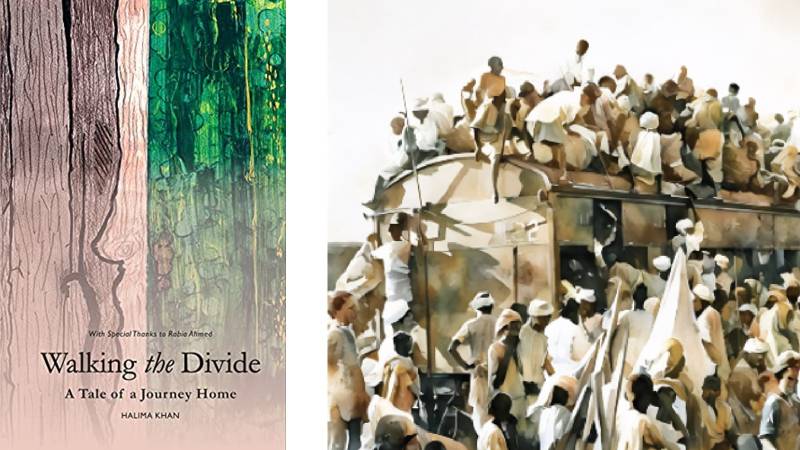
Halima Khan is a writer and curator with a background in Communication Studies and English Literature. She writes for several publications, including Dawn and Global Voices. In addition to her work as an author, Khan is an advocate for social causes, including Pink Ribbon Pakistan. Walking the Divide is a work of historical fiction based on factual events and personal recollections of the 1947 Partition of British India. The book is described as “a work of fiction weaved over a framework of facts.”
The story is a fictionalised account of the real-life experiences of Syed Sardar Ahmed. It follows his poignant and physical journey as he navigates the violent chaos and tragedy of the Partition. At the age of 21, Syed Sardar Ahmed was forced to leave his ancestral village of Kharkhoda (in what is now India) and migrate to what became Pakistan. After escaping a near-death experience on a train, he retraces his “bloody journey” back through the new borders in a search for his family, whose fate is uncertain. He is the lone survivor, in the end, in his entire family from the village as massacres take place on trains entering from both sides of the border. The book deals with the uncertainty he feels regarding the survival of his large family. The story explores themes of pain, loss, and the struggle to build a new life with hope. There is mention of the peaceful India before partition and Sardar even attended Aligarh University for a few years before partition because his mother thought that knowledge was the most important asset one could have in life.
Central to the book are the themes of forced migration and displacement, capturing the loss of home, the challenges of entering a "new beginning" and the struggle to build a new life
Khan has based the novel on extensive interviews and conversations with Syed Sardar Ahmed to capture the emotional reality of his experiences. The questions the author asks are as relevant today as they were in 1947: what was the emotional and human cost of partition of the subcontinent, what happens when individuals migrate together, and how important the individual experience is to the telling of the narrative of an event. The central themes are those of migration and displacement. The forced migration of Sardar Ahmed, the loss of home and the challenges of entering a “new beginning.”
Title: Walking the Divide: A Tale of a Journey Home
Author: Halima Khan
Publisher: Sang-e-meel Publications, 2021
The book also deals with the trauma of separation, the unknown fate of loved ones and the attempt to reclaim or revisit the past. In the aftermath of the partition of British India in 1947, the book brings up questions of belonging and what it means to belong to one place. The novel hints at survival against the odds as it ends with a pictorial narrative of Sardar Ahmed with his grandchildren in Pakistan. The entire tone of the novel is as if the author is reflecting on life, emotional with poetry dispersed in between, and the focus is on each individual in the novel rather than the macro-history that is taking place.
Walking the Divide matters because it offers a perspective on the events of Partition (1947) from one individual’s story, adding nuance and human dimension beyond statistics. It invites readers to consider the emotional consequences of border creation, migration, and the unsettled nature of “home.” For Pakistani readers (and beyond), it helps fill gaps in popular histories of Partition by telling lesser-heard stories of survival and displacement.
Because it is “fiction weaved over a framework of facts,” readers should be aware that not every detail may be strictly historical, even if based on real testimony. Also, the focus is very much on one individual journey, so it provides depth rather than breadth: other refugee/migrant experiences may tend to vary. The emotional tone may make it more literary than purely historical, which is important to recognise.
Though Syed Sardar Ahmed made it across the border, his family and many other families were not as lucky. To learn how his family’s life ended tragically it is essential you pick up a copy of Khan’s book and learn first-hand how Partition impacted the entire sub-continent. Syed Sardar Ahmed lived to see his grandchildren but his brothers did not, his parents did not, his aunts and uncles did not. And this is the story of many houses in Indo-Pakistan. ‘Walking the Divide’ reminds us how lucky we the current generation of the sub-continent are to be given liberty and freedom as a gift from our elders be it –Jinnah, Nehru, Gandhi. We have two countries to call our own today, but we must never forget the blood that was spilt to get here. We must always remember. ‘Walking the Divide’ makes sure we don’t forget. We all owe Khan a debt of gratitude for penning a book on partition to make us remember at a time when most would rather forget. It takes a great deal of courage to do so and it seems Khan has mettle. For history buffs and those interested in the politics of our subcontinent, this is a must read.