

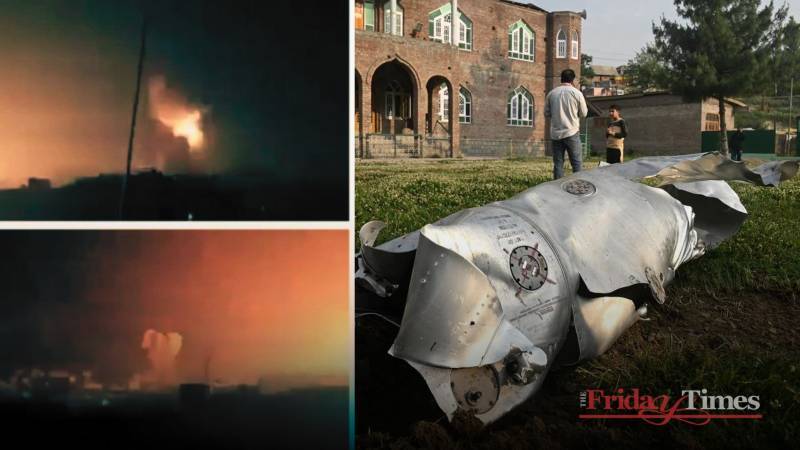
The night between 6 and 7 May proved to be one of profound dismay and humiliation for India. The Indian Air Force (IAF) lost six aircraft in what many analysts have described as one of the most significant air combat engagements in recent history. Over seventy Indian fighter jets — including the much-vaunted Rafales — engaged just twenty Pakistani aircraft, yet suffered a decisive defeat.
This outcome stemmed from a series of deep-rooted strategic miscalculations.
For over two decades, the Indian establishment — with unwavering support from Godi media — has systematically indoctrinated its public with the narrative of Pakistan as a “jihadi state.” In support of this portrayal, India has allegedly staged a number of false flag operations on its own soil since 2001: the Mumbai attacks, the Parliament building attacks, the Samjhauta Express bombing, the Pulwama incident, and most recently, the killing of 26 tourists in Pahalgam on 22 April — among others.
The objective was to embed in the Indian psyche the belief that every Pakistani harbours an intrinsic hatred of Hindus and seeks nothing less than India’s destruction. This narrative served two interlinked purposes: first, to undermine Pakistan’s credibility in Western capitals by portraying it as a haven for extremist groups; and second, it helped build a political constituency for the far-right BJP/RSS government led by Modi. Simultaneously, India carried out covert operations within Pakistan through support for organisations such as the BLA and TTP. These efforts contributed to a persistent global perception of Pakistan as politically unstable and a security risk, thus discouraging foreign investment and harming its economic trajectory.
Indeed, the economic toll on Pakistan was considerable.
It was assumed that the imprisonment of Imran Khan and the subsequent unrest had fatally undermined public confidence in the Pakistan Army
The West, driven by an appeasement policy towards India, viewed as a vast consumer market with inexpensive labour, proved largely receptive to this narrative. India lobbied vigorously in Western capitals, particularly Washington, and succeeded in having several religious organisations designated as terrorist groups. Meanwhile, Pakistan found itself trapped in a vicious cycle: as concerns about internal security mounted, economic isolation deepened, fuelling further political instability. Investors diverted their attention to India, often admonishing Pakistan to resolve its security challenges and stabilise its political environment. Labels such as “fundamentalist,” “extremist,” “Islamist,” and “jihadi” became politically expedient terms, deployed with remarkable elasticity in the post-9/11 global order.
This time, however, India misread the shifting geopolitical landscape.
India’s much-touted demographic dividend — based on its vast pool of cheap labour — is fast losing relevance. Even its sizeable call centre industry now faces disruption due to the rapid advancement of AI-driven automation. India’s continued strategic importance, therefore, lies not in its labour force, but in its role as a lucrative export market — particularly for defence manufacturers in the United States and France, on whom its military remains heavily reliant. And more importantly, as a US pawn against China.
China, meanwhile, no longer depends on low-wage workers. Automation is transforming industrial output, with a pivot towards highly skilled, technologically adept labour rather than merely inexpensive manpower. American policymakers — including Donald Trump — are well aware of this. While Trump staged photo opportunities with factory workers at the White House, he, like other Western leaders, understands that 21st-century manufacturing relies not on sheer human numbers but on advanced automation.
Therefore, when, in the wake of the Pahalgam incident, Indian External Affairs Minister S. Jaishankar toured his favoured European capitals, he was met with an unexpectedly cold reception. One need only contrast his previous bombastic visits with his recent moaning: “We look for partners, not preachers.” The Europeans had simply requested credible evidence of Pakistan’s involvement in the Pahalgam attack, which Indian media and Jaishankar had swiftly and confidently attributed to Pakistan. The basis? Circumstantial evidence. In effect: “We’ve spent two decades convincing you that Pakistan exports terrorism — surely this must be them too. What is there to investigate?”
But this time, the Indian narrative failed.
President Trump made it clear that he enjoys cordial relations with both India and Pakistan, and hoped they would resolve the matter “one way or another” — a dispute, he quipped, that dates back “a thousand, or perhaps fifteen hundred years.” In other words: I don’t give a damn! One American pro-India analyst attempted to refute Pakistani Defence Minister Khawaja Asif’s blunt remark that Pakistan had long done America’s “dirty work” in the region. Asif was referring to the US-sponsored jihad during the Soviet invasion of Afghanistan and the post-9/11 War on Terror. However, the same analyst conceded that applying excessive pressure on Pakistan might push it wholly into China’s orbit — an outcome the United States is keen to avoid.
This evolving global reality was yet another critical miscalculation on India’s part. One might have expected Jaishankar, of all people, to have foreseen it.
Another serious misjudgment by Indian policymakers concerned Pakistan’s internal political dynamics. It was assumed that the imprisonment of Imran Khan and the subsequent unrest had fatally undermined public confidence in the Pakistan Army. This belief proved to be ill-founded. Despite a prolonged media assault on the military’s credibility, the Pakistani public rallied in support of its armed forces in the face of Indian jingoism and war-mongering following the 22 April incident. The message to India was unequivocal: whatever our political differences, you will not be permitted to exploit them at the expense of our national security.
The Indian media, meanwhile, stoked daily antagonism.
A favourite theme was to mock Pakistan as a “bhikari” — a begging nation — whose economic plight was, ironically, exacerbated by post-9/11 geopolitics in which India played a significant part. Convinced of Pakistan’s economic fragility and political divisions, India deemed the time ripe for escalation. This sense of invincibility was buoyed by the abrogation of Article 370, which revoked Jammu and Kashmir’s special status. Bollywood, alongside Godi media, played a key role in fostering a hyper-nationalist psyche and a misguided sense of national pride.
All the Indian guests who appeared on my show, Talking Politics, were singularly lacking in humility. Instead of engaging in nuanced dialogue, they offered Pakistan unsolicited lectures on economic development, education reform, and governance — all the while overlooking the complex realities, which perhaps only began to dawn on them, hopefully!
No less misplaced was India’s exaggerated belief in its air superiority following the acquisition of 36 Rafale jets from France — with a hefty €7.8 billion in 2016. The arrival of the first batch on 29 July 2020 instilled a dangerous overconfidence within the Indian defence establishment.
That illusion was decisively shattered in the early hours of 7 May.