

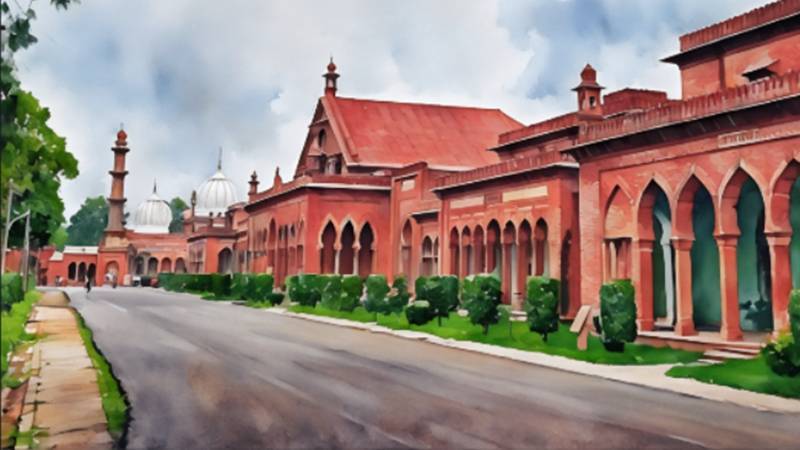
I should tell you something before this goes any further. I have never been to Aligarh. Never seen Aligarh Muslim University (hereafter, simply Aligarh) with my own eyes, only through the eyes of those who have. But there’s a minutely subtle reflection of Aligarh that stays on my trail. I vividly remember it was 2018, and I stumbled upon a few books by a certain Mukhtar Masood (later, I would be searching for his grave, which would lead me to visit all the graveyards in Shadman). The first one was Harf-e-Shouq, and the dedicated part read: Tulab-e-Aligarh College ke naam. This had me wound up, and I began skimming through it. Skimming turned to reading, which evolved to annotating.
We often talk about Delhi and Bombay, and the life that these metropolises sustained, but never about Aligarh and the impact it had on the Muslims of the sub-continent, and particularly the earlier Pakistani elite. As Jaun Alia once remarked, “Pakistan … ye sab Aligarh ke laundon ki shararat thi” (Pakistan, this was the mischief of boys from Aligarh).
And yet, when one tries to make this case, one runs into what Mencken noted in In Defence of Women, that practically all of them think it necessary to bring up a vast mass of evidence to establish what should be an axiom. Mukhtar Masood, an Aleeg, was the Commissioner of Lahore who inaugurated Minar-e-Pakistan, and, as Hamid Mir has noted, pointedly refused to yield the occasion to Ayub Khan. The irony being that Ayub Khan was an Aleeg too. But then, Aligarh produced all kinds. Much has been written about the people of Aligarh; not much, though, has been written about Aligarh.
It was Strachey Hall that birthed the Muslim Educational Conference in 1886, and it was this conference that gave rise to the Muslim League in 1906. It is also worth noting that Aligarh served as the Muslim League’s office until 1910. Thus, the journey that began in 1886 ended in 1947. Lord Lytton, the infamous Governor General, laid the stone in 1877, and it took nineteen whole years for this Hall to see its completion.
Sir Syed knew how to sweat and endure. In 1885, construction halted due to a lack of funds, and it was proposed that those who gave Rs. 500 would have their names carved into the walls of Strachey Hall. The idea worked. Rs. 60,000 poured in. Rs. 500 to have your name carved in the kernel of eternity. Women gave away their jewellery, and a man who was said to have Rs. 500 saved up for his daughter’s wedding preferred to lay it down, brick by brick, for something that felt closer to the sacred.
This, perhaps, is the rawest testament to the grandeur of this institution: that it is possible to be remembered and endorsed beyond borders, outlasting the voices it once echoed, the movements it mobilised, and the strength it endured
This is the story of Strachey Hall. The very Hall in which Quaid-e-Azam Muhammad Ali Jinnah later gave a speech addressing the students of what he called the arsenal of Muslim India. Jinnah returned repeatedly from 1938 to 1944. He was granted a lifetime membership of the Aligarh Muslim University Student Union (AMUSU) in 1938. It is also worth noting that Quaid-e-Azam Muhammad Ali Jinnah was a founder of the University Court and a donor to it. In recognition of these contributions and his broader role in shaping the early subcontinent's constitutional landscape, a portrait of him was displayed at Aligarh. However, this portrait would later become a source of controversy, with the administration being asked to remove it.
Unlike the person who wrote the letter for the removal of Quaid’s portrait, Strachey Hall had greater magnanimity. The Hall also hosted Ambedkar, Gandhi, Nehru, Iqbal, Sarojini Naidu, Liaquat Ali Khan, Lord Curzon, Lord Reading, Lord Irwin, and Lord Willingdon. All housed within the signature Mughal red brick, but not particularly Mughal-esque in purpose. A classic colonial foundation, but a subtle attempt to drift past that semblance. Strachey Hall borrows from both traditions without belonging to either.
The building itself is perfectly composed. What was rebellious was the act of building it. Sir Syed took the coloniser's form and the Mughal's material and built something that served neither empire nor dynasty, but education as a means of political survival. Sir Syed once talked about his struggles and the reward he got in return, in such words: “the work that I have done, and the trouble I had to go through in winters, summers, and during the rains. I was the porter and the overseer.
I have worked as an engineer and did not hesitate to spend my own money. The reward our friends gave us was in the form of pamphlets, specially published and distributed here in Aligarh, accusing the Secretary (Sir Syed) of keeping the construction work under his own supervision to skim money from it.” This is the penalty that the man of intellectual curiosity and resolve needs to pay. Sir Syed knew it well.
What drew me to write about Strachey Hall, and Aligarh more broadly, was a genuine sense of reverence I felt while reading Harf-e-Shouq. I have studied in institutions with their own legacies, but the feeling was never quite the same. I may never write about any institution I attended (surely, if I ever write a biography, I will mention them). But Mukhtar Masood's desire to counter every allegation ever made against Sir Syed and Aligarh was deeply personal.
The imprints Aligarh left on Masood sb, prompting him to write with such devotion and rigorous allegiance, have implanted in me an adopted affection of the sort I wouldn't otherwise hold for any place, concrete or abstract, that I've never walked through, and yet I admire it more fondly than many I have formally encountered. This, perhaps, is the rawest testament to the grandeur of this institution: that it is possible to be remembered and endorsed beyond borders, outlasting the voices it once echoed, the movements it mobilised, and the strength it endured.