

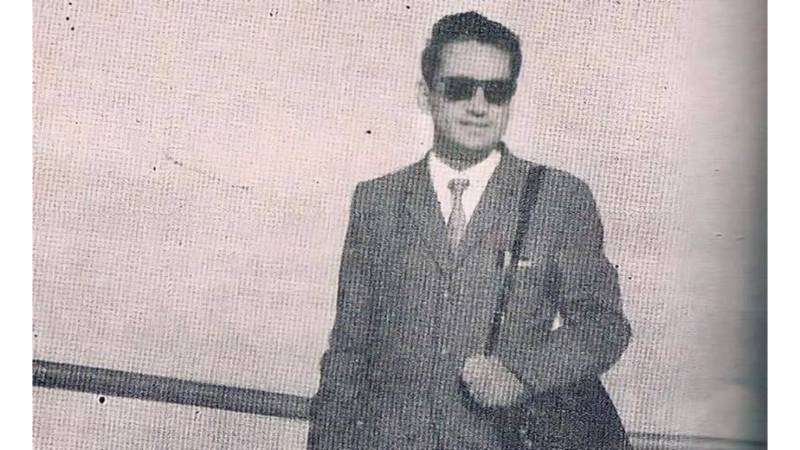
“Ab mein akhlaq se toota hua sayyara hoon
Haan mein aavara hoon, aavara hoon, aavara hoon”
(Now I am a planet severed from etiquette
Yes, I am profligate, I am profligate, I am profligate)
After leafing through the latest edition of the Kulliyat of Urdu’s superlative, singular poet Mustafa Zaidi –who died 55 years ago this October in Karachi – the above-mentioned standalone couplet of his kept reverberating in the mind. Unfortunately, Zaidi’s extramarital liaisons, the circumstances of his early death and the rather colourful posthumous publicity that continues to envelop him meant that his due as a stalwart of the progressive movement of Pakistan in the 1960s has mostly eluded him.
However, the last two years have seen a sort of welcome Zaidi revival, with his maiden collection of poetry Zanjeeren (Chains) being republished in Pakistan from Karachi (2023), and the volume under review being published late last year, along with the expose by Saba Imtiaz and Tooba Masood-Khan in Society Girl about Zaidi’s affair with his beloved Shahnaz Gul. In addition, Nayyer Khan has just come out with creatively adapted English translations of thirty-odd poems and ghazals by Zaidi earlier this year.
Despite all this, while attending the launch of this latest and most complete version of Zaidi’s Kulliyat, as well as that of Society Girl, both at the Lahore Literary Festival earlier this year in February, one felt that the focus was too much – again – on Zaidi the person and the lover, or at best as a ‘Shia’ poet and not as a superb artist in his own right. Not for nothing was Imtiaz and Masood-Khan’s book subtitled “A Tale of Sex, Lies and Scandal,” as if that was all that defined Zaidi. Hence it is with a view to critical engagement with the poet himself and his total published work, namely the Kulliyat, that one tries here anew to make a case for Mustafa Zaidi.
Syed Mustafa Hasnain, Mustafa Zaidi, was born on 10 October 1930 in mohalla Rani Mandi Allahabad (India). His father’s name was Syed Lakht Hasnain Zaidi who served in the Police Department and retired from the post of Deputy Superintendent.
Mustafa Zaidi passed the matriculation examination in second division from Modern School Allahabad in 1945. He was still in school when he began composing verses and selected the pen-name Tegh for himself. He compiled a notebook of couplets for which the title Rooh-e-Asr (Spirit of the Times) was proposed. The first poem of this collection was something like this:
“Zindaan tassavur ka hoon qaidi magar ae Tegh
Mahboob khayaali ka giraftaar nahi hoon
Har chand na roze na namaazon ka hoon haami
Mein dair-nasheen shaykh rayakaar nahin hoon
Majmua azdaad hoon afkaar ka paikar
Talvaar kabhi hoon kabhi talvaar nahin hoon
Asha’ar mein rasmi gul-o-bulbul nahin mere
Mein khalvati mushaahid rukhsaar nahin hoon
Sarmaaye ke mandir ke pujari se hai nafrat
Idbaar ke kandhon pe koi baar nahin hoon
Mein moatarif in sab ke kamaalaat ka lekin
Mein Ghalib-o-Sauda ka parastaar nahin hoon
Hai fakhar ke main Josh sukhandaan ka hoon pairo
Aur kashmakash-e-zeest se bazaar nahin hoon”
(I am a prisoner of the prison of imagination but O Tegh
I am not a captive of an imaginary beloved
Though I am neither a defender of fasting nor prayer
I am not a deceiving preacher who sits in the temple
I am a sum of opposites, a portrait of ideas
Sometimes I am a sword, sometimes not
My verses do not possess the usual lover and beloved
I am not an intimate observer of the beloved’s cheek
I detest the worshipper of the temple of wealth
I am not a burden upon the shoulders of deprivation
I acknowledge the skills of all of these, but
I am not an admirer of Ghalib and Sauda
I am a proud disciple of Josh the poet of eloquence
And am not weary of the struggle of life and sustenance)
After completing his education up to Matric, Mustafa Zaidi was sent to his elder brother Ahmad Raza in Kanpur; who got Mustafa Zaidi admitted in the Agricultural College. The course taught was against Mustafa Zaidi’s disposition. Therefore due to a lack of interest in studies, he failed in the first year examination. Ahmad Raza was a follower of religious traditions whereas Mustafa Zaidi was a rebel. So he composed a poem for his brother, whose couplet is as follows:
“Hazrat Ahmad Raza ko koi samjha de ye baat
Maada ulte gae k din rooh ki kul kaenaat”
(Someone instruct respected Ahmad Raza about this matter
The spirit of the whole universe will one day be overturned by matter)
Mustafa Zaidi was admitted to Ewing Christian College Allahabad after being called back to Allahabad. He came first in college in the first year examination and got a scholarship. He was studying in the first year when he fell in love with a girl named Saroj Bala Saran. He would repeat her name all the time. His poem with the title ‘S’ was also published in the college magazine.
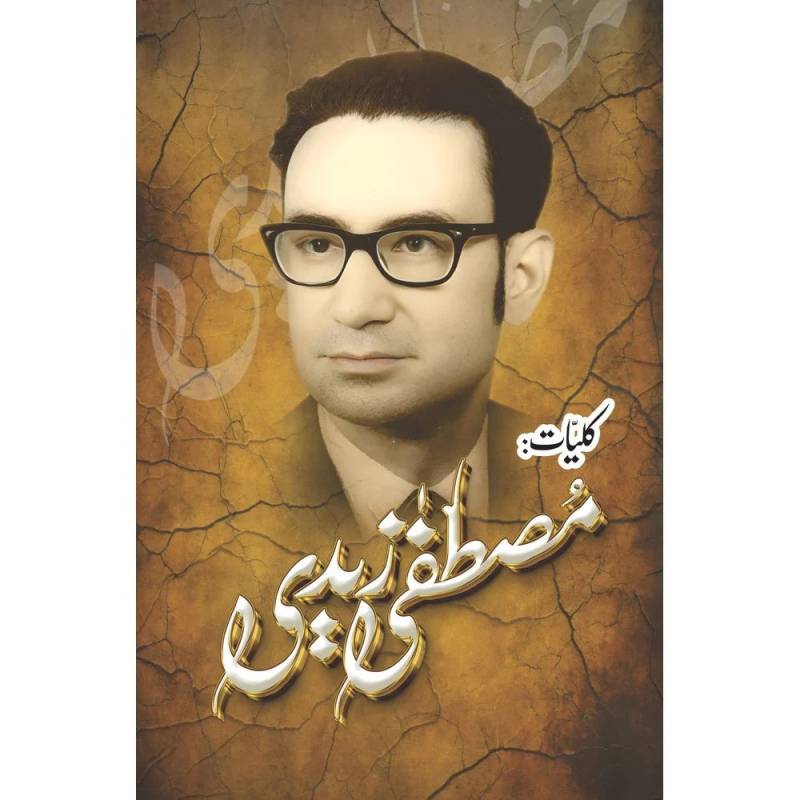
Title: Kulliyat: Mustafa Zaidi
Compiled and edited by: Syed Baqir Ali Shah
Publisher: Sang-e-Meel Publications, Lahore, 2024
Pages: 431
When he reached the second year, Sarla Kapoor won his affection. A poem Aik Hum-Jama’at Khatoon Se (To A Female Classmate) in the volume Roshni was very much written on Sarla Kapoor. Likewise Prem Kumar Jain, whom Roshni has been dedicated to, was very close to Mustafa Zaidi’s heart.
In 1948, Mustafa Zaidi passed the Intermediate examination. That same year together with Ibn-e-Safi he issued a monthly Nikhat from Allahabad. Then with great pomp and show he also issued the journal Kiran. Mustafa Zaidi used to go to different book stalls himself to distribute the journal. His first poetic collection Zanjeeren had been published by that time (1947).
In 1949 Mustafa Zaidi’s second poetic collection was published with the title of Roshni (Light), and it had Tegh Allahabadi as his name written upon it. The next year in 1950 Mustafa Zaidi passed his BA examination. He stood sixth in the whole university in first division and stood first in English. He was awarded the Professor Dunne, Iqbal and ON Bhatia gold medals on this success. After success in BA, he took admission in MA English in Allahabad University.
During studies, due to failure in love, he tried to commit suicide and for many days was involved in the struggle between life and death in Colvin Hospital Allahabad. During those same days, he began composing his third poetic collection. The advertisement which he had sent for publication in the journal Aanchal stated that this volume was to be published by Prabhat Publishers Allahabad with the title Dharti Ke Geet.
Mustafa Zaidi passed the first year examination of MA with very good marks. In 1952 Mustafa Zaidi’s elder brother Mujtaba Zaidi brought him to Pakistan. He was admitted to Government College Lahore. Just a week before the MA exam, he again tried to commit suicide; this attempt was more dangerous but anyhow he was saved. Mustafa Zaidi gave the exam and stood first in the whole university.
In 1953 Mustafa Zaidi shifted to Karachi and began teaching in Islamia College Karachi. But he was not satisfied with the educational environment of the college. He even wrote a satire of their principal MA Maulvi. Ahmad Ali Syed had recorded two lines in his impressions:
“Kaarvaan dar kaarvaan hai maulvi
Ibtidan dar hadees deegaraan hai maulvi”
(Maulvi is caravan after caravan
Maulvi is the beginning after the others’ tradition)
When he became weary of the environment, Mustafa Zaidi resigned. He found employment at Peshawar University in September 1953, but then left this job too, due to a quarrel with an American female professor.
Mustafa Zaidi appeared in the Civil Service examination in 1954, and was successful. He got professional training in Comilla, East Pakistan. Upon his return in 1956, he was appointed Assistant Commissioner Sialkot. After a short while he went to London for studies as per the Colombo Plan. There he met Vera von Hill, she too had come there for the desired result. After returning from London, Mustafa Zaidi came to Sialkot. A few days had passed when Mustafa Zaidi’s elder brother Mujtaba Zaidi died in a traffic accident.
On 14 October 1958, Mustafa Zaidi and Vera von Hill married in Sialkot. The next year on 24 August he had a son who was named Mujtaba after his departed brother. At the end of 1948 he was transferred as a Political Assistant to Dera Ghazi Khan. He also lived in Fort Munro for a while. In 1959 he moved to Layyah as a Sub-Divisional Magistrate. After a stay of merely eight months here, Mustafa Zaidi was sent to Khanewal. Shahr-e-Aazar (City of Idol Carvers) was published in the same period. From Khanewal Mustafa Zaidi reached Murree.
In January 1960 a daughter was born to Mustafa Zaidi who was named Ismat. In April he was sent to Lahore as the Deputy Secretary Education. Prior to the Lahore transfer Mauj Meri Sadaf Sadaf (My Wave, From Pearl to Pearl) had come in the market after publication. In December 1960 he was appointed as the Deputy Commissioner Jhelum. Then after performing his official duties in Nawabshah, Khairpur and Sahiwal he came to Lahore in 1965. Here during his stay he was awarded the Tamgha-e-Quaid-e-Azam by the Government of Pakistan.
In March/April 1968 he went to London for training on a Nuffield Foundation scholarship. This time his wife and children too were with him. After completing the course Mustafa Zaidi reached Lahore travelling through various countries. Here he received the order for his appointment as Secretary Basic Democracy West Pakistan. He worked for some time. This was the final position in which he worked. On 3 December 1969, he was suspended from service and in May he was dismissed. His name was also among the 303 individuals who, having been declared corrupt by the government, were removed from their posts. After some time Mustafa Zaidi sent his wife and children to Germany and himself moved to Karachi. During his stay in Karachi he attempted to go to Germany.
On 4 February 1972, Irtaza Zaidi told in a court statement that in his last days Mustafa Zaidi wanted to go to Germany. He was afraid of Shahnaz’s other lovers and wanted to leave Pakistan quickly. After his removal from office, he applied numerous times in a short time so that he could get permission to visit Germany, but there was no response. Mustafa Zaidi also requested the Martial Law authorities but to no avail. He had written the last request in this connection a few moments before his death.
Mustafa Zaidi established relations with Shahnaz in the final years of his service but upon the end of the official employment, Shahnaz began to neglect him, due to which Mustafa Zaidi was distressed and angry. On 24 September, when Shahnaz returned from a tour of Europe, Mustafa Zaidi tried to meet her, but she continued to evade him.
On the morning of 13 October Shafiqur Rahman and Deputy Superintendent Police Yunus Jafar reached Mustafa Zaidi’s residence, and the door was shut from inside; it was broken. Zaidi’s corpse was recovered from the room. Shahnaz was lying unconscious in the adjoining room.
On 15 November 1970, according to the Daily Mashriq, the learned session judge rejected Shahnaz’s bail application. The judge had written that the accused had been arrested as per the Martial Law regulation 23, which related to smuggling and an allegation of murder was deposed on it as per Article 302 of the Pakistan Penal Code. Therefore the bail application is rejected. The judge clarified that if arrest without remand according to Article 302 is considered unlawful then a writ application can be filed in a competent tribunal for its relief from wrongful confinement.
According to the newspaper report of 17 September 1971, the court witness Deputy Superintendent Police Ghulam Abbas of Forensic Science Laboratory said in the court of the district magistrate Karachi Mr Kunwar Idris that the hair which was found from the bed of Mustafa Zaidi bore deep resemblance to the hair of the accused Shahnaz. Seven diaries of Mustafa Zaidi were also presented in the court, so that further problems of the case be solved. Earlier Irtaza Zaidi had presented the photocopies of four loving letters of Shahnaz in court. Irtaza Zaidi also presented three local English dailies and one English magazine in court, in which photographs of the Karachi businessman Pirbhai and Shahnaz from some ceremony were published. A piece of paper was also presented in court, on which it was written: “What had one thought, what happened. Alas who we thought was ours, was not.”
On 5 November 1971, the witness of the plaintiff and Deputy Director of the Capital Development Authority Ishtiaq Ahmad in his statement in the court of district magistrate Kunwar Idris told the court that Mustafa Zaidi was his friend. He had to participate in a seminar in Berlin on 12 October 1970. On his way to Berlin, he also met Mustafa Zaidi in Karachi. During the conversation Vera Zaidi telephoned from Germany. When Mustafa Zaidi inquired about the children, his voice became hoarse. We ate dinner at Café Gul Bahar in the evening. On the way back, Mustafa Zaidi bought seven to eight issues of Weekly Mail from a monument of Pakistan Chowk. The reason for buying so many issues, Mustafa Zaidi read out a news, the news headline was:
“Now sports promotion bureau in smuggling racket”
The detail of the news was that a woman from Bangalore had gone to set up a Pakistani stall at the Berlin Trade Fair and the money that she had earned with the help of this department, she had not sent to Pakistan. That woman was Shahnaz. Mustafa Zaidi told that he had had relations with Shahnaz and she wanted to marry him. But she did not meet him on her return from Germany and was now close to a big businessman Pirbhai.
Mustafa Zaidi told that Shahnaz and Pirbhai belong to a group of smugglers and now at the behest of Pirbhai, Shahnaz has asked for the return of her photos and letters from Zaidi.
Ishtiaq Ahmad advised Zaidi to be careful. At this, Mustafa Zaidi, producing a pistol from the cupboard, said that although he was careful enough, he was no coward. Ishtiaq appeased Mustafa Zaidi adequately, at which the latter agreed to summon Mr Farooq from Lahore to Karachi to stay with him.
But when Ishtiaq Ahmad returned to Pakistan from Berlin on 20 October 1970, in the hotel he found a chit in which the news of Mustafa Zaidi’s death was written. The writing was Vera Zaidi’s who had reached Karachi from Germany as soon as she heard the news of Mustafa Zaidi’s death.
The news of the case of this mysterious death of Mustafa Zaidi continued making the headlines of newspapers. Approximately after two years on 26 May 1972, magistrate Kunwar Idris absolved Shahnaz. Afterwards investigation began again on the case on an appeal but soon the court again absolved Shahnaz. According to the court decision, Mustafa Zaidi had committed suicide. Mustafa Zaidi was buried in the cemetery of Khurasan Bagh Karachi.
It is interesting to note, as is evident from first and second drafts of many poems and ghazals – even whole volumes – reproduced in this volume, that Mustafa Zaidi continuously amended and revoked his verses. There are three ways in he used to perform this rejection and acceptance: merely changing the title of the poem; changing a few words of some lines; and such a change that in comparison to the first draft, the second draft has changed a great deal. To the editor’s credit, he has included the first drafts in this volume so the poet’s intellectual transformation and progress can be judged. So we learn that there are seventeen poems that were included by Zaidi in new collections after cutting and clipping.
Among the three previously unedited poems included in this volume, the marsiya is a treat for Zaidi’s fans and admirers. However it is not true to say that Zaidi’s first poetic volume Zanjeeren has not been republished in any of his collected works appearing in Pakistan. As this reviewer has noted at the beginning this volume has recently been republished from Karachi.
Be that as it may, the publication of this definitive version of Mustafa Zaidi’s collected work will go a long way in ensuring that the poet’s reputation will be based on poetic merit alone and thus will indeed justify the most superlative praise of his collected work by the likes of Faiz, Firaaq and Josh, when it first appeared posthumously in the mid-1970s.
Note: All the translations from the Urdu are by the reviewer.