

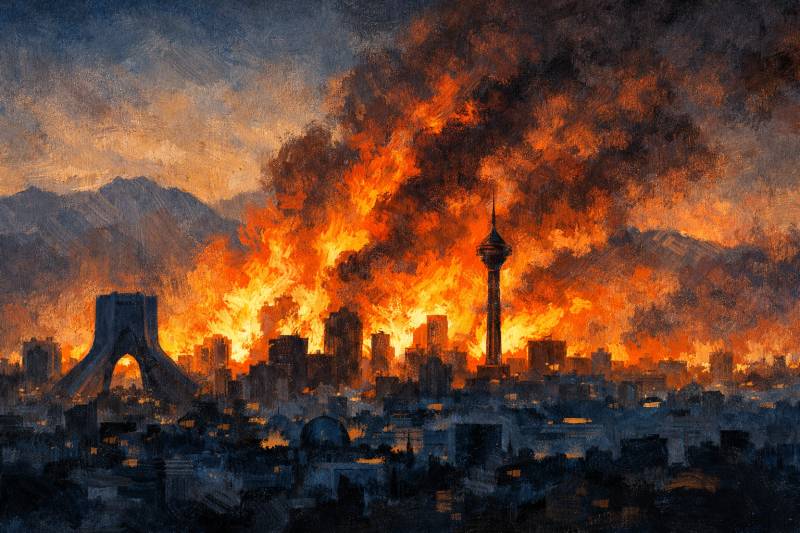
Anyone who believes that U.S.–Israel airstrikes could instantly and effortlessly eliminate the leadership of the IRGC, Iranian military intelligence, the minister of defence, and even the Ayatollah simply because Israeli intelligence is supposedly omnipotent — well, I have a bridge in Bandar Abbas to sell you.
Consider the Ayatollah in particular. The Iranians had weeks of warning during an unprecedented U.S. military buildup that war was coming, yet Khamenei remained in his residence and was not transferred to a secure underground bunker. That alone should raise eyebrows. As the kids would say today, that situation looks extremely “suss.”
Major geopolitical shifts rarely unfold the way they appear on television. When outcomes seem improbably clean or strategically convenient, it usually signals negotiations, understandings, and compromises taking place far from public view. The region appears to be entering a broader transition — one aligned with the emergence of a multipolar world order in which Iran is gradually integrated into a Middle East increasingly shaped by GCC economic leadership and Chinese influence, in collaboration with the Western financial–industrial complex.
The Ayatollah was already 87 years old and nearing the end of his natural political lifespan. To think that his death would lead to regime change or collapse is absurd. Regime change in Iran can only happen once the people of Iran and the IRGC stop viewing their government as their legitimate representatives.
Absent a full-scale ground invasion and prolonged occupation — something that would cost thousands of American lives and is politically inconceivable — outright regime change was never realistically on the table. All parties understand this constraint. Khamenei may have chosen martyrdom over hiding as a way of cementing support for, rather than weakening, his regime — though under new leadership.
What we may therefore be witnessing resembles less a sudden collapse than a managed internal recalibration — a continuation of patterns seen in prior regional confrontations, such as the twelve-day war in 2025, where hardline elements were effectively removed under the cover of external conflict.
What emerges instead may be closer to a “regime reset” than regime change: a restructuring that allows Iran to reduce reliance on regional proxy warfare while recalibrating its strategic posture, including nuclear ambitions and support for proxy forces, without formal capitulation. At the same time, the United States appears positioned for a gradual strategic disengagement from direct Middle Eastern dominance, leaving regional management increasingly to Gulf powers.
The global elite are the ultimate disaster capitalists. They do not simply profit from destruction; they profit from the “peace” that follows
This conflict will therefore likely conclude sooner rather than later, with each side declaring victory. Israel and the United States will cite leadership decapitation and deterrence restored, while Iran will point to its demonstrated missile capabilities striking Israel and American military bases with near impunity, as well as its resilience under attack. Symbolic wins on all sides allow de-escalation without humiliation. Iran will be weakened. Israel and the military-industrial complex surrounding it will also be weakened.
But for now, you are supposed to believe this spirals into World War III. That fear is part of the leverage in this negotiated transition. In reality, what this process may do is eliminate proxies and sideline hardliners. Netanyahu’s days are likely numbered as well — clearing the path for a controlled reset and accelerating a broader shift in the global order. The Middle East, long shaped by external intervention, may reorganise around new balances of power, with Israel increasingly aligned with GCC economic leadership and Iran moving deeper into China’s strategic orbit.
Because this is what transnational capital prefers. The global elite are the ultimate disaster capitalists. They do not simply profit from destruction; they profit from the “peace” that follows. It becomes a closed-loop cycle of extraction.
The likely outcome is therefore neither World War III nor liberation — neither for the Iranian population nor for a world still structured by powerful transnational economic interests. Paradoxically, however, it may produce something more historically durable: stability. For the first time in decades, sustained regional development may become more profitable than perpetual conflict, aligning geopolitical incentives toward reconstruction rather than destruction.
A few important caveats remain. If the United States commits ground troops to Iran, or if the U.S. or Israel were to use nuclear weapons, then this entire analysis collapses. None of us is prepared for what would follow. Instead of a global reset, we would be heading toward a global catastrophe, and at that point, all bets are off.