

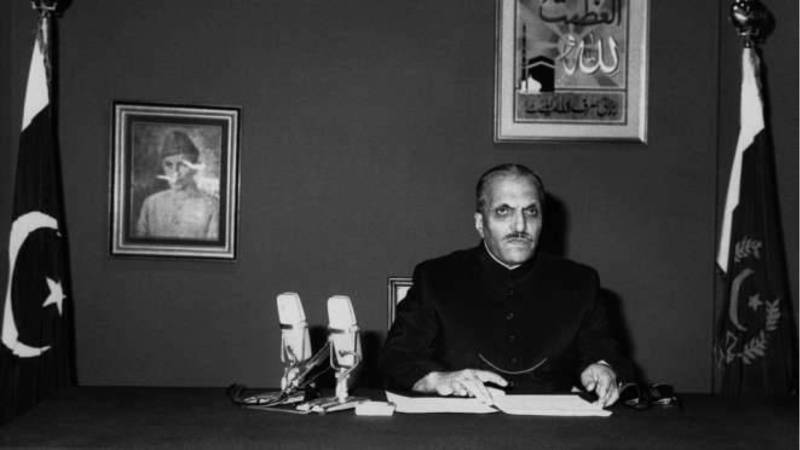
The tale of Pakistan’s Islamisation is often blamed on General Zia-ul-Haq, but the truth is far older and more unsettling. Zia did not create the monster; he inherited it in fragments, shaped by years of clerical appeasement. What set Zia apart was that he did not merely use it — he made it his own. He gave it a body, a constitution, and a mandate. The same clergy that earlier regimes had tolerated and bargained with became, under Zia, a permanent fixture of state power. It was no longer a tool; it became his shadow, fed on ordinances, legitimised through textbooks, and deployed as the moral spine of his dictatorship. The clerical class had long been indulged. Zia gave it roots.
In 1953, violent anti-Ahmadiyya riots erupted in Lahore. These were not spontaneous outbursts; they were the result of an organised campaign by Majlis-e-Ahrar and Jamaat-e-Islami (JI). The unrest forced the state to declare Pakistan’s first martial law. The Munir–Kayani Commission, established in response, warned that no two clerics could agree on the definition of a Muslim. Their conclusion was clear: if Pakistan were governed according to clerical definitions of faith, it would descend into chaos. That warning was ignored. The clerics were not punished — they were empowered.
By the 1960s, Jamaat-e-Islami had entrenched itself in universities. Its student wing, Islami Jamiat-e-Talaba, wielded influence through intimidation, violence, and administrative leverage. Pervez Hoodbhoy, in Islam and Science, documented how these militias stifled academic freedom and turned educational institutions into ideological fortresses. Debate was replaced with dogma; dissent became dangerous.
Their influence extended far beyond campuses. In 1971, during the civil war in East Pakistan, JI formed the Al-Shams and Al-Badr militias to support the Pakistan Army’s brutal crackdown on Bengali nationalists. The Hamoodur Rehman Commission Report, along with later war crimes trials in Bangladesh, documented these groups’ direct involvement in atrocities, including targeted killings, torture, and enforced disappearances. Their violence was framed as the defence of Islam, but in truth, it was the weaponisation of faith to suppress democratic aspirations.
The clerics did not hijack the republic — the republic opened the door
Jamaat’s opportunism was never limited to ideology. It was deeply political. In 1969, when General Yahya Khan assumed power, JI altered its stance overnight. Ayub Khan had banned the party in 1964, but Maulana Maududi, JI’s founder, now led a delegation praising Yahya as a leader committed to Islam. This was the same Yahya whose personal life bore little resemblance to religious orthodoxy. But JI was never truly concerned with morality — it was always about access to power. As noted by The Friday Times and historians such as K.K. Aziz, JI willingly allied itself with military rulers so long as this secured political space.
Even Zulfikar Ali Bhutto, who styled himself as a modern Muslim leader, could not resist clerical pressure. In 1974, he declared Ahmadis non-Muslims through a constitutional amendment, granting religious parties the legal authority to define faith itself. Later, he banned alcohol and nightclubs to placate the right wing. Historian Dr Mubarak Ali has repeatedly argued that such acts of appeasement weakened the secular foundations of the state. Bhutto’s concessions did not shield him from clerical vengeance; they only set the stage for Zia-ul-Haq.
Zia did not need to dismantle existing barriers. He simply walked through the doors his predecessors had left ajar. He imposed the Hudood Ordinances, made religious education compulsory, and legitimised public floggings. He embedded the clerical worldview into law and curricula. But in doing so, he was merely harvesting what had long been sown.
The damage was not confined to the legal sphere. It was cultural, intellectual, and spiritual. Religion was transformed from a source of moral guidance into an instrument of political control. Faith, once a personal compass, became a state mandate. Mob violence in the name of blasphemy, the systematic exclusion of minorities, and the erosion of critical thinking were not unfortunate side effects — they were direct consequences of decades of state–cleric collusion.
To understand the depth of this decline, one must study the rise of clerical opportunism alongside military expediency. Yahya Khan, for example, was no Islamist; his lifestyle was openly indulgent. Yet, as Nadeem Farooq Paracha has documented in The Friday Times, Yahya was persuaded by intelligence advisers and former Ayub-era bureaucrats to use JI as a counterweight against Bengali nationalists and Bhutto’s socialist movement. Yahya quietly supported JI, hoping it would deliver electoral success in both East and West Pakistan. That gamble failed: the Awami League swept East Pakistan, while the Pakistan People’s Party triumphed in Punjab and Sindh. JI was routed. What followed was civil war and a military defeat that dismembered the country. Yahya was disgraced, but JI emerged politically unscathed — ready to align with the next ruler.
This has been the pattern. Leaders come and go, but the clerics remain. Whether under Bhutto, Yahya, or Zia, JI and its allies have always found their way back to the corridors of power. Their survival is not divine — it is profoundly political.
Today, Pakistan lives with the aftershocks of that long surrender. The 1953 riots, the 1974 amendment, the 1971 militias, and the Zia-era laws are not distant history. They are present in every blasphemy mob, every silenced academic, and every child taught to fear difference. The state did not fall to the mullahs overnight; it welcomed them, one compromise at a time.
If Pakistan is to recover, it must begin with an honest reckoning. The clerics did not hijack the republic — the republic opened the door. Until that truth is acknowledged, no reform, no rhetoric, and no vision of national revival will stand on solid ground.