

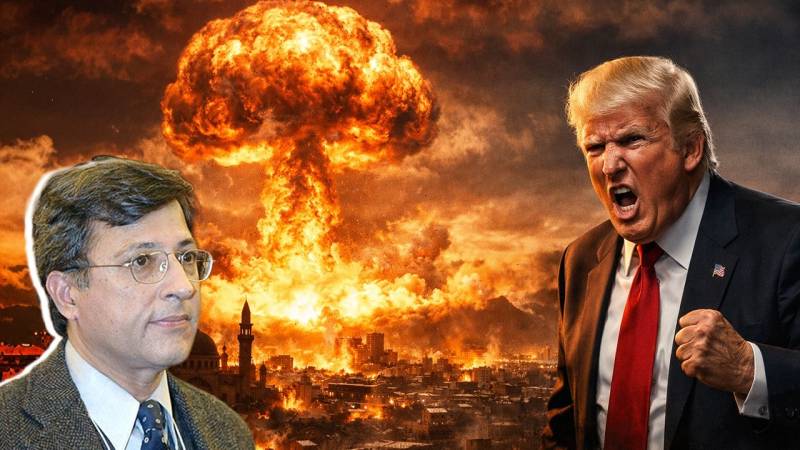
A temporary ceasefire in the six-week-old US-Israeli war on Iran, brokered by Pakistan, has just been announced. But no one—not even Donald Trump—can know the endgame. Just watch the head-spinning timeline:
Sunday, April 5 (infrastructure destruction-I): “Tuesday will be Power Plant Day, and Bridge Day, all wrapped up in one, in Iran. There will be nothing like it!!! Open the fucking strait, you crazy bastards, or you’ll be living in Hell — JUST WATCH! Praise be to Allah.”
Monday, April 6: (infrastructure destruction-II): “Their infrastructure could be taken out in one night. I’m telling you, no bridges, no power plants. I’m considering blowing everything up and taking over the oil.”
Tuesday, April 7 morning (threat to commit genocide): “A whole civilization will die tonight, never to be brought back again. I don’t want that to happen, but it probably will. However, now that we have Complete and Total Regime Change... maybe something revolutionarily wonderful can happen, WHO KNOWS?”
Tuesday, April 7 evening: Announcement of two-week Pakistan-mediated ceasefire.
Never has humankind seen so much power concentrated in the hands of a man so willfully capricious. Whether the ceasefire will hold, for how long, and in what ways is for the days ahead to tell. Hours later, there were already indications of a problem with Iran insisting that Lebanon be included, while Trump has apparently been persuaded to the contrary by Netanyahu.
All can change except for the man whose finger is on the nuclear button. He is a textbook malignant narcissist who, in the language of psychotherapy, is a pathological fusion of grandiosity with a reflexive propensity to lie, together with a bottomless need for adulation, a chilling lack of empathy, and derives pleasure from acts of cruelty. While history has endured megalomaniacs like Hitler and Stalin, it has not known one as mercurial, so prone to pivot.
This ceasefire is a stinging defeat for a man used to quick, vacuous victories through bullying and unbridled force. In his calculation, Iran should rightly be on its knees. And yet it alone controls the Strait of Hormuz, flatly refusing to negotiate while it was being bombed. Instead, it retains its missiles and drones with the capacity to resume attacks on America’s Arab allies and take potshots at Israel.
The announced ceasefire is palpably fragile. Even if America holds back, there is no guarantee that Israel will back off from its goal to expand its territorial boundaries indefinitely and dominate the region
Trump’s frustration makes him truly dangerous. He has been stymied by a recalcitrant theocratic state that has taken blow after blow, withstood the killing of its venerated leader, the bombing of its cities, the destruction of vital infrastructure, and the systematic targeting of its schools and universities. He is now rancorous, thwarted, and vengeful.
Hence, the nuclear fear remains intact. The so far unbroken taboo, inviolate since the nuclear ash settled over Hiroshima and Nagasaki, may yet crack. When Trump, echoing General Curtis LeMay’s 1965 threat toward North Vietnam, threatened to “obliterate” Iran and bomb it “back into the Stone Age”—rhetoric repeated by Defense Secretary Pete Hegseth—he wasn't just posturing. In fact, he was signalling that in an administration which respects no norms, mushroom clouds are acceptable.
The "how" and "when" remain open questions, but if the ceasefire ceases to hold, the crosshairs are likely fixed on the Fordow Fuel Enrichment Plant or, just as probably, Isfahan, where Iran’s fissile material was allegedly transferred before the June 2025 attack. Buried deep beneath a mountain of solid rock, Fordow is the nuclear facility that Trump had earlier claimed to have “obliterated.”
The math of escalation is inexorable: Iran reportedly holds roughly 450 kilograms of 60 percent enriched uranium. While a rudimentary gun-type nuclear weapon would be assembled using 80-100 kilograms of this material, a sophisticated implosion-type bomb needs 20-25 kilograms of uranium enriched to contain 90 percent of the uranium-235 isotope, a process requiring only a few weeks. If Iran has mastered the complex engineering required for the latter, its current reserves represent a potential arsenal of 8 to 10 nuclear warheads.
The game hinges on the upgrade. Iran can push its stockpile to weapons-grade in a matter of weeks. Conventional "bunker busters" like the GBU-57 have already failed; 14 were dropped on Fordow and Natanz in 2025, yet the heart of the program kept beating. To achieve absolute destruction, the hammer would have to be nuclear.
If the United States chooses to go nuclear in Iran, the Pentagon’s solution would likely be an earth-penetrating warhead like the B61-11 or the newly deployed B61-12. Washington would frame such a strike not as a Hiroshima-style apocalypse but as a "clinical necessity"—a tactical operation designed to kill hundreds rather than tens of thousands.
But Iran will not surrender quietly and would retaliate with everything it has. A lucky strike from a sophisticated missile could sink an American aircraft carrier; a coordinated swarm of drones and missiles could turn major Arab oil terminals into pillars of fire. At that point, the "clinical" experiment could end, and the apocalypse would begin as the United States reaches for its next nuclear target.
Even for a man who finds gratification in the suffering of others—who celebrated the recent destruction of Iran’s biggest bridge followed by cars plummeting down—Trump’s nuclear ambitions are constrained by American electoral politics and the upcoming November elections, a potentially hostile public reaction, and a somewhat reluctant military – he had to fire his top generals.
Until now, America and Israel have operated in lockstep. They executed coordinated strikes on Iran’s Bushehr nuclear power plant—which has nothing to do with bomb-making—on March 18 and April 4, 2026. These were presumably "signalling strikes" since they only destroyed an auxiliary building and killed a single guard. Their intent was clear—even if the endgame is not. The message has been received: in coordination with the Israeli Defence Forces, over 200 high-level Russian technicians evacuated Bushehr, leaving behind only a skeleton crew to manage a potential emergency shutdown.
But "signalling" near a live reactor is a high-stakes gamble with an unclear ultimate purpose. While the plant continues to feed the grid, a direct hit on its containment dome would trigger a radiological catastrophe far exceeding that of Chornobyl or Fukushima. With 70-80 tons of uranium dioxide in its core and a massive inventory of spent fuel lying in nearby cooling ponds, a breach would shroud the Persian Gulf with a lethal miasma of radioiodine and caesium-137. This wouldn't just be a strike against a regime; it would be a death sentence for the region’s environment and its people.
Israel—which pulverised Gaza to rubble and is pursuing a similar outcome in South Lebanon—may have fewer inhibitions than the United States. Where Washington might hesitate, Israel may well aim for the dome. For America’s Gulf allies—the UAE, Kuwait, Bahrain, Qatar, Saudi Arabia, and Oman—the fallout would range from the devastating to the permanent, the outcome depending on wind direction and speed.
With an undeclared arsenal of over 150 warheads and reliable means to deliver them to any corner of Iran, Israeli nuclear strikes on Iranian population centres are no longer a fringe theory; post-ceasefire, they would become a live strategic option in Jerusalem if somehow Iran manages to breach Israel’s Iron Dome missile defences more regularly and with greater effectiveness.
The announced ceasefire is palpably fragile. Even if America holds back, there is no guarantee that Israel will back off from its goal to expand its territorial boundaries indefinitely and dominate the region. The takeaway for every middle power and so-called rogue state is becoming undeniable: If you have the bomb, you don’t get bombed. The race is on to get it while they still can.