

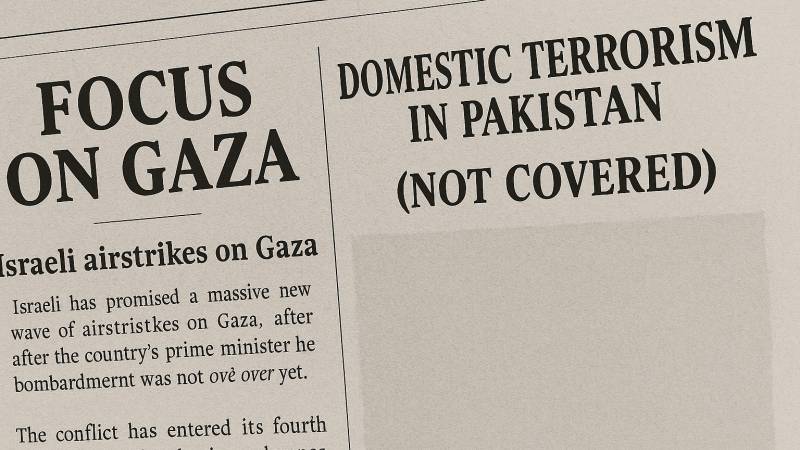
On Eid day, newspapers across Pakistan published editorials and reports expressing deep concern over the suffering of Muslims worldwide during the holy month of Ramadan. Chief among these was the coverage of Israeli airstrikes on Gaza, which tragically claimed the lives of 332 innocent children in the final ten days of the month.
While this humanitarian crisis rightly drew condemnation, a parallel tragedy went largely unnoticed: 339 Pakistanis were killed and 221 injured in violence and counter-violence operations during the same month. International crises such as Gaza demand global solidarity. But when that solidarity comes at the cost of ignoring domestic tragedies, it reflects a troubling moral inconsistency.
Terrorism, insurgency, and sectarian violence surged across Pakistan during Ramadan, but these events were overshadowed by an overwhelming focus on external conflicts. During the month of Ramadan, 102 militant and insurgent attacks took place in the country resulting in 406 casualties—190 killed and 216 injured. Of these, 24 attacks were publicly claimed by militant and separatist outfits, with the Balochistan Liberation Army (BLA) emerging as the most active, taking credit for 16 incidents. Other attacks were attributed to the Tehreek-e-Taliban Pakistan (TTP), Islamic State Khorasan Province (ISKP), and the Gul Bahadur faction of the TTP.
No segment of society was spared from this wave of terror. Among the victims were 199 civilians (93 killed, 106 injured) and 205 security personnel (93 killed, 112 injured). From pesh imams, qaris, muftis, and worshippers offering prayers in mosques to laborers, public transport passengers, and daily wage earners— ordinary citizens faced unspeakable violence for no crime of their own.
The perpetrators—militant religious factions and Baloch separatists alike—justified their actions through ideological lenses. Whether framed as religious jihad or nationalist resistance, the outcome was the same: innocent lives were lost and communities terrorised.
Just as the Palestinians have not received sufficient protection or a cohesive response from the global Muslim community, similarly, Pakistan’s people are left to suffer in the face of terrorism and sectarian violence without a clear and unified international stance
Islam unequivocally forbids violence against civilians — especially during the sacred month of Ramadan. Yet, condemnations of violence in Pakistan often appear selective and politically calculated. Consider the case of Maulana Fazlur Rehman, who swiftly condemned the assassinations of Mufti Shakir and Maulana Hamid-ul-Haq Haqqani but remained conspicuously silent when ordinary daily wage workers, coal miners, and barbers were killed and kidnapped. It wasn’t just Maulana Fazl — political leaders from the Pakistan Muslim League-Nawaz (PML-N) and the Pashtun Tahafuz Movement (PTM) also expressed concern over the targeted killing of these religious figures, while similar tragedies involving marginalised labourers failed to elicit comparable outrage. This pattern of selective empathy reveals a troubling hierarchy of grief — one that privileges certain lives as mournable while rendering others invisible.
Extremist groups in Pakistan continue to justify their actions under the guise of religious righteousness, exploiting sectarian divisions and seeking political leverage. Yet their attacks against fellow Muslims stand in direct contradiction to the core principles of Islam, which categorically forbid the targeting of civilians, places of worship, and religious figures. In their distorted worldview, Ramadan is not merely a month of spiritual reflection, but also a period in which so-called acts of jihad are believed to carry greater religious merit. This narrative draws selectively on historical precedents from early Islamic history — most notably the Battle of Badr (17th Ramadan, 2 AH) and the Conquest of Mecca (10th Ramadan, 8 AH) — to legitimise contemporary violence."
The silence surrounding the acts of violence in Pakistan stands in stark contrast to the vocal international responses to other conflicts, such as Gaza. Pakistan’s internal conflicts, primarily driven by extremist ideologies, have continued for years, but instead of focusing on these domestic atrocities, many political figures and activists seem to be preoccupied with external geopolitical issues. This selective attention means that Pakistan’s ongoing humanitarian crisis remains largely ignored or underreported.
The coverage of the Palestinian cause alongside the muted response to domestic violence is stark. Solidarity with Gaza must not come at the cost of apathy toward our tragedies. If our outrage is truly grounded in principles of humanity and justice, it cannot be selective or shaped by geopolitics. Ramadan’s message of mercy is universal—it must extend equally to all, both within our borders and beyond.
The Pakistani state faces not only the repercussions of external aggression but also the constant threat of internal extremism, yet the political leaders, social activists, and opinion makers often fail to give equal focus to these domestic issues. This oversight from print media, social activists, and political leaders in Pakistan is concerning. The disproportionate focus on external crises, such as the Palestinian conflict, often leads to the marginalisation of equally pressing issues within the country itself where we have higher responsibilities.
Furthermore, the lack of unified action or effective response to the violence within Pakistan compounds the problem. Just as the Palestinians have not received sufficient protection or a cohesive response from the global Muslim community, similarly, Pakistan’s people are left to suffer in the face of terrorism and sectarian violence without a clear and unified international stance. The suffering of Palestinians deserves global solidarity — but not at the cost of forgetting the bloodshed within our own borders, where civilians endure daily violence, are relegated to the sidelines of international attention.