

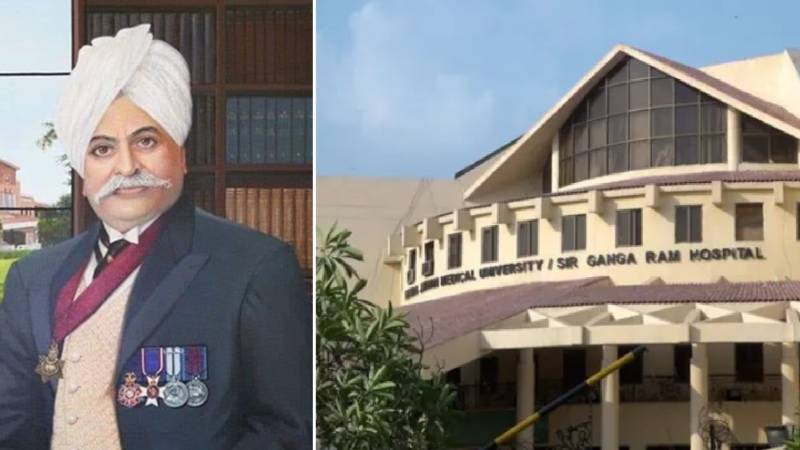
There are few persons who have contributed as much to the development of Lahore as Sir Ganga Ram; a true son of the city.
Taking a historical survey, the first great builder of the city was Emperor Akbar who constructed the Fort, raised the surrounding wall, erected the thirteen gates in that wall and doubled the size of the original city by creating new housing areas from Shah Alam Bazaar to the eastern segment of the circular road. For nearly three centuries, these were the limits of the city except for a few developments in the north of the GT Road, and some burial complexes across the river in Shahdara.
However, the British expanded the city tremendously and Sir Ganga Ram played a major role in this phase. Much has been written about this great benefactor of the city and this author, born and raised in Lahore, also desires to pay homage to the man by recounting his contributions to the development of the city.
The British brought the concept of public welfare; something that the Mughals and the Sikh rulers did not practice. Early in their occupation of the city in 1849, the colonial government decided to build elegant public buildings, from the eastern end to the western on both sides of the Mall; perhaps the widest road that they had so far built in their Indian empire and only to be exceeded in magnificence by Kingsway in New Delhi in 1916. To create an architecture that was commensurate with their status as masters of the whole subcontinent, they had the services of four very talented and efficient engineers and architects; one British and three locals.
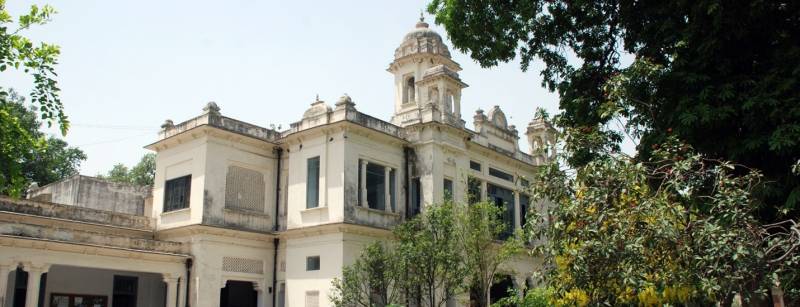
The first of this quartet was Kanhyya Lal Kapoor, a graduate of Roorkee Engineering School and the first native engineer appointed to the nascent Punjab Public Works Department (PWD) in 1852. The second was John Lockwood Kipling, who came to India in 1865 as a professor in JJ School of Arts, Bombay but stayed on in Lahore for twenty years becoming the principal of Mayo School of Arts and the first curator of Lahore Museum. The third was Bhai Ram Singh, an architect who was mentored by Kipling. The fourth talent was Sir Ganga Ram, who outshone the other three. Evidently, Muslims were late entrants to the field of engineering. The first names recorded in the discipline are Niaz Ali Khan, Anwar Khan, Hira Khan and Fazal ur Rehman Shariff – but they all graduated after the 1900s.
From designing its most elegant British-era buildings to using his vast agricultural wealth to found hospitals and colleges, Ganga Ram's work was driven by a profound sense of public duty, a legacy that earns him a standing ovation in the city's heart even today
Ganga Ram was born in 1851 in Mangtanwala, a village on the Lahore-Sharaqpur-Nankana Sahib road. In 1873, he graduated from Roorkee Engineering School and worked on the development of Durbar Hall in Delhi followed by a stint on Amritsar-Pathankot railway line. Then he left for Bradford, England, to study waterworks and drainage; a training that stood him in good stead in his later years after his retirement from PWD.
In 1885, Ganga Ram returned to Lahore from England and became the executive engineer of PWD. It was during this tenure as a builder and as philanthropist that he changed the face of Lahore and stamped his genius on the city forever. Lahore, as we know it, cannot be envisaged without Ganga Ram and his contributions. He remains the most popular and admired son of Lahore.
A friend of mine, holding an LLM degree from McGill University in Montreal, told me a story. He said that when he was the Vice President of High Court Bar in 1994, he welcomed the Vice Chancellor of Oxford University to his address before the Lahore High Court Bar. The next day, he accompanied him and the Oxford team to an event arranged by Oxford University Press at Lahore. As they entered the hall, there was a loud cheerful clap. The Oxford Vice Chancellor was a bit bewildered. He told my friend that while he expected a warm welcome, this reception was really odd and enquired whether the energetic applause was for him. My friend replied that it couldn’t be for him either and decided to investigate. He went to the front row of the audience and asked one of them who they were applauding. The response was that it was for the young man in the Oxford team who was the great grandson of Sir Ganga Ram. This is the love and admiration that the Lahoris continue to hold for this truly great man.
Sir Ganga Ram was first tasked to design and build Mayo School of Industrial Arts (now National College of Arts) and then the Aitchison College. In 1887, for the golden jubilee of England’s Queen Victoria, he was commissioned to design and build the General Post Office and the Lahore Museum, the Albert Victor wing of the Lahore Mayo Hospital, Government College Chemical Laboratory, Victoria Girls School, the law courts and a police station. He also helped in the construction of Lady McLagan Girls High School (still stands in its original home with the same name), the chemistry department of the Government College University and many other graceful buildings.
After his retirement from PWD, Ganga Ram decided to apply his enormous energies in the field of agriculture. He acquired or leased about 11,000 acres near Jaranwala and built the village of Gangapur (Bedi, BPL, Harvest from the Desert). The Gogera Branch of Lower Chenab Canal passed close to this land but was at a lower level, preventing gravity flow. Never one to give up, he thought of implementing lift irrigation. He procured a steam engine and transported it to Buchiana, on Sheikhupura-Jaranwala line, from Lahore via train, but there was no way that it could be taken to Gangapur in assembled condition. He, therefore, built a narrow gauge, horse pulled train track and brought the engine to site.
Soon, the water started flowing, turning brown barren land to green fields. He remodelled the locality with broad roads and a wide square, all lined with shops for commercial activities. He planted thousands of trees for environmental effect. He acquired seeds from all over the world for wheat, cotton, maize and spices. He employed machinery at his farms and bred cattle. The horse driven train was retained to link the village with Buchiana railway station to convey passengers as well as agricultural produce. The train remained in active use for decades before becoming non-operational due want of repairs. In 2010, it was restarted as cultural heritage.
Having succeeded in the first agricultural project, he undertook another in Renala, Montgomery (now Sahiwal) district. In 1917, government was faced with the problem of returning soldiers from WW1 who had been promised land for settlement. Ganga Ram proposed that he be allocated 23,000 acres of land along Lower Bari canal but the area was higher than the canal in elevation, hence only fit for lift irrigation, which required electricity for the pumps. He found that at a certain point, the canal dropped by three feet; a little less for production of hydroelectric power. He redesigned the fall to achieve a drop of six feet. He was able to install five turbines, producing 220 kw.
This contract was for three years at the end of which developed land was returned for allocation to the returning soldiers. Subsequently he got a lease of 40,000 acres for seven years, which was a huge undertaking. Construction was undertaken for seventy-five miles of irrigation channels, six hundred and twenty-six miles of water courses, forty-five bridges, five hundred and sixty-five miles of village roads, one hundred and twenty-one miles of boundary roads, and six hundred and forty culverts (Ref. Punjab Eminent Hindus, pp 29). Eventually, 80 thousand acres of land was developed.
Ganga Ram made enormous wealth from his agricultural enterprises. He used it for social development of people and especially of Lahore. He was acutely aware of persecution of Hindu widows. In 1926, he issued a pamphlet depicting that in India, there were 8 thousand widows under the age of one year, 15 thousand between the ages of four and five, 100 thousand between ages of five and ten, and 280 thousand between the ages of ten and fifteen. This was great social injustice. He resolved to address the situation and established a Widow Remarriage Association. As remarriage of young widows progressed, Ganga Ram spent 2.5 million of his own money in 1921 to establish a Widow Home for aged women. This was the first such facility in India.
In 1921, he purchased a piece of land in Wachowali, inside the walled city (very close to where this author grew up). At a cost of over Rs 1.25 lac, he constructed a building for Ganga Ram Dispensary. As the scope of the dispensary expanded, Ganga Ram bought land on Queens Road near Mazang and established a Hospital in 1943. In 1944, his family started a medical college by the name of Balak Ram Medical College named after a son of Sir Ganga Ram. The college was closed in 1947 because of riots but in 1948, Fatima Jinnah Medical College for Women was started in the same premises. The hospital is now expanded to 550-beds and the medical college is elevated to university. Establishment of this Hospital and the attached medical college is the most renowned and visible contribution of Ganga Ram.
Ganga Ram was aware that Indians do not have organised commerce knowledge. He approached the government and offered a few hundred thousand rupees to establish a commerce college. The institution was named Halley College of Commerce. Today, it is one of the premier educational institutions of Punjab. Another premier education institution established by him was Ganga Ram High School for Girls. It commenced in 1922 in a building on Hall Road with 60 students and 13 staff members as a residential school. Gradually, it grew in size and was shifted to a larger area and better buildings at its current location on Jail Road. The institution is now called Lahore College for Women University, with 15 thousand students.
He was cognizant of the fact that one man, no matter how wealthy, could not undertake charity work alone. He, therefore, established Sir Ganga Ram Trust. Many fine properties by wealthy people were donated to the Trust, which continues its work from Delhi. The Trust established a Ganga Ram Hospital in Delhi after partition.
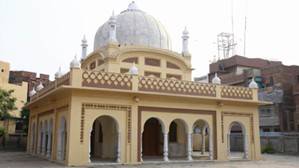
Sir Ganga Ram died in 1927 in London but his ashes were brought back to the subcontinent some of which were scattered in the Ganges and the remaining were placed in his small but elegant tomb in Lahore near Karim Park.
Its true that Muslims donate a lot of money in the context of zakat and sadaqa but it is essentially a religious activity within the Muslim community and Islamic institutions for reward in hereafter. However, Hindus and Sikhs in Punjab, and Parsis in Bombay and Karachi were very prominent for undertaking charitable activities in socail context in the fields of education and medicine. Subsequently, the Memon community in Karachi, especially Abdul Sattar Edhi, Indus Group, etc and some individuals in Punjab, notably Imran Khan in Lahore, too worked for welfare of people. Such examples are, unfortunately, few and far between. Some of the leading industrialists and landowners in Sindh, Punjab and KP, who have accummulated huge wealth, have only served themselves and their families; constructing palatial villas, buying properties overseas, living luxuriously but displaying no social responsibity.
Sir Ganga Ram, therefore, stands tall – a man whose gifts to Lahore in the medical and educational fields continue to benefit humanity.