

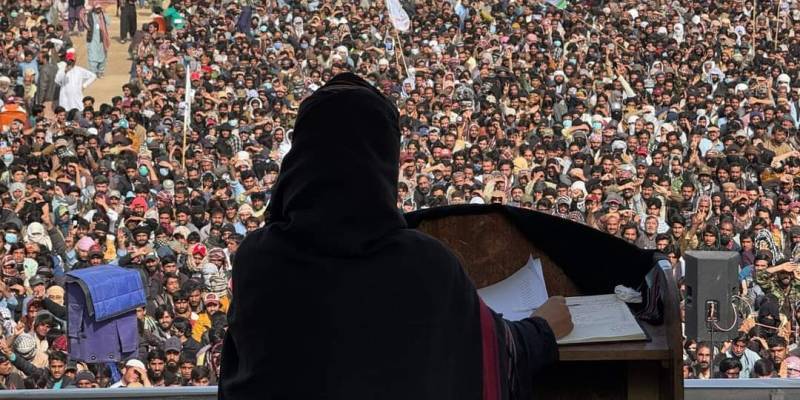
The brave, freedom-loving daughters of Balochistan are back in the federal capital, yet the media remains largely indifferent to the spectacle of protesting women from Balochistan. For reasons best known to the authorities, they have been denied their constitutional right to protest in front of the Press Club in Islamabad. Instead, they are now registering their protest while sitting on the roadside.
Across the democratic world, the right to protest is regarded as a basic constitutional right. Yet, the daughters of Balochistan protesting in Islamabad are being met with indifference—and in some cases, anger and resentment from local traders due to the inconvenience caused by their gathering. Islamabad has played host, and even offered a warm welcome, to dharnas by political entities such as the PTI and TLP. But the women of Balochistan face an unwelcoming and hostile society simply because they have dared to act with the same courage and assertiveness seen in the political culture of Punjab—daring to protest in the heart of the federal capital.
After centuries of colonial suppression and control, Balochistan is slowly awakening from a deep slumber. Its daughters are now marching forward with courage and a firm belief in a secular and egalitarian Pakistan, asserting their right to feminine empowerment within the broader political movement for justice and equality. In the underdeveloped and impoverished province of Balochistan, women have been at the forefront of the campaign for Baloch rights since the early 2000s.
Like many political movements, the Baloch struggle was once dominated by men—but that is no longer the case. Today, Balochistan presents a different picture: women and feminist warriors are spearheading the movement for their constitutional and political rights. This current protest movement is distinctly different from previous ones. It is now led by women-centric organisations such as the Baloch Yakjehti Committee (BYC), with women leaders—not their male counterparts—at the helm. These leaders intelligently deploy political rhetoric, highlighting their roles as mothers, daughters, and sisters in the struggle for Baloch rights and recognition.
The rise of the women-led Baloch movement did not happen overnight—it evolved slowly over the past two decades
The origins of this movement lie in the early 2000s, when the campaign against enforced disappearances gained momentum. Wives, daughters, and sisters of the disappeared began appearing in protest marches, holding up photographs of their loved ones. Through these actions, they asserted their roles as political activists, placing women at the vanguard of this political struggle.
The Role of the Baloch Students Movement
The rise of the women-led Baloch movement did not happen overnight—it evolved slowly over the past two decades. It began with the banned Baloch Students Organisation–Azad (BSO-Azad), which recruited and trained young women from colleges across the province. The BSO-Azad was founded by Dr Allah Nazar, following a split from the original BSO over political differences.
Women have also played a leading role in the Baloch Students Action Committee, founded in 2008. One of the earliest female leaders to gain national attention was Farzana Majeed, whose brother, Zakir Majeed—the then vice-president of BSO-Azad—was allegedly abducted in 2009. Farzana spent the following years leading protests alongside missing persons activist Mama Qadeer, demanding the release of all missing persons and an end to the practice of enforced disappearances.
Another iconic figure in the Baloch women’s movement was Karima Baloch—affectionately called “Baruk Karima” or “Lumma” (mother) in the local language. These two women inspired countless others to step out of seclusion and join the struggle for political rights. In addition to grassroots organising, Karima also wrote regularly in Urdu, with many of her essays translated into Balochi and Brahui and widely circulated among students and activists.
In one article titled Women’s Struggle from a Historical Perspective, Karima wrote:
“Throughout history, in every national struggle—past or ongoing—women have played an equally significant role alongside men. Women make up half of every country and nation’s population. When half of the population is prepared and involved in a struggle, victory is achieved much sooner. If a movement is driven by the sacrifices of men alone, its pace towards success is halved. But when the efforts of women are added, the struggle doubles in strength and momentum.”
Tragically, Karima Baloch faced numerous threats to her life and was forced to flee Pakistan, eventually seeking political asylum in Canada in 2016. She met a violent and tragic end—her body was discovered near the waterfront in Toronto. The circumstances of her death remain contested, with many Baloch leaders continuing to question the official narrative. When her remains were flown back to Pakistan, authorities initially refused to release her body to her family. This sparked protests across Balochistan and was even raised in Parliament, where Balochistan National Party–Mengal (BNP-M) Senator Dr Jahanzeb Jamaldini remarked:
“The security agencies are afraid of a dead body… of a graveyard.”
Protesters demanded justice and chanted defiantly:
Tum kitne Karima maaroge? Har ghar se Karima niklay gee!
(How many Karimas will you kill? A Karima will emerge from every home.)
She was eventually buried in her hometown of Tump under heavy security, with women leading her funeral procession.
Historically, political movements have been led by men, with women relegated to the sidelines. But the female leaders of the BYC are now integrating women’s rights into the nationalistic agenda. They firmly believe that women’s liberation cannot be separated from the larger political struggle. Their empowerment as women, they argue, is inextricably linked to their active participation in the broader fight for justice and equality for all.