

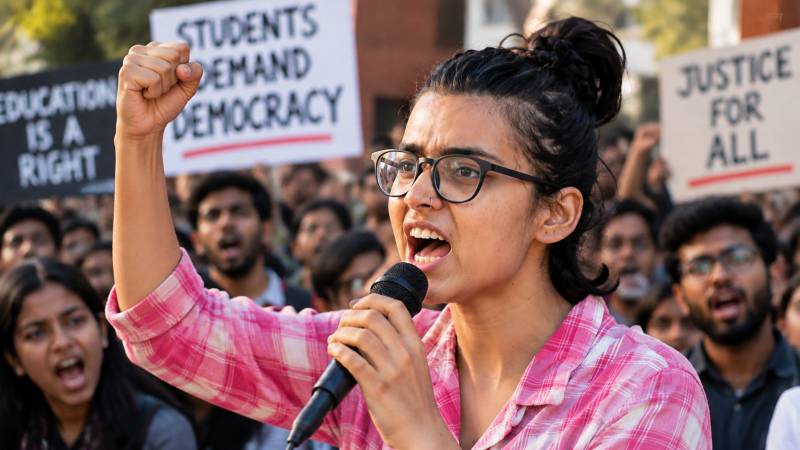
The name Tora Bora evokes American bombs falling on the mountains of eastern Afghanistan in December 2001. A quarter-century later, a near-echo of that name belongs to a very different kind of force: Neha Bora, a young Indian student leader whose tools are books and questions. The pun ends here. What follows concerns something more serious: what it means to lead a movement, and what it means to follow one.
Neha Bora, 29, comes from Khatima in Uttarakhand. They are a doctoral researcher at Jawaharlal Nehru University and national president of the All India Students' Association (AISA). Politics was not the plan. Theatre came first, and, as Bora told Reuters, it taught them to inhabit lives unlike their own. The student protests against the Citizenship Amendment Act in 2019-20 pulled them into activism, and since then they have campaigned on education, examination irregularities, unemployment, civil liberties and electoral accountability. Their formation was as much literary as political. As a schoolchild in Bengal, they encountered Pablo Neruda, Arundhati Roy and Charu Majumdar, writers who opened questions about injustice, power and the possibility of another world. That training shows in their speeches, which translate student grievances into the language of constitutional rights. Reuters describes Bora as soft-spoken in conversation but forceful at the microphone.
Their most recent fight is over the Special Intensive Revision of India's electoral rolls. Bora and other activists allege that the exercise has struck millions of names from voter lists. The Election Commission rejects any suggestion of bias, and the BJP accuses its critics of undermining democratic institutions. These claims remain contested, but the protests have placed electoral transparency and institutional independence at the center of public debate. Bora was detained during demonstrations in October 2026 and urged supporters to keep the movement alive.
The ultimate measure of political consciousness is not how fiercely we defend the people we admire, but how courageously we preserve our freedom to question them.
What I find most instructive, however, is something else. In an interview with Newslaundry, Bora pushed back against the habit of making them the face of the movement, insisting that the organisation and the collective effort behind it matter more than any single person. In an age of charismatic leaders, that is a rare instinct, and a deliberate one. A movement built on one face is only as durable as that face. Bora refuses to be the movement's idol. Can the same be said of those who rally around Imran Khan? Pakistan's Gen Z is among the most politically energised generations the country has seen. Social media gave young people a stage to challenge official narratives and demand accountability, and much of that energy has gathered around Khan, fuelled by what his supporters see as political injustice and the misuse of state power against him. That attachment has understandable roots and should not be dismissed.
The objection is obvious: when a leader is jailed and his party squeezed, unconditional solidarity feels less like worship than duty. There is truth in that. Defending a man's political rights, his right to contest, to be tried fairly, to speak, is a democratic obligation, and it should not wait for agreement with his politics. But solidarity and surrender are different things. When criticism of a leader is treated as betrayal, whether it comes from outsiders or from within his own camp, a political movement stops being a democratic force and becomes a following. The test is simple to state. Can a supporter examine Khan's record in government, on parliament, minorities, women's rights, the media and the economy, with the same standards applied to his opponents? Can they defend his rights and still disagree with his choices? The test is not Pakistan's alone. Bora's own movement faces it, and so does every political camp in India, where leader-worship is hardly a rarity. A rule that binds only the other side's followers is not a principle. It is a tactic.
Political maturity does not mean becoming the most devoted follower of a popular leader. It means keeping the confidence to question every centre of power, including the one with which you identify. Bora's composure and reading remind us that resistance need not take the form of theatrical outrage, and that Neruda and Roy matter here not because reading alone makes a revolutionary, but because literature widens our understanding of suffering and of what a different society might look like. The ultimate measure of political consciousness is not how fiercely we defend the people we admire, but how courageously we preserve our freedom to question them.