

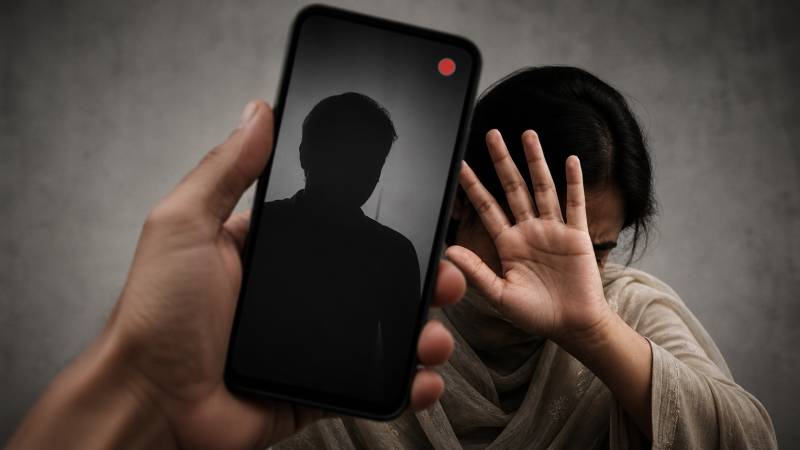
We have all seen a particular kind of video where someone thrusts a phone into someone's face at a wedding, a marketplace, or a restaurant. The subject flinches or looks away, but the man keeps going. And in the background, barely noticeable, someone else quietly shifts out of frame, turning away or perhaps pulling a dupatta to cover their face. All this because they didn't sign up to be recorded and then scrutinised for the world to see. But by evening, that video has two million views.
A few days ago, Pakistan’s most-watched vlogger, Rajab Butt, found himself in hot water once again after filming in a restaurant, where a woman behind him could be seen trying to cover her face while he recorded. Known for his controversial statements and actions, Rajab Butt drew criticism not only from the public but also from politicians online.
انتہائی شرمناک حرکت ، ان لوگوں میں نہ شرم ہے اور نہ ہی عقل ہے۔ جہاں دل کرتا کیمرہ نکال کر شروع ہو جاتے، کوئی خیال نہیں کہ آگے پیچھے کوئی فیملی بھی بیٹھی ہے۔ بدقسمتی کی بات یہ ہے کہ کچھ لوگوں کیلئے ایسے لوگ ہیرو ہیں https://t.co/EIarIjMAOZ
— Hina Parvez Butt (@hinaparvezbutt) April 28, 2026
Across Pakistan, a generation of content creators has decided that public space is a film set, and everyone in it is an unwilling extra. The business model is that they harvest people's discomfort, bottle it as entertainment, and sell it to an algorithm that rewards spectacle and undermines dignity.
The philosophical case here is actually straightforward. Privacy isn't a modern invention or a Western import that doesn't travel well in Pakistan. The right to exist without being observed or catalogued is as old as the instinct to close a door. Aristotle drew a line between the polis (public life, argument, visibility) and the oikos (the household, the private). That distinction didn't collapse with the smartphone, but somehow we are just pretending it did.
The camera will keep appearing in people's faces for as long as there's money in it
When someone films you without consent, sure, they are being utterly rude. But they are also asserting that their right to broadcast overrides your right to simply be. And in a country where most people have very little institutional power, having a stranger with a ring light decide your face is content for the day is a particular kind of humiliation.
The financial logic makes it worse because these aren't small passion projects. Rajab Butt and his imitators monetise reach, and that too by the millions. Your grandmother's confused expression, your daughter's scarf slipping at the wrong moment, your awkward pause when the camera appears — all of it is inventory. You are the raw material, yet you receive nothing, and he gets the cheque.
But here's where it gets even more uncomfortable. The outrage that follows these videos is real, and mostly justified. What's less discussed is what the outrage is actually protecting. If you watch the comment sections carefully, a significant portion of the criticism isn't about the violation of privacy in principle. It's about the visibility of women. "Aurat ki shakal nazar aagui," someone writes. "Beghairat," says another. The concern isn't that a person was filmed without consent. It's the woman who was filmed. We can decipher that from the fact that even if the women related to him are in his videos by choice, he is bashed for not keeping his family honour.
This matters because it conflates two very different things. Purdah, as a practice or religious commitment, belongs to the woman who observes it. But when people weaponise the language of purdah to police women's presence in public spaces, or to suggest that a woman's honour is distorted because she appeared in a video, that’s a form of control.
So the real problem with daily vloggers and content creators isn't that they film women. It is that he films anyone without asking.
There's also a useful comparison in how older urban cultures in South Asia actually handled proximity and observation. Lahore's walled city, for all its density, had a remarkably sophisticated grammar of public and private. The street was shared; the courtyard was not. You could shout across a gali, but you didn't peer into someone's deorhi. Not because of a law, but because a social contract existed that everyone had implicitly signed.
That contract assumed you'd live near these people for the rest of your life. Reputation was bilateral. You couldn't humiliate your neighbour without consequence, because tomorrow you'd need him to run an errand, watch your children, or testify to your character before a landlord. The internet algorithm has no such accountability. It rewards the views and not the relationship. And so the informal agreements that once made shared space liveable have simply dissolved, because there's no social cost for dissolving them anymore.
Pakistan does have laws on consent and harassment, though enforcement is a separate conversation. But legal frameworks aside, what's really needed is a cultural renegotiation. Content creators should be required to obtain consent before filming identifiable individuals. Platforms operating here should be pressed to demonetise content that clearly violates those norms. And we, the greatest stakeholders as audiences, should stop rewarding discomfort with engagement, because every view is a vote.
Privacy in Pakistan isn't dying because people don't value it. It is dying because we've built an economy that profits from its absence.
The camera will keep appearing in people's faces for as long as there's money in it. That's the honest answer.