

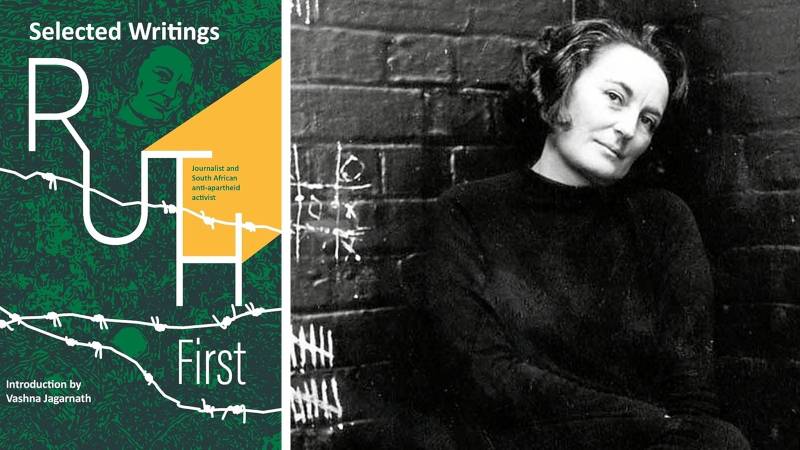
This year already marks the birth centenaries of such legendary African intellectuals and anti-imperialists as Frantz Fanon and the Congolese patriot Patrice Lumumba, both of whom attracted significant interest from anticolonial and solidarity movements worldwide, including here in Pakistan; while 2024 marked the birth centenary of a revolutionary who at least deserves as much attention as Che Guevara, that other protagonist of guerilla warfare – Amilcar Cabral. To this mix, then, is added the name of Ruth First (1925 – 1982), whose life and work regrettably also remains rather lesser-known outside Africa, despite the fact that she went beyond her own calling as a Pan-Africanist to devote more than just an academic interest to the revolution in Libya during her short, stormy life.
This is why a collection of First’s selected writings – albeit in a slim volume – is particularly welcome on the occasion of her birth centenary, which begins today. It collects her pieces on some of the themes which concerned her as an activist-academic both within her native South Africa and without, like the historic Women’s March in 1956, the shape of the apartheid state and prospects of the struggle against it, and her Pan-Africanist concerns in countries like Libya and Mozambique.
The first piece is an eyewitness account of a massive demonstration of South African women in October 1955, which culminated in a historic march to Pretoria in August 1956, now celebrated as Women’s Day in South Africa. A cross-section of South African women took part in this ‘conquest of Pretoria,’ as depicted by First.
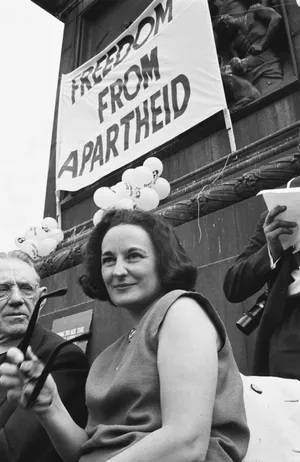
The second piece South Africa Today begins by looking at contemporary South African society with a telling quote serving as a justification for white South Africans defending their apartheid regime, “If you faced our problems, you would act as we do.” Pretty much the same emotional shibboleths underpin Zionist and Western complicity of the Israeli state against defenceless Palestinians today.
Though published in 1961, upwards of six decades later it reads more like a description of the mechanism Israel has instituted in its successive dispossession of the Palestinians. Consider this chilling passage from First:
“There is the claim that apartheid is the word of God and that racial segregation is specifically enjoined in the Bible. There is the assertion that Africans have contributed nothing to ‘civilisation’ and that the African, not only in the Union but further afield on the continent, has no history but one lived out in savagery. There is the conviction that Africans are different from the white man in a variety of ways difficult to define.” (p 24)
Israelis and their fervent supporters never fail to address world public opinion in a similar manner about their being a chosen people, a people without a land for which the Bible promised a land without a people – ie Palestine.
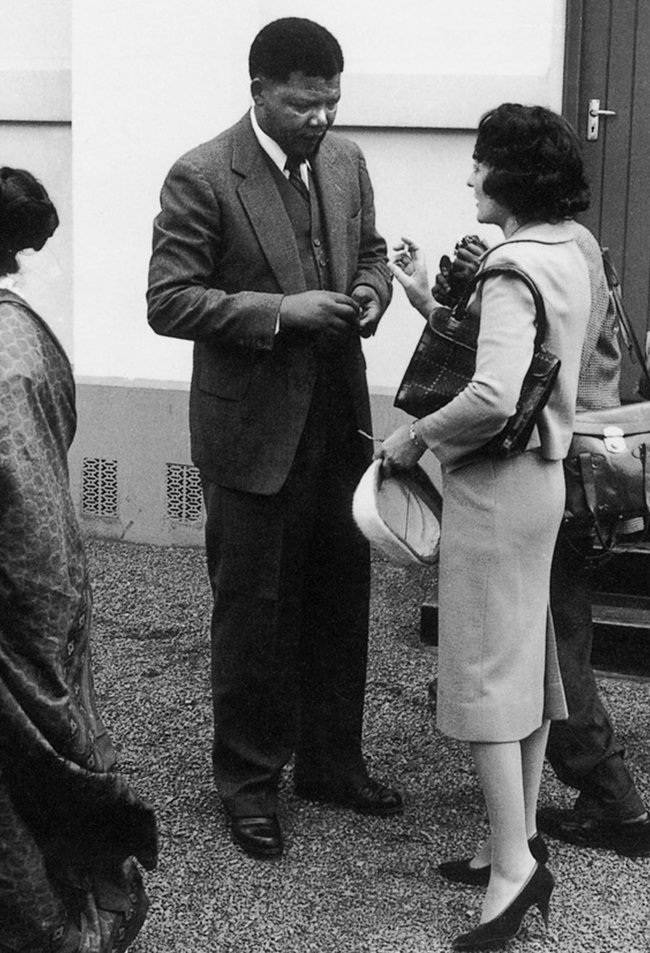
The third piece chronicles the transformation of the hitherto peaceful anti-apartheid movement advocating the historic Freedom Charter – a non-racial constitution for all South Africans – towards armed struggle in the wake of the horror of the Sharpeville Massacre on 1960, which occupies the same place in the anti-apartheid struggled as the massacres at Jallianwala Bagh in Punjab and Qissa Khwani Bazar in then-NWFP closer to home in ending any moral justification for continued white rule in South Africa. In the legendary Nelson Mandela’s prophetic words, quoted by First:
“Is it politically correct to continue preaching peace and nonviolence when dealing with a Government whose barbaric practices have brought so much suffering and misery to Africans? […] Have we not closed a chapter on this question?” (p 38)
It considerably warmed the cockles of my parochial heart to see legendary Pakistani Marxist sociologist Hamza Alavi being referenced by Ruth First on the question of whether the ‘revolutionary bourgeoisie’ in Libya could adequately be described as anti-imperialist
The fourth chapter is an extract from First’s pathbreaking work on the Libyan Revolution titled Libya: The Elusive Revolution (1974), a book which was a central reference point for this scribe as he worked on a paper on revolutions in oil economies during his days as a postgraduate student in Leeds back in 2002, and which was my ‘first’ introduction to First and her work. It opens with a correct assessment of the historic 1973 victory of Arab forces over Israel but the fervent Marxist in First also does not blind her to the fact that “Sadat’s post-war tactics proved to be a logical continuation of the search of the Egyptian bourgeoisie and bureaucracy for close and amicable relations with the United States.” (p 46)
Despite the admirable achievements of Libya under Colonel Qadhafi – and which are missed more now when one surveys the ruins of that state following his violent ouster and brutal murder – First notes that, “Despite its great wealth, Libya is dependent in the fullest sense of the word, providing crude oil to the metropolitan centres of the world in exchange for manufactured goods, foodstuffs, and even primary materials.” (p 49)
It also considerably warmed the cockles of my parochial heart to see legendary Pakistani Marxist sociologist Hamza Alavi’s name being referenced here in relation to the question of whether the ‘revolutionary bourgeoisie’ in Libya could adequately be described as anti-imperialist in the wake of its collaboration with the multinational oil companies. This collaboration eventually cost Libya its independence and led to its destruction by a Western invasion in the present century.
Giving her well-considered verdict on Libya’s Arab nationalist regime – and by extension other Arab countries similarly under military rule – First remarks, “The army acts as a ruling class in charge of a statist economy.” (p 51)
The final piece in the collection documents the exploitation of working-class Mozambicans in the gold mining sector through the migrant labour system. It is a landmark text from the days First spent as a visiting scholar in Maputo, which would prove to be her final stop before her untimely assassination by the agents of the apartheid state.
Title: Selected Writings
Author: Ruth First
Publishers: LeftWord Books, New Delhi, 2023
Pages: 74
Although Vashna Jagarnath performs a yeoman’s service in introducing the unfamiliar reader with First’s life and work in her lucid introduction, one wishes that a more representative collection which also included her works or extracts from her own classic prison memoir One Hundred and Seventeen Days and her co-authored biography of pioneering South African suffragette Olive Schreiner would have succeeded in giving more heft to this slim work, as well as providing the reader an idea about her ideological and writerly evolution over time. And especially for her readers in Pakistan, it would not have been out of place to read an extract from her groundbreaking work on the coups d’état in Africa; military coups still being bête noire both for many African countries and here in South Asia in the present century.
Also, Jagarnath complains in the conclusion to her introduction of the book that First’s legacy and memory in contemporary South Africa is being misunderstood and tarnished by holding her up as a liberal rather than the communist that she was. This collection could have rectified this by adding more specimens of her writing on communism.
Undoubtedly Ruth First needs to be taken as seriously as a theorist of apartheid as her contemporary Fanon is now taken to be for colonialism outside the confines of Africa. While perusing this collection, I also kept thinking about First’s exact contemporary, Pakistan’s own legendary communist Tahira Mazhar Ali Khan, who like the former was also born a century ago this year, but had a much longer life than First. Both women were larger than life characters who braved the travails of jail, dictatorial regimes and patriarchy to defy the class privileges they had been born into, and left an everlasting impact in the fight for equality and socio-economic justice.