

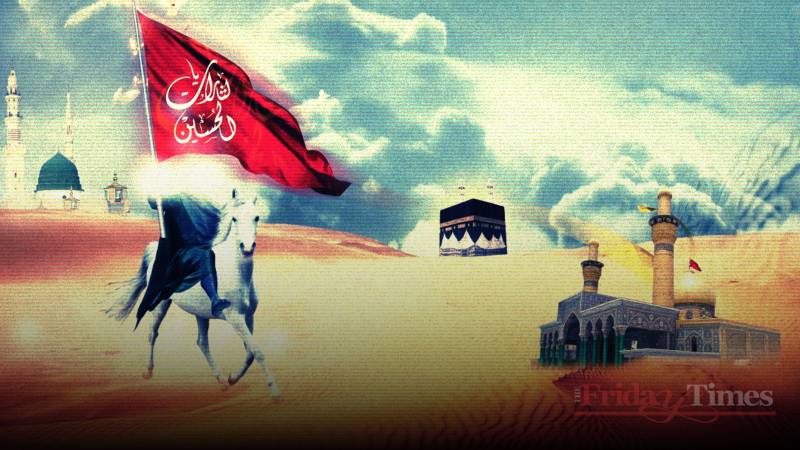
“Remember me when the truth becomes alone. Alone and sad.”
—Hussain Ibn Ali (A.S.)
Muharram, the first month of the Islamic lunar calendar, also known as the month of mourning, ushers in the start of a new Islamic year and brings back memories of the excruciating ordeals braved by the grandson of Prophet Muhammad (PBUH), along with his 72 fidus Achates. It is also one of the four sacred months of the Islamic year, and the meaning of Muharram is 'forbidden', referring to the prohibition of warfare. These months, in which warfare is forbidden unless imposed, are Muharram, Rajab, Dhul Hijjah, and Dhul Qadah.
Out of the twelve and four sacred months, only Muharram is famously known as the month of Allah. In this blessed yet tragic month ordained by Allah, Muslims should seek His proximity, blessings, providence, and purification of the souls by reciting the Qur'an, offering voluntary (nafl) prayers, and observing fasting. The Messenger of Allah said, "The best month for fasting after Ramadan is Muharram." Sins committed in this month are considered more serious, and virtuous deeds are greatly rewarded.
Unlike New Year celebrations, the month of Muharram prompts Muslims to reflect on the immense sacrifices of Hussain Ibn Ali (A.S.) in the Battle of Karbala, a pivotal stand against tyranny that ultimately led to his martyrdom and that of his family. The questions linger: what drove Hussain's decision to take that desperate path? Why did his other contemporary Muslims not join him? Perhaps it was because they valued their lives and feared death, whereas Hussain possessed a deeper understanding from Allah Almighty that eluded them.
The thread of sacrifice woven by Ibrahim and Ismail (A.S.) found its ultimate expression in Hussain Ibn Ali and his family, echoing the unwavering conviction that defined their ancestors. As Ibrahim's unshakeable faith paved the way, Hussain's stand became a testament to the enduring legacy of submission to Allah's will. He was not just Fatima's son but also the Imam of the Muslim Ummah and the apple of Prophet Muhammad's eye. Hussain (A.S.) did not die that day; instead, he became immortal, leaving behind a legacy unmatched in history.
His legacy is etched in history, and unborn generations will certainly continue to remember and follow his path until the last day of this world
The sombre dawn of Muharram brings forth the heart-wrenching tale of Karbala. As Imam Hussain's caravan traversed the scorching desert, they found respite by the banks of the River Euphrates. However, Yazid's forces stood unyielding, obstructing their path. Hussain (A.S.) sought to avoid battle and preferred negotiation, but he found himself between a rock and a hard place: either pledge allegiance to Yazid ibn Muawiyah or face death, and he chose the latter. In the face of escalating tensions, Hazrat Abbas unsheathed his sword, only to be soothed by Imam Hussain's sage counsel, which redirected their camp to a distant location.
As the days passed, the situation worsened. On the seventh day, the water supply was cut off to compel their surrender, and on the 10th of Muharram, the fateful showdown reached its crescendo. Hazrat Hussain (A.S.), the revered and cherished grandson of Prophet Muhammad (PBUH), stood firm and resolute, refusing to surrender or compromise, even as all his adherents fell in battle. With the scorching desert exuding heat beneath his feet and the blistering sun beating down on him, his throat was parched from thirst for three consecutive days. Beads of perspiration trickled down his forehead and entire body. Alone against thousands, he stood tall, unfazed by what was about to befall him.
As poet Adeem Hashmi beautifully and masterfully depicted the Karbala event in his poetry:
کہا اتنی صفیں اک سمت، چند افراد اک جانب،
کہا تعداد میں جو کم ہے، لشکر سب سے اعلیٰ ہے۔
کہا سجدے میں اک سر اک طرف، اک سمت اک لشکر،
کہا اس جنگ کا یہیں تو منظر سب سے اعلیٰ ہے۔
His horse, Zuljanah, was unlike other horses; he epitomised steadfastness, endurance, patience, loyalty, and strength like his master. Hussain Ibn Ali mounted his last and loyal companion one last time, Zuljanah, and charged into the fray with crescent dust rising behind him, a lone figure against an army of thousands. A line of archers took their position, and a volley of arrows rained down on him; yet, he pressed on, his spirit unbroken. Despite being vastly outnumbered, he fought with unyielding courage, his sword slicing through the chaos, and ultimately he embraced martyrdom valiantly, with his body brutally riddled with arrows and wounds. His fealty to Allah remained unwavering, his courage unparalleled, and his prowess inimitable, akin to his father Ali Ibn Abi Talib.
Hussain's (A.S.) conviction was unswerving to such an extent that he refused to go into Yazid Ibn Muawiyah’s allegiance and sacrificed everything to please Allah Almighty. After the martyrdom of Imam Hussain (A.S.), the forces of Yazid headed towards the tents, displaced the women from their places, mistreated them, deprived them of their veils, and their tents were torched.
On Muharram 10, the cities' arteries pulsate with devotion as millions of Muslims worldwide march in solidarity, clutching Alams emblazoned with 'YA Hussain' held high. With hearts heavy with sorrow, they echo the haunting refrain 'Labaik Ya Hussain', as if invoking Hussain's spirit in reverence. Chest-beating and tears flow freely, a poignant tribute to Hussain (A.S.) and his family. In these processions, Zuljanah – the majestic grey Arabian stallion of Imam Hussain – is revered as a symbol of loyalty and strength, bred and nurtured by the Prophet's own hands. For the Shia community, Zuljanah's presence is a vital part of Ashura's sombre ritual, a testament to their enduring mourning.
Therefore, the nearly six-foot-tall, robust stallion has been groomed and tended meticulously throughout the year for this momentous day. On the early morning of Ashura, Zuljanah is caparisoned, draped with a white cloth sprinkled with red colour and stapled with arrows around his body, symbolising blood and injuries sustained during the epic battle fought between Hussain (A.S.) and Yazid at Karbala.
Islam is a call to action, with courage at its heart. Hazrat Hussain (A.S.) stood unwaveringly against oppression and injustice, defending the Islam that his father and grandfather had instilled in him – principles that others among his contemporaries were willing to compromise. The Karbala narrative conveys a powerful message: when the principles of Islam are being compromised or eroded by those within, stand firm against them, even if it means sacrificing your life. This unwavering commitment to preserving Islam has been exemplified by luminaries such as Imam Abu Hanifa and Imam Ahmad bin Hanbal, who braved adversity to uphold the faith.
To top off this write-up, Hussain (A.S.) rose above all sects and transcended all worldly divisions. He followed the path and principles set by his Almighty with unwavering conviction and did not compromise on them. His Creator could have done miracles: He could have sent invisible succour, rained down relief during those final days or issued a natural water spring (chashma) from the earth as He did earlier for Hazrat Ismail (A.S.), but didn't intervene this time and chose a different trajectory – one that was unimaginably tragic, yet radiant with sublime Husaini values.
His legacy is etched in history, and unborn generations will certainly continue to remember and follow his path until the last day of this world. Allah's path and Islam's path are fraught with unimaginable challenges, but those who persevere in His course and surrender their will to His will shall find His succour, providence, and success in both worlds.