

Decades after leaving Dadu City, its streets still return to me with surprising clarity. One warm April day in 2026, I walked through Machhi Market with Rajib Azad, a retired schoolteacher, writer, and active member of the Sindhi Adabi Sangat’s Dadu branch. Four decades of absence had not weakened the city’s hold on my memory. The old lanes, corners, and familiar landmarks returned gently, as if they had waited all these years.
Among my earliest memories stands Amir Manzil, my maternal uncle Atta Muhammad Junejo’s home in Shahni Paro, right beside Qureshi Clinic on Market Road. Every summer vacation, my mother, Gulshad Begum, brought us there. Those days became a quiet sanctuary of family warmth, stories, and peaceful hours.
Not far away stood Saeen Surajmal’s bookshop at Mukhi Gheti. Every year my father, Wali Muhammad Junejo, a primary school teacher, took me inside to choose new textbooks. We kept this small ritual alive until I finished eighth class. Further along memory’s path stood Government Permanand Hardas Pilot Secondary School, where I studied, and Shoukat Sindhi’s sweetshop, where I sat with friends like Maqbool Panhwar, Akram Lala Panhwar, and Mustafa Charan.
His evening gatherings were defined by the soulful melodies of the sitar, bridging religious divides through the universal language of music
This time, I returned simply to document the life and times of Maharaj Devi Dina Ram at Shahi Bazaar. Maharaj Devi Dina Ram entered this world in Vikram Samvat 1898, corresponding to 1841 AD. Mystery still veils his exact birthplace. Some anchor it in Kanhri village within Sehwan Taluka; others point to Tajoji, a small hamlet near Sann and Manjhand. His father, Ram Maharaj Lal Dina Ram, watched the boy absorb the Ramayana, the Gita, the Guru Granth Sahib, and the Manusmriti. The young seeker mastered both Persian and Sanskrit. In the pages of Sindh Ja Bha Likal Lal, Maharaj Dawarka Parsad Rochiram Sharma portrays a child who avoided idle talk and sought deep reflection. He often sat in lotus posture beneath a great tree beside the village well, observing the world in silence. A single glance from him could turn a stranger into a devoted friend.
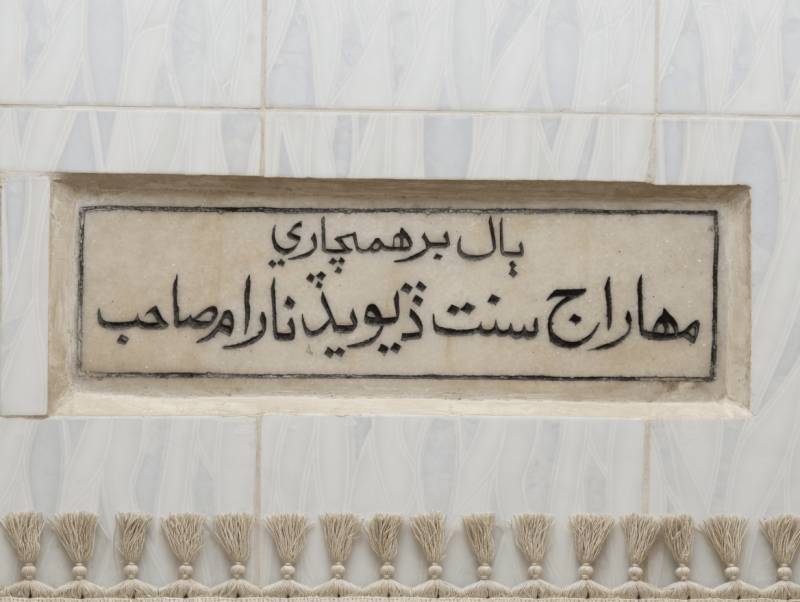
At twenty, his body reached full strength and his wisdom flowered completely. When neighbours brought marriage proposals, he refused them all. In 1861 he slipped away from his village and reached Dadu. His parents searched everywhere, then followed him to the town. Maharaj received them with love yet spoke with firm clarity: he had found his path and could not turn back. They returned home; he stayed. He lived in a simple house with one room, a kitchen, and a small prayer room. He sat each evening on a mat beneath a chhapro, a thatched structure/roof made from primarily water reed, combed wheat reed, or straw. His day began at three in the morning with meditation and reverence for Panch Mahabhoot: Earth (Prithvi), Water (Jal), Fire (Agni), Air (Vayu), and Space (Akash). According to Hindu philosophy, these five elements constitute the universe and the human body. He worshipped them through practices such as yoga and meditation. Afterwards, he cooked simple vegetables, rested briefly, and opened his doors at three in the afternoon.
Maharaj Devi Dina Ram wore simple clothes: a jamo, a traditional loose-fitting tunic worn by both Muslims and Hindus in pre-partition Sindh. He paired this with a thick dhoti made of raw fabric and a plain white topi. Inside his home, he wore chakhrion (wooden chappal), but when he stepped outdoors, he donned Multani ghetlao, a sturdy leather footwear crafted by local cobblers, and carried a beragi. He mirrored the lives of the ancient Maha Rishis, embracing a path of absolute simplicity that shunned waste, possessions, and the hoarding of goods.
Every day he performed Sandhya Upasana at sunrise, noon, and sunset. In those years Dadu held barely three thousand souls. Soon seekers began to gather. On summer evenings Maharaj sat in the open yard. During the winter, he sat beneath the covered thalho, a raised mud mound, as devotees gathered around him. Conversations touched Hinduism, Islam, and the deeper truths beneath every faith. Then Maharaj lifted his sitar. One note bloomed, and he sang the longing of Mira and the devotion of Surdas. Hindus and Muslims sat together, drawn close by the sacred melodies. Peace descended as the bhajans flowed. Silence lingered long after the last note faded.
During my recent visit, I sat with Ramesh Kumar, a retired teacher, and Mukhi Gurmukhdas, current Mukhi of Dadu Panchayat and a small businessman. They shared many stories of Maharaj’s wisdom and compassion. He cherished small girls especially. Whenever devotees offered sweets or food, he accepted the gifts and immediately distributed them among the children; he always reminding parents and male children to carry some sweets home for the girls.
Maharaj always helped the suffering with open hands. One such soul was Darya Khatoon, a renowned singer and dancer of her time. Seths and landlords from far-flung areas like Tando Rahim Khan, Drigh Bala, Khairpur Nathan Shah, and Sehwan longed to catch a glimpse of her or speak just a few words. When illness struck, she consulted various Hakims and followed every suggested remedy, yet the disease persisted. She grew pale, and her sorrow and sickness became evident even from a distance.
Desperate for a cure, she visited the Darbar of Maharaj. Upon reaching the gate, she cried out and begged for healing. Maharaj asked one of his devotees to bring her inside, where she weepingly shared the story of her suffering. He listened to her with deep concentration and sympathy. Maharaj often healed people by fixing his gaze on their glabella, the point between the eyebrows. He healed Darya Khatoon in this same manner. Once cured, she returned to her profession. Both Hindus and Muslims referred to such miracles as daya darshini. Whenever she passed the Darbar afterward, she sang devotional songs and performed the jhumir, a traditional Sindhi dance. During these moments, people gathered instantly to witness even a single move of her delicate dance.
Maharaj was equally popular among Hindus and Muslims. Hindus regarded him as a Maha Rishi of ancient times, while Muslims believed him to be an Awliya Allah. Maharaj never drew a line between the two faiths. To him, all human beings were reflections of God and shadows of Bhagwan. He believed that no one on Earth, whether priest, Mullah, or Brahmin, had the right to control, categorise, or label a creature not made by human hands. He was a firm believer in tolerance, and there are many examples where he showed mercy rather than strict justice.
In the early years of the twentieth century, an incident occurred involving the Lachheramani family of Dadu. A young man named Kesodas befriended some Mullahs and converted to Islam. Later, reflecting on his hurried decision, he wished to return to Hinduism. In those days, it was almost a rule that once a person left their Dharma, there was little chance of being accepted back. Kesodas’s case was brought before the Dadu Panchayat and was finally placed before Maharaj Devi Dina Ram. After listening to both Kesodas and the Panchayat, Maharaj prepared a case in favour of the young man. He corresponded with his Hyderabad-based friend, Maharaj Naena Ram Sharma, and ultimately ruled that if Kesodas wished to return to Sanatan Dharma with a clean heart, he should be welcomed back. This decision showed that Maharaj always chose tolerance over rigidity.
Maharaj passed away on Amas in Bado of Sambat 1965, which was roughly the 25th of September 1908. At the time of his death, only a few men and one woman were permitted to enter the wado sufo, a large square room. Soon after, the doors of the Ashtan were closed. The entire city of Dadu came to a standstill. People poured in from nearby villages and towns to pay their respects. Notably, more Muslims than Hindus came to pay their respects. Because of the huge crowds, people were asked to offer salam or pranam and move on quickly. Telegrams were dispatched to Hyderabad and surrounding towns. In the afternoon, Maharaj’s body was moved to the Shamshan Ghat. It seemed as though the whole of Dadu moved with him. The air was filled with the singing of Bhajans, cries of grief, and loud sobbing. By 3:00 PM, the mourners began to return from the cremation site.
Mourners continued to arrive from across Sindh for several days. On the fourth day, Maharaj’s hathion (bones and ash; or asthi) were gathered to be sent to Haridwar, the ancient pilgrimage site where the Ganges exits the Himalayas. Following his departure, devotees began singing a new type of Bhajan. Poetry was recited in his praise, and even Muslims sang Kalams in his glory. On the twelfth day, the feet of Brahmins were washed, and sacred food was offered to them. Additionally, food was served to every house in the city, both Hindu and Muslim. During the final two days of mourning, the eleventh and twelfth day, Bhagat and Bhajan sessions continued until the early morning. Renowned performers like Delo and Basho Bhagats, who were predecessors of Bhagat Kanwar Ram and experts in Sindhi Sangeet, travelled from Garhi Yasin, now a town and taluka in Shikarpur district, to perform. Bhagat Manghanmal of Chhanno, a nearby village now a part of Dadu Municipality, also attended punctually. He famously praised the presence of Bhagat Delo Basho. One stanza of his poem was: “Bhagat Ayo Delo Basho / Lago Tin Jo Mazo Khasho,” the presence of Bhagat Delo and Basho multiplied the joy.
Until the 1920s, particularly amidst the political fervour of the Non-Cooperation and Khilafat Movements, the life, healing stories, and passing of Maharaj Devi Dino Ram remained the most enduring subject of conversation in the social gatherings of Dadu.