

Who would’ve thought that a simple triangle could become a turning point in someone’s learning journey—or that a circle could unlock joy?
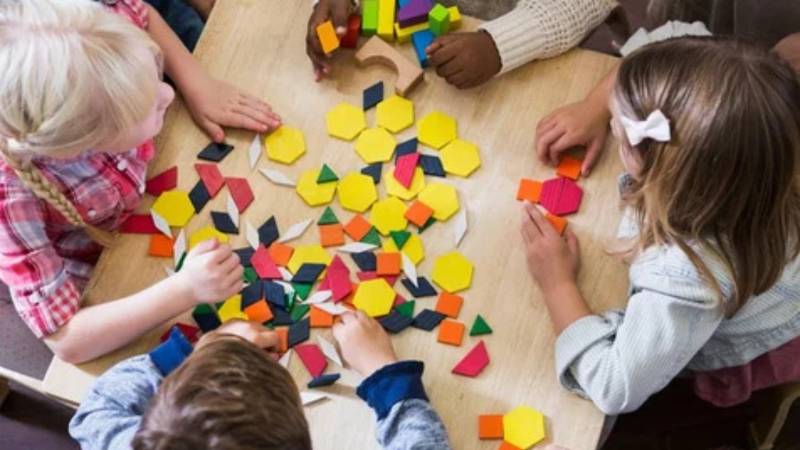
That’s exactly what I discovered in a small classroom tucked away in Pakistan. As part of my M.Phil. research, I designed an activity I called Shape Fusion Fun, built around art, storytelling, and sensory play. The idea was to help autistic students recognise shapes, but what unfolded was so much more. In one session, a boy who rarely met anyone’s gaze began quietly tracing a triangle with his finger, completely focused and, for the first time, visibly content. Another child pointed at a red circle and named it aloud, smiling so broadly it felt like the classroom had lit up.
These weren’t just academic milestones—they were human connections, unfolding through colour and form.
The question that led me to that classroom was simple: How can we make learning more inclusive and emotionally safe for autistic children in our education system? Traditional methods weren’t enough. Worksheets, verbal instruction, repetition—they often fell flat. I wanted to try something different, something tactile, visual, and story-driven.
Sometimes, the most powerful breakthroughs arrive quietly—in colour, in motion, in a shape drawn carefully on paper by a child finally feeling seen
Shapes, I found, are quietly powerful. They don’t ask for words. They aren’t complicated. They provide structure without pressure. And for neurodiverse learners, especially those navigating sensory challenges or limited verbal communication, shapes offer a gentle, grounding language. In our sessions, a square would become a house. A circle transformed into a moon. A triangle turned into a tree—or sometimes a spaceship, depending on the child’s imagination.
Soon, the students began to personalise these shapes in ways I hadn't anticipated. One child assigned emotions to colours—yellow for happy, blue for quiet. Another, usually silent during class, started mimicking shapes in the air with his hands, as if drawing invisible stories.
This wasn’t just learning—it was expression, ownership, play. It was the classroom becoming theirs.
And the shift wasn’t just in the students. Teachers who once struggled to engage these children noticed a difference too. Children who rarely focused during lessons began anticipating the art sessions. They came alive with crayons, paper, and open-ended prompts. They laughed. They collaborated. They surprised everyone.
I started seeing the classroom differently. Instead of a space with fixed routines and expected outcomes, it became a place of possibilities. I stopped rushing to correct, and instead began watching quietly. Some of the most profound breakthroughs came in the in-between moments—when no one was trying to be "correct," just present.
Through this experience, I’ve learned that education doesn’t always have to follow a script. In fact, for many children, especially autistic learners, the best learning happens outside the lines. A triangle can become a rocket. A circle can become the sun. And in those moments, the classroom becomes not just a place of instruction—but of belonging.
We talk a lot about inclusion, but we often forget that real inclusion demands creativity. It’s not just about making room at the table—it’s about rethinking the table entirely. We need to move beyond rigid curricula and embrace approaches that reflect how different minds make sense of the world.
In the end, Shape Fusion Fun taught me that learning doesn’t always need words to make sense. Sometimes, the most powerful breakthroughs arrive quietly—in colour, in motion, in a shape drawn carefully on paper by a child finally feeling seen.
And yes, sometimes, a triangle really can change everything.