

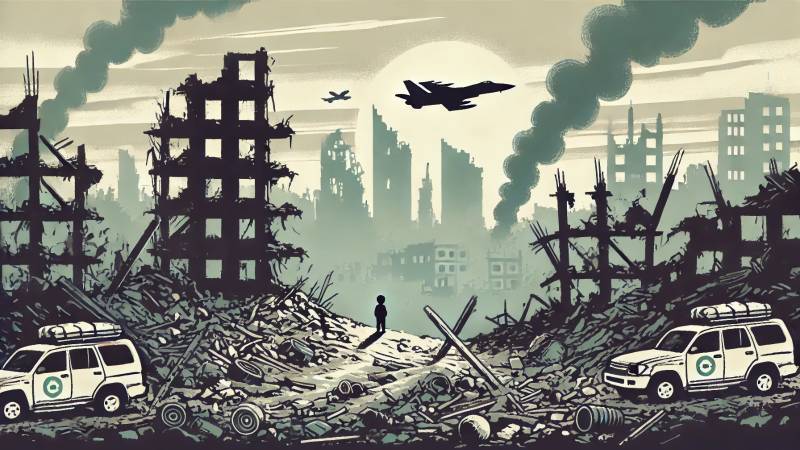
As the world grapples with a record number of conflicts globally, Gaza stands as a stark reminder of the devastating economic toll of violence—and the urgent need for peace. As of writing this, there has been no aide (including essential food, water, medical supplies) for almost two months. On Friday (April 25) the World Food Programme confirmed it had run out of food stores. Unless the blockade is urgently lifted, millions face starvation in Gaza.
According to the Interim Rapid Damage and Needs Assessment (IRDNA) conducted by the World Bank, United Nations, and European Union, the conflict has caused an estimated $53 billion in damages and reconstruction needs—a staggering figure that underscores the immense challenge of rebuilding Gaza’s shattered economy.
Beyond the immediate dire humanitarian situation, the months of violence have deepened poverty in Gaza, disrupted essential services, and set back development by decades.
Even if humanitarian aid resumes and a new ceasefire is negotiated, the economic toll, its long-term consequences for Gaza’s population, and the task of reconstruction are monumental in a region already grappling with extreme deprivation.
The Link Between War and Poverty
Violent conflicts are among the most significant drivers of poverty worldwide. The 2024 Human Development Report highlights that 19% of the world’s poor (218 million people) live in war-affected countries, where poverty rates are more than three times higher than in peaceful nations.
The economic cost of the Gaza war is not just measured in dollars but in lost lives, shattered futures, and generational trauma
In Gaza, the devastation has exacerbated pre-existing vulnerabilities. Even before the latest escalation in violence, 40% of Palestinians lived below the poverty line, with high unemployment and crumbling infrastructure. In February 2025, after months of intense bombing, Gaza’s economy had contracted by 83%, reducing its contribution to the Palestinian economy to just 3%, despite housing 40% of the population, and now since the ending of the ceasefire and the humanitarian blockade, the situation is even worse.
Key Economic Impacts of the War (in February 2025)
1. Physical Destruction ($30 Billion in Damages)
- Housing: Over 60% of Gaza’s housing stock has been destroyed or damaged, accounting for 53% of total damages ($15.8 billion).
- Commerce and Industry: Factories, markets, and businesses have been decimated, with $5.9 billion in damages (20% of total losses).
- Infrastructure: Roads, water systems, and electricity networks have suffered $2.5 billion in damages, crippling basic services.
2. Economic and Social Losses ($19 Billion)
- Health Sector: With hospitals bombed and medical supplies blocked, losses are estimated at $6.3 billion.
- Education: Schools have been destroyed, and an entire generation faces disrupted learning, costing $3.2 billion.
- Food Security: In February, prices had already surged by 450%, with famine-like conditions emerging due to blocked aid. This has only intensified with the UN reporting: “Food prices have skyrocketed 1,400 per cent compared to the ceasefire period earlier in the year, while essential food commodities are in short supply.”
3. Humanitarian Crisis
- Displacement: 83% of Gaza’s population (2 million people) have been displaced, many multiple times.
- Casualties: In February 2025, at least 47,000 people had been killed, including 13,000 children, with 111,000 injured. This is now estimated to be over 61,000.
- Disease and Hunger: Lack of clean water, malnutrition, and outbreaks of infectious diseases threaten long-term health consequences.
The Challenges of Reconstruction
Rebuilding Gaza will require $53 billion, a sum that dwarfs previous reconstruction efforts in conflict zones. However, the obstacles go beyond funding:
1. Rubble and Debris Clearance
- Between 41 to 47 million tons of rubble—equivalent to several times the debris from the 9/11 attacks—must be cleared before reconstruction can even begin.
- The rubble contains unexploded ordnance (UXO) and human remains, making clearance dangerous and slow.
2. Governance and Coordination
- Effective reconstruction depends on stable governance, but Gaza’s political divisions and Israel’s restrictions on materials (like cement and steel) pose major hurdles.
- The Palestinian Authority (PA) is financially crippled, with the West Bank’s economy shrinking by 16% due to spillover effects.
3. Long-Term Economic Recovery
- Even if physical infrastructure is rebuilt, Gaza’s economy will take decades for the economy to recover.
- Unemployment, already at 45% before the war, will skyrocket further without massive job creation programs.
- Psychological trauma and loss of skilled workers (through death or emigration) will hinder productivity.
A Path Forward?
The IRDNA report outlines a three-phase recovery plan:
- Short-Term (0-3 Years): $20 billion for emergency housing, health services, rubble clearance, and cash-for-work programs.
- Medium-Term (3-5 Years): Rebuilding infrastructure, schools, and hospitals while restoring governance.
- Long-Term (5+ Years): Economic revitalisation, job creation, and sustainable development.
However, without a lasting political solution, reconstruction efforts risk being undone by future conflicts. The international community must push for a durable ceasefire, unimpeded aid access, and a credible peace process—otherwise, Gaza’s cycle of destruction and poverty will continue.
Conclusion
The economic cost of the Gaza war is not just measured in dollars but in lost lives, shattered futures, and generational trauma. Reconstruction will require unprecedented funding, coordination, and political will—but even then, true recovery is impossible without justice, stability, and an end to the cycle of violence.