

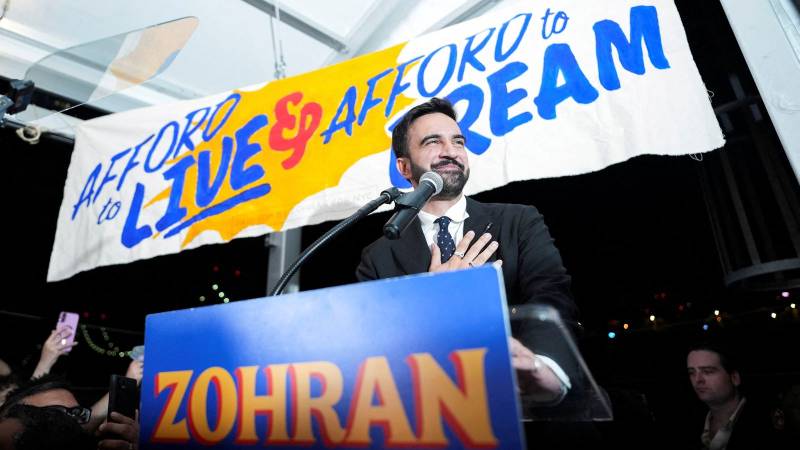
It’s finally happened, the Democrats have crossed the line. Zohran Mamdani, a 100% Communist Lunatic, has just won the Dem Primary, and is on his way to becoming Mayor. We’ve had Radical Lefties before, but this is getting a little ridiculous. – Donald J. Trump
In today’s changing world, the long-celebrated idea of diversity as a strength now faces deep anxiety. Zohran Mamdani’s recent win in the Democratic primary for Mayor of New York City, and his potential to become the city’s first Muslim mayor, reflects a generational and ideological shift within the Democratic Party, signalling the rise of progressive politics over establishment centrism.
The son of Mira Nair, a renowned Indian filmmaker, and Mahmood Mamdani, a Columbia professor originally from Gujarat, India, Zohran carries a deeply global identity. His family migrated from Uganda to the United States when he was seven, and he is now married to a Syrian artist. Together, his background and life choices represent a cross-section of immigrant, Muslim, and South Asian identities—making his candidacy a powerful symbol of the complexities and possibilities of inclusion in contemporary American politics.
Yet it also serves as a powerful example of the frictions and coexistence challenges faced by modern, hyper-diverse societies. Zohran has managed to win hearts across communities by sending a beacon of pluralism. His election campaign successfully used multilingual videos—including Urdu, Hindi, and Spanish—to increase his appeal among diverse communities. By bridging neighbourhoods from Astoria to the Bronx, he demonstrated that representation is possible in truly diverse societies where multiculturalism thrives. But not everyone is celebrating.
Underneath the surface lies a frowning discomfort, and behind the smiles and speeches is a growing fear—the fear of losing cultural identity, of being left out, of watching one’s heritage fade away. This fuels reactions such as reactive nationalism, racism, Islamophobia and stereotypical fears. Has the melting pot boiled over?
Zohran Mamdani’s win has sharpened the ongoing debates in the U.S. around cultural identity, representation, and how far traditional definitions of ‘American-ness’ can stretch before some feel the country is becoming unrecognisable.
People—whether in Pakistan, New York, Paris or Nairobi—must learn that identity doesn’t have to be a fight but a shared human story
For centuries, societies have tried to manage diversity in two dominant ways. The melting pot, as in the United States, where people are urged to blend into one shared ‘American’ culture. And the salad bowl, as seen in Singapore and Malaysia, which celebrates coexistence and groups living peacefully while retaining their distinct flavour. Although both models worked in the past, today’s hyper-diverse democracies are struggling to find balance—and neither metaphor is working fully. In this post-assimilation world, identity politics, representation, and cultural memory collide in novel and uncomfortable ways.
In France, the enforcement of laws protecting French secularism is met with protests from Muslim communities who feel targeted, their identities under attack. In the UK, Rishi Sunak—a British Indian—becoming Prime Minister was a symbolic reversal of colonial history: a person of Indian descent leading the country that once ruled India. It triggered a cultural reckoning among native communities—English, Welsh, Irish, and Scottish—who have voiced concerns about losing traditional values and identities, and perceive it as the erosion of ‘Britishness’. The anxiety is not always xenophobic; it is often rooted in genuine concerns and fears of losing one’s historical heritage, language, and values.
Even in Pakistan—a country thought to be culturally homogenous—similar issues exist, with cultural shifts underway. In Khyber-Pakhtunkhwa, particularly in Peshawar, the indigenous Peshawari culture and local language are being severely undermined by broader Pashtun cultural dominance, primarily due to the radical influx during the Afghan war and, more recently, because of the city’s horizontal expansion. In Punjab too, the Punjabi language and culture are quietly fading from urban life, replaced by Urdu and English media culture and a new middle class shaped by globalised Islamic identity. In contrast, Sindhis are actively preserving their culture by tightly holding on to their language and heritage through education and cultural celebrations. Meanwhile, Baloch communities have managed to protect their traditions by remaining closed and tightly-knit.
Back in the U.S., the election of Donald Trump—twice—signals more than political leanings; it reflects cultural fatigue. Many Americans are tired of the constantly changing, fluid national culture that comes with continual immigration and identity shifts. They want to settle into a clear sense of “what it means to be American.” The tension between cultural continuity and cultural change is no longer abstract; it’s showing up in voting booths and public discourse alike. Meanwhile, diverse communities continue to fight for fair representation and equality. When neither side feels heard, resistance grows—through racism, stereotypes, and sometimes even hate.
This tension reveals a real policy dilemma: should nations strive for democratic pluralism with co-evolution and active participation of diverse cultures, or push for cultural homogeneity to preserve shared norms, values, and stability? In reality, neither the melting pot nor the salad bowl fully resolves this challenge or offers a complete solution.
And when both models become unwelcome—what options remain?
Perhaps it’s time to talk about a third way: interculturalism, where societies seek harmony and equality while allowing communities to keep their identities. While the melting pot demands blending in, and the salad bowl seeks coexistence, interculturalism goes further by inviting mutual, planned transformation through dialogue and respect. It means evolving together by building bridges based on shared values, civic engagement, and common norms—instead of building walls or erasing cultures.
For example, Canada’s intercultural dialogue is supported by policies that encourage both civic values and cultural expression, setting a precedent for how shared identities need not come at the cost of ethnic heritage.
But for this to succeed, we need leadership that leads with vision—not fear, prejudice, or the illusion of a threat that may, in fact, be a miscalculation or a reflection of deep-rooted racism. What we need is rational, principled leadership. Media must unite and start cultivating empathy rather than fanning stereotypes. Schools must teach cultural literacy and tolerance alongside civic duties. Most importantly, we must accept that identity is not a zero-sum game.
People—whether in Pakistan, New York, Paris or Nairobi—must learn that identity doesn’t have to be a fight but a shared human story. We don’t have to lose ourselves to live together.
Diversity is not going away. And if we want peaceful, united societies, we must choose a path that includes everyone without erasing anyone—one that defines how we live with diversity, and how we shape the society we all share.
It remains up to us.