

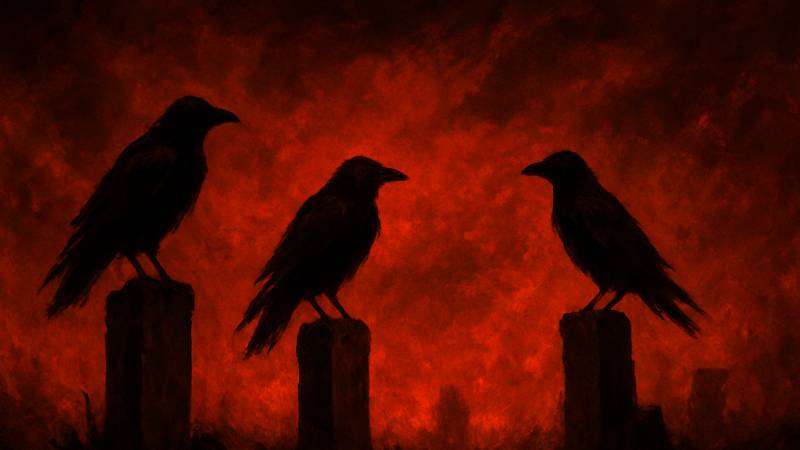
In the year 2225, when the dust of countless constitutional crises and political intrigues had finally settled over the Republic of Westeros, three black crows, once self-proclaimed savants of the Realm’s Apex Court, alighted upon the warped pillars of the Infernal Archive. Their feathers, though gleaming like obsidian, sagged with a profound and desolate fatigue. Their talons scraped against the stone, strained beneath the heavy burden of the very judgments they had delivered. Those judgments, now fossilised in the depths of this accursed repository, were monuments to destruction rulings that shattered the rule of law, disfigured the constitution and extinguished the last trembling embers of democracy in Westeros.
The first crow, Justice Lago, his name a shadowed homage to Shakespeare’s Iago from Othello, carried an ancient scroll inscribed with ratio decidendi from an era when the purported survival of the state was exalted even above the supremacy of the constitution. A genius of jurisprudence, he could weave arguments of dazzling brilliance, but his intellect bore a sinister edge. Most notoriously, he had validated the dissolution of assemblies under the infamous doctrine of necessity.
In his reasoning, he leaned heavily on Hans Kelsen’s theory of legal positivism, declaring that once effective control of the state shifted, the new authority became the legitimate source of law, setting a precedent that extra-constitutional rule could be sanctified by judicial imprimatur. The powerful cheered his reasoning as masterful; however, history recorded it as collaboration dressed in scholarly robes. His talent was extraordinary, but his conscience was compromised by expediency, thus leaving a legacy of legal precedents that weakened institutions, eroded public trust and fortified the non-democratic forces of Westeros.
The second crow, Justice Raskolnikov, an echo of Dostoevsky’s perpetually anguished creation, flapped into the Infernal Archive, dragging with him the twin burdens of shallow elitism and absurdly inflated self-regard, alongside a generous helping of envy and sinful ambition. He had theatrically snatched symbolic identity from a political party at the behest of the mighty, assisted the government in handpicking election officers from a thoroughly compromised bureaucracy, and orchestrated the required majority in the assembly to ensure the ruling power could slip a constitutional amendment through without so much as a hiccup.
He became the guardian of election theft and the custodian of an illegal regime’s survival. Like his literary namesake, he thrived by clutching at authority, flattering the powerful and enabling injustice
Ever the self-styled thinker of rare intellect, he nevertheless allowed envy and hatred to warp every judicial fibre of his mind. He convinced himself that election rigging served some higher purpose, even as it obliterated the rule of law and trampled democracy underfoot. His thoughts were a circus of machinations, resentment and guilt. Scholars whispered that he desperately needed Freudian psychoanalysis, for every judgment he issued bore the unmistakable fingerprints of either moral confusion or audaciously selfish design.
The third crow, Justice Uriah, a spectral tribute to Dickens’ Uriah Heep, had risen through the ranks by bending the arc of justice to the will of the illegitimate regime ruling Westeros. He readily anointed the Throne’s tribunals with a veneer of legality, placing ordinary citizens at the mercy of special courts never meant for them. With a single stroke of his pen, he gifted the Starks’ entitled share in power to the undeserving Lannisters, transforming popular representation into the spoils of power. And finally, he sanctified the regime’s quiet encroachment into the sacred chambers of the higher judiciary.
For these acts of service, the gates of reward opened wide. He was enthroned as the head of the High Tribunal of the Realm’s Apex Court and later elevated to lead the Central Dominion Court, a newly forged institution conceived not to uphold law but to empower the executive. He had ascended purely by luck, though his mind was painfully inadequate; legal reasoning, coherent argumentation, even drafting a single paragraph of proper legal English lay far beyond his abilities. Yet despite this mediocrity, he became the guardian of election theft and the custodian of an illegal regime’s survival. Like his literary namesake, he thrived by clutching at authority, flattering the powerful and enabling injustice, his incompetence concealed only by his relentless eagerness to serve the machinery of tyranny.
As they approached the centre of the archive, the flames rose higher, projecting their earthly legacies. A table of judgments appeared before them, demanding introspection. The three damned silhouettes became embroiled in a heated argument. Each wanted to build an argument that he deserved the bottommost abyss of the accursed realm.
Equal in guilt, equal in ruin, they were stripped of their robes and transformed into black crows, condemned to circle the deepest pit of the abyss for eternity
Justice Lago stepped forward first, moving with the poise of a villain who knows he is brilliant.
Lago: “Let it be stated for the record, I am the architect of devastation. With a stroke of doctrine, I dissolved assemblies, enthroned tyrants and forged precedents that strangled democracy. Genius, yes, but of the darkest kind. While the republic slept, I rewrote its destiny.” The flames hissed approvingly.
Justice Raskolnikov snapped his mirror into view, holding it aloft like an actor revealing the tragic mask.
Raskolnikov: “Do not dare claim supremacy in damnation. My crimes were carved from the marrow of envy itself. I stole elections while preaching virtue. I let ambition rot my reason. I thundered judgment from the bench, yet every word was dipped in hatred, ego and the obsession to flaunt. Look (shakes the mirror violently). This reflection torments me because it knows my sins better than you know yours.”
Then, timid footsteps. A nervous shuffle. Justice Uriah approached as though apologising for taking up space.
Uriah: “I humbly confess, I only followed procedure. I upheld stolen elections because the powerful wished it so. I let illegality prosper because obedience was safer. I lacked brilliance, yes, but never loyalty to those who commanded. Surely, sirs, that makes me the worst?”
Raskolnikov turned to him with theatrical disgust, leaning in until the embers reflected in his eyes like twin daggers.
“You? Uriah? A contender? Do not mock this tribunal of the damned. You are no jurist; you are an empty robe. A timid clerk wearing the mask of justice. Even in a middling province, you would fail the lowest judicial exam. Lago twisted the law with brilliance; I corrupted it with intention. But you destroyed justice through sheer incompetence. A tragedy without intellect. A farce in human form.”
Uriah recoiled as if struck, bowing so low he nearly touched the smouldering floor.
Uriah (trembling whisper): “I only wished to survive. To stay close to power. I am ever humble, ever obedient, ever the worst.”
Even in this infernal theatre, no verdict could declare a single loser. In the end, the Inferno reached its verdict: none of them was better or worse than the others, for each had ruined justice in his own spectacularly pathetic way. Lago, the evil genius who twisted law into origami for dictators; Raskolnikov, the preening narcissist who mistook his envy for intellect; and poor Uriah, the trembling clerk who somehow stumbled into a judge’s chair and never stopped bowing. Equal in guilt, equal in ruin, they were stripped of their robes and transformed into black crows, condemned to circle the deepest pit of the abyss for eternity.
One good thing is that all three agreed on one point: their delusion of permanence. Each, in his own pompous way, had once believed the robes on their shoulders were stitched from eternity itself. They imagined their tenure would stretch into forever, that the world below would remain obediently frozen in the posture they preferred. In their minds, the perks would never stop, the protocol would never thin, and the privileges would ripple endlessly like some divine pension for services never quite rendered. But eternity has a sense of humour. And now, in the deepest pit of hell’s endless underworld, their “forever” is as black as their judgments.
Truth is, their judicial deeds have exposed them to agonising sentences. They will remain in the Infernal Archive as black crows. Their story has become a parable of three black crows burning in hellfire. Their names are destined to be remembered only as warnings of what becomes of judges who betray the law. Down below, the damned laugh at them; up above, mortals curse them, and the three bicker day and night, still trying to decode who was the worst judge.