

You don’t grow up in Peshawar without feeling the shadow of Bala Hisar on your back.
As a boy, I’d often ride my bicycle past its mighty walls, craning my neck to catch a glimpse of the flag fluttering at its summit. It wasn’t just a fort. It was a guardian, a storyteller, a sentinel that had seen it all — from emperors and invaders to schoolboys like me, dreaming under a restless sky.
Bala Hisar — the “High Fort” — occupies a hillock on the western edge of the city, its eyes fixed towards the Khyber Pass, that eternal gateway of invaders and empires. The Mughals stood here. So did the Sikhs, the Durranis, the British, and now, our own khakis. In a thousand years, not a single power in the region dared to ignore it. That should tell you something.
But to me, it was always more than stone and mortar. It was memory.
My father would tell tales of Ahmad Shah Durrani, who made the Fort his winter capital; of Babar, the first Mughal, who passed through here dreaming of Delhi; and of the Sikhs, who stormed it with cannon fire, and then the British, who rebuilt it to suit their military taste — cold, efficient, and imposing, as it stands now.
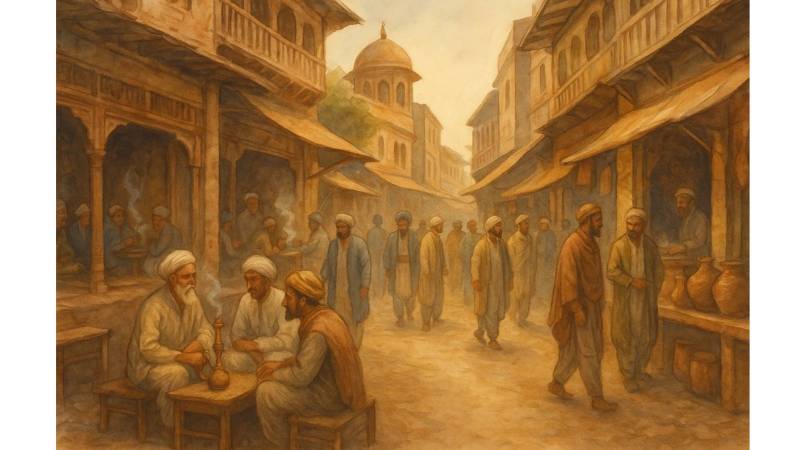
Yet none of these stories captured the soul of Bala Hisar as much as the ones whispered by old men in the chai-khanas (tea houses) nearby. They’d speak of secret tunnels, of treasure buried beneath, of dungeons where both rebels and kings once languished. Of how, on some nights, if you stood very still, you could hear horses galloping inside the walls.
Yes, the fort is still in use. The Frontier Corps call it home now — and the public cannot simply stroll in. But that, in a strange way, preserves its mystery. Bala Hisar is like an old lonely man on high seas; who has stopped speaking — but whose silence says more than a thousand words.
My father would tell tales of Ahmad Shah Durrani, who made the Fort his winter capital; of Babar, the first Mughal, who passed through here dreaming of Delhi; and of the Sikhs, who stormed it with cannon fire
Once, when I stood with my own son near the Chowk Yadgar and pointed towards Bala Hisar in the fading light, I realised that this fort has never been conquered by mere arms. It has survived because the city beneath it — Peshawar — never gave up.
Bala Hisar is not just a monument of the past. It’s a mirror. It shows us what endures.
Therefore, when I think of this city of mine, with its blood and poetry, its bazaar noise and jasmine air, I begin here — at the citadel of empires. The place where all roads into Peshawar begin… and end.
Gor Khatri: Crossroads of Civilisations
If Bala Hisar was the city’s forehead — proud and defiant — the Gor Khatri is its navel: ancient, layered, sacred, and hidden from public eye.
Gor Khatri doesn’t impress the first-time visitor. It sits quietly atop a rise in the heart of the old city, surrounded by chaotic bazaars, narrow alleys, and the aroma of chapli kebabs. But dig — not just with hands, but with imagination — and you’ll find twenty-five centuries whispering through its stones.
I walked there once as a young officer, off-duty and curious, still wearing my polished boots as I stepped into history’s dust. The caretaker, an old man with yellowing teeth and impeccable manners, smiled when I asked, “Yeh Gor Khatri kya hai?” (What is this Gor Khatri?)
He didn’t answer directly. He just said, “Yeh sheher ka asal paimana hai.”
“This is the city’s original measure.” Later, I came to understand what he meant.
This very spot — long before Pakistan, before Islam, before even Alexander — had been inhabited. Archaeologists say that beneath Gor Khatri lie the remains of Pushkalavati, the ancient capital of the Gandhara kingdom; a city once known to Chinese pilgrims, Indian princes, Greek invaders, and Buddhist monks. There’s evidence of a Persian-era fire temple, a Buddhist stupa, a Mughal caravanserai, and a Sikh command post — all layered like geological time.
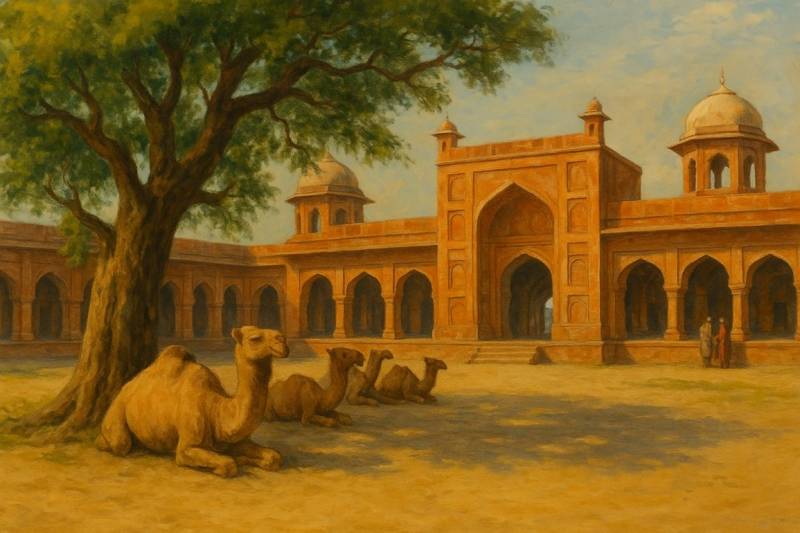
The site has housed a Mughal princess — Jahan Ara, daughter of Shah Jahan — who built a grand Sarai here for weary travellers. In her day, water flowed through clean tanks, and camels rested in shaded courtyards. She is rarely mentioned in our textbooks, but I often imagine her walking these grounds, parchment in hand, supervising construction with her noble father’s eye for proportion.
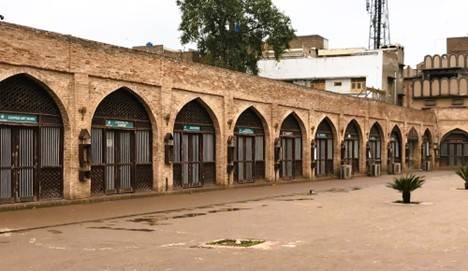
The Sikhs later added a fire temple here — no surprise, since Peshawar’s streets once echoed with the chants of Hindus, Buddhists, Jains, Zoroastrians, and Sufis. All left their footprints; none are erased. A mosque stands on one side of its excavated corner, and a temple on the other. Jahan Ara’s Serai, now a museum is located in another corner. The entire quadrangle is surrounded by a road still known as Gorakh Nath Temple Road.
What’s most moving, though, is the remnant of a well attributed to Rani Dadi, a Hindu noblewoman. It still survives, enclosed behind steel bars, where local children drop coins and make quiet wishes. Sometimes, it feels like the whole of Peshawar — with its bruised pride and stubborn soul — is still wishing, still waiting, still remembering.
As a boy, I didn’t know this — I just knew that near Gor Khatri, the kite shops were the best, and the barber’s radio always played Mehdi Hassan. But now, years later, I understand that here lies not just a physical location, but a philosophical centre — a place where civilisations shook hands, where traders rested, and where the city decided to live on, no matter who ruled it.
Gor Khatri doesn’t shout. It hums, for those who care to listen. And in that hum, you can hear everything — from Buddhist chants to Sikh bugles, from Mughal poetry to Pukhtun lullabies.