

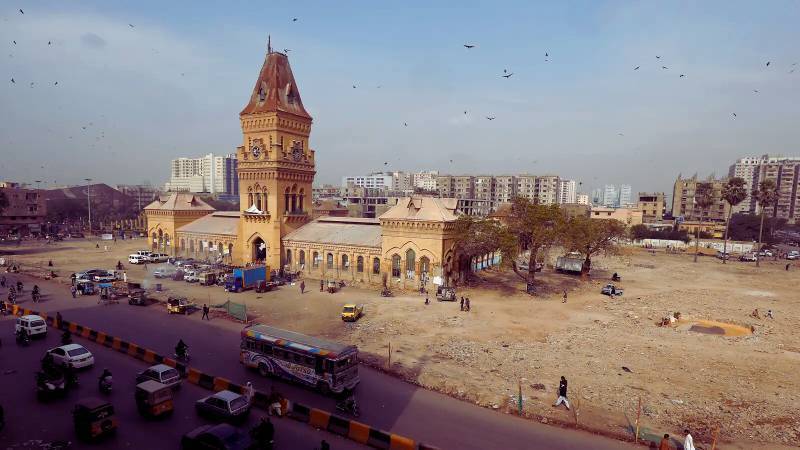
Anyone who’s lived in Karachi for a reasonably long period will not think that it isn’t the best-planned of cities, unlike Islamabad or even Lahore. They will also know that it’s a massive city, and even some areas of it are probably larger than most other cities in Pakistan. They will also know that much of the planning and construction tends to be haphazard. Of course, as a city, it is very diverse, eclectic, and cosmopolitan and has its own charm.
That said, the way the city is government and how its land is owned and used creates lots of problems – mostly for its 20 million-plus residents. For instance, instead of say one municipal agency that owns public land and regulates the use of privately-owned land, like say the Capital Development Authority in Islamabad, Karachi has over a dozen such agencies. The Karachi Metropolitan Corporation (KMC), whose head is Karachi Mayor Murtaza Wahab, is the largest of these but not the only one.
In fact, some of the city’s most affluent neighbourhoods are outside its jurisdiction since they lie within the confines of various cantonment boards and the Defence Housing Authority. Other federal agencies like the Ministry of Railways, Ministry of Defence, and Ministry of Ports and Shipping also own large chunks of the city’s land, and much of this is in prime locations – and by prime one means that it’s ideal for commercial use, and always under the eyes of the city’s powerful builders’ mafia.
Because of the lack of planning, fuelled in large part by the multitudes of municipal agencies and land-owning bodies, we see many residential neighbourhoods with schools, colleges, universities, clinics, hospitals, restaurants, and the like. This is especially common, but not confined, to areas under the administrative control of the KMC and its sister concern, the Karachi Development Authority or KDA. When unplanned commercial growth happens, we often see local residents filing petitions in the courts seeking that such establishments be removed since they are not allowed under the Karachi Building and Town Planning Regulations, 2002 (KBTPR). So, at any given point in time, there are numerous such petitions in the courts, with stay orders obtained by the errant commercial establishments in most of the cases.
Instead of clamping down on illegal commercial use of residential properties in Karachi, the Sindh government has amended existing building regulations so that residential homes can be used for commercial purposes
But now with a quietly done wholesale change via a Sindh Building Control Authority notification dated March 13 to the KBTPR, all such commercial businesses on residential properties and people’s homes will be legal – and therefore any litigation based on the previously unamended regulations will become redundant. This also means that henceforth in the city of 20 million, it will be okay to open a school, a clinic a restaurant, or even a hospital or a university in a purely residential neighbourhood. Of course, those who live in Karachi know that this was already the situation but at least under the law this was all illegal – but with the change in the regulations, it will be perfectly legal.
The change in the building regulations has been allowed by the Sindh Building Control Authority (SBCA) and the rules that have been changed are specifically the Karachi Building and Town Planning Regulations of 2002. The rule change happened formally after the SBCA issued a notification to that effect dated March 13, 2025.
So, instead of clamping down on illegal commercial use of residential properties in Karachi, the Sindh government has amended existing building regulations so that residential homes can be used for commercial purposes. The change in the building regulations means that those who operate schools, clinics, hospitals, shops, offices, and the like in residential properties in Karachi will no longer expect to be sued in court by residents and will be able to continue their commercial businesses
At any given time, there are numerous such court cases by residents against those who till now were seen to be misusing residential properties by running commercial businesses. And it is expected that these legal challenges will now be dismissed because of the change in the building regulations.
The explanation given by the SBCA, via an official quoted in Dawn, is that since there were so many instances of violations of the previous town planning and building regulations, and since most of these were done by people with connections, it was thought best to change the rules instead to accommodate them. The official claim was also that this was done in the public interest since it would help citizens. That is however quite a stretch because neighbourhoods where there are schools, clinics, restaurants, and the like have serious issues related to traffic, road use, sanitation, solid waste collection, and so on.
Clearly, the rule change, which was done quietly because the Sindh government knew it would cause public outrage, is a blow to the rights and quality of life of residents in areas set aside for residential purposes.