

As noted previously, Pakistan should move ahead with the deployment of smart meters which can reduce operating costs for utilities and enable the provision of time-varying rates (TVRs), which can help customers lower their energy bills. The state of Hawaii lies in the Pacific Ocean, some 2,500 miles from the mainland of the US. It was the last state to join the US in 1959. It ranks 40th in population and is home to 1.5 million people.
The state was once a monarchy, ruled by native Hawaiians. They had close ties with the British crown, and many of them studied in the United Kingdom. Thus, the state flag has the unique distinction of being an American state with the Union Jack embedded in it. The flag has eight stripes, representing the four major and four minor islands in the state. A significant portion of the state’s population is of Asian descent, including Chinese, Japanese, Filipino and Korean ethnicities.
The Aloha State, as it is called, also has the unfortunate distinction of having the very highest electricity rates in the US. Affordability is a top priority, as is resilience and reliability. Blessed with ample sunshine and a tropical climate, Hawaii also has extensive deployment of solar panels on roofs. In Honolulu, the state capital and largest city, 49.5% of single-family homes have deployed them.
I was invited to discuss electricity rates – specifically, TVRs -- at a conference that was held in Maui, which I had visited a few times but always for pleasure. On the first day, I participated in a Deep Dive session on TVRs. Some 40 people attended. I was one of three speakers. Then we engaged in a dialogue with the participants. On the second day, I participated in a plenary session, which was located in a large and beautiful auditorium called the Castle Theater. I think some 200 people were in the room.
Hawaii has deployed smart meters to nearly 90% of its residential customers. Since 2015, when the state ended net energy metering, rooftop solar panels are increasingly being paired with batteries. Electric cars are also making their presence known.
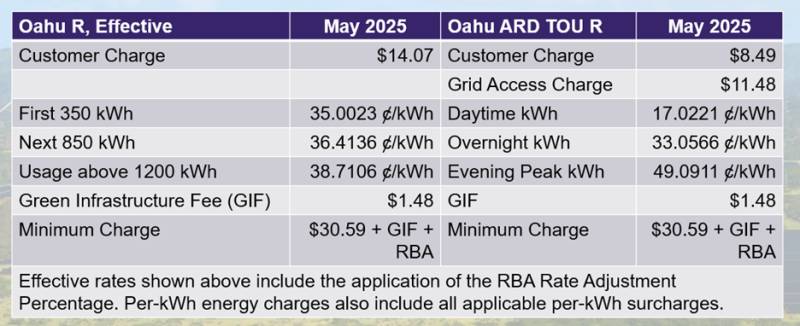
The time is ripe to deploy TVRs, especially now that a scientifically-designed pilot has been completed. The TVR is shown below.
The pilot provided some evidence of customer response, but not as much as we have seen in warmer or colder climates. That was to be expected since Hawaii has a tropical climate, and the penetration of central air conditioning systems is low. However, the penetration of electric water heating is quite high. If customers had been educated and incentivised to set the timers on those water heaters, higher load response would have occurred. But, as I learned, most of the existing water heaters don't have timers on them and virtually no one is going to manually turn them on and off.
Even if TVRs don't promote load shifting, by reducing peak load and shifting it to off-peak periods, they promote equity
Much to my surprise, just a few minutes before the conference was going to start, the news broke that the state regulator had decided to end the advanced rate design docket through which the pilot was implemented. I learned this in the hallway while talking to the former chair of the regulatory commission.
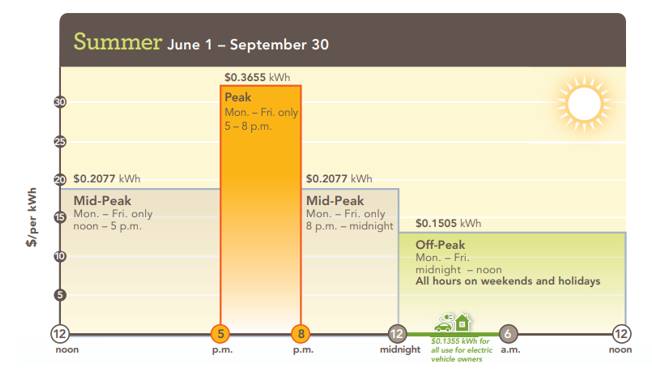
In the Deep Dive session, one of my co-presenters was a former commissioner at the regulatory regulator who had earlier worked as a pricing expert at the municipal utility that serves California’s state capital. There, she helped design and execute one of the best TVR pilots not just in the US but in the world and laid the foundations for a very successful deployment of TVRs that has become the envy of the world. The rate is shown below.
The other speaker was from the Hawaiian electric utility. He was very knowledgeable about the utility’s TVR pilot.
During the question-and-answer session that followed our presentations, it was clear that some people were very opposed to the very concept of TVRs. They were adamant that TVRs should not be implemented in Hawaii. At some point, a serving regulatory commissioner stood up and presented the highlights of the commission’s order.
The dialogue in the session was intense. We polled the audience at the end. A third did not vote (almost the same percentage as in the November presidential elections). Of the remainder, half were opposed to TVRs, and half were supportive. It was the perfect stalemate!
Later, I huddled together with my co-panelists. The next morning, we presented the findings at the opening plenary session. I was blunt. I expressed my disappointment with the regulatory commission’s order and said it reflected a misunderstanding of the rationale for TVRs.
Existing electric rates that do not vary with time-of-day are not fair to customers. This is an inconvenient truth that no one speaks about. Customers who use less energy during the peak hours pay more than they should be paying. They subsidise customers who use more energy during the peak hours.
Even if TVRs don't promote load shifting, by reducing peak load and shifting it to off-peak periods, they promote equity. If Hawaii offers TVRs, half of the customers would be better off without any load shifting. So would the others who engage in load shifting. Choice should not be withheld from electric customers.
Even in Hawaii, if a customer uses Uber to get from Point A to Point B, they will find that prices vary by time of day. I tested the proposition while driving to and from my hotel to the conference. Additionally, even in Hawaii, movie theaters have matinee shows with lower ticket prices, and restaurants have happy hours, with lower off-peak prices. That is as true in Hawaii, as it is in the rest of the US, and in fact in much of the world.
It is imperative that Hawaii, and all regions of the globe, should price electricity to reflect the time-varying cost of electricity. Both the utility and the customer would be better off.