

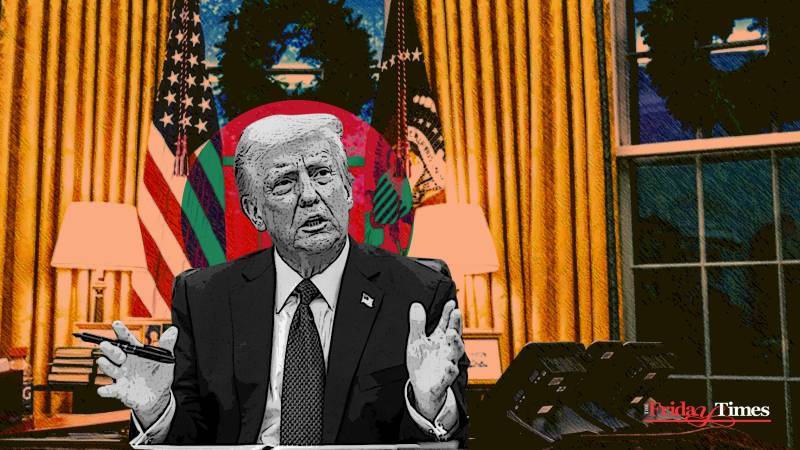
Donald Trump’s re-election shows that right wing populism is here to stay for the foreseeable future. This populism is based on the resentment of workers who have been disenfranchised in advanced economies by hyper-globalisation. Whilst the technocratic elite have extolled the benefits of free trade, they have not adequately pushed for compensation for the losers of globalisation. Thus, perceived grievances are behind the rise of Trumpism, the brunt of which will be borne by countries threatened by a 25 percent tariff, as evident from the recent case of Colombia.
Whilst some call for retaliatory tariffs, others argue against retaliation. The latter view is consistent with the mainstream economics lesson drilled at the ECON 101 level that free trade makes every nation better off, and tariffs cause deadweight loss (inefficiency). The idea is that retaliatory tariffs would harm consumers by making imports from the U.S. expensive.
However, I broach the issue through pluralist perspectives to emphasise that issues of ecological constraints, worker rights, and power are often absent in textbook economics. Based on such heterodox perspectives, my argument is that the response to power is countervailing power. Thus, labour unions form countervailing power against corporations to get better wages and work conditions in an otherwise asymmetrical power relation. Similarly, retaliatory tariffs constitute countervailing power against Trump’s tariffs, as was the case with the tariffs imposed under the first Trump regime.
The Limitations of Textbook Economics
Textbook economics assumes equal bargaining power between workers and employers, or between two countries in trade. It ignores the asymmetrical power relation between large corporations and the workers situated in the gig economy with insecure contract work, high unemployment, and outsourcing. In this context, corporations derive monopsony power in the labour market, as workers face the costs of searching, upgrading, or transitioning from one sector to another.
Maybe Trump’s bullying would allow us to recognise the lesson from a 2003 rom-com that “bullies only respond to strength”, which means we should be prepared to be much stronger
Similarly, the asymmetrical power relation between the two countries is ignored in the standard economic model from the early 19th century. This model by David Ricardo assumes that labour can move from one sector to another without incurring costs, capital cannot move across countries, and that markets are perfectly competitive.
However, such assumptions do not hold in the 21st century. First, trade does not involve perfect competition but instead multinational companies (MNCs) with market power. For instance, two corporations hold 90 percent of the market share in processing Canadian beef, i.e. the Brazilian JBS and the American Cargill. Second, workers cannot easily transition from one sector to another. This is especially so, as they lose skills, self-esteem, and purpose and develop mental health problems due to unemployment. Finally, capital easily moves across international borders through offshoring and outsourcing.
Thus, some argue that free trade theory is inconsistent with reality whereas others argue that the standard argument for trade liberalisation does not apply to powerful countries like China under President Xi Jinping. The same applies to the U.S. under President Donald Trump.
When Tariffs are Justified
The new trade theory advanced by Nobel Laureate Paul Krugman explains that a large proportion of trade happens between advanced economies that trade similar but differentiated goods. It allows tariff policy for industrial development.
Similarly, distinguished economist, Ha-Joon Chang has argued that advanced economies used tariffs and only promoted free trade once they had developed technological leadership.
The case for taxes or tariffs is also justified by market failure, which results when free trade leads to ecological damage and inequitable distribution of income. This happens as emissions accumulate with back-and-forth transportation of goods and as communities get disrupted when people lose jobs.
Tariffs are also justified in a model of a small open economy with a foreign monopoly. Overall, tariffs can be justified for various reasons that include addressing ecological damage, economic inequality, and the power of a foreign monopoly.
The Response to Power is Countervailing Power
To recapitulate, the textbook lesson is to view tariffs as harmful. However, I would argue that the response to Trump’s tariffs should not be dictated by the simplistic viewpoint of rejecting tariffs unilaterally and unconditionally. Maybe ecological concerns would allow us to think outside the box, slow down, and reject “unequal exchange in international trade”. Maybe Trump’s bullying would allow us to recognise the lesson from a 2003 rom-com that “bullies only respond to strength”, which means we should be prepared to be much stronger. Overall, the response to power is countervailing power not abject compliance.