

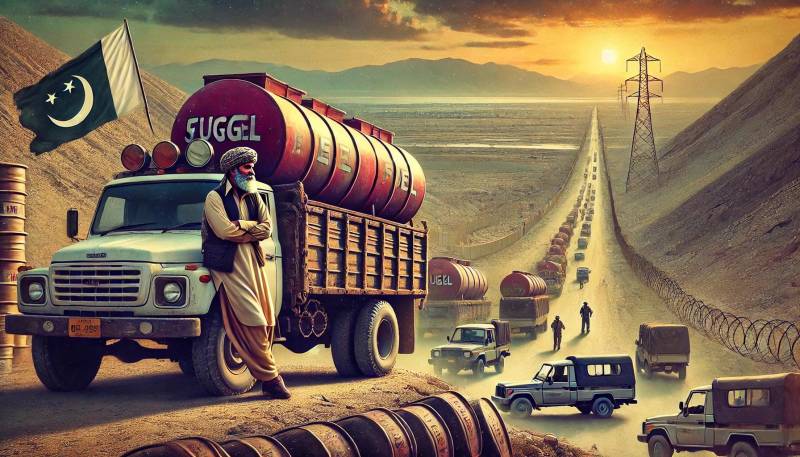
Along the dusty fringes of Balochistan, where Pakistan’s border with Iran stretches 900 kilometers, the illicit fuel trade, diesel and petrol smuggled westward, sustains countless families. But as Pakistan tightens its grip on this shadow economy in 2025, lives like that of truck driver Karim Bakhsh are unraveling.
Balochistan’s border with Iran is a smuggler’s artery. Iran’s subsidised diesel, priced at $0.05 per liter in 2024, contrasts sharply with Pakistan’s $0.95 regulated rate, per Pakistan State Oil. This disparity drives a daily flow of 2 million liters into Balochistan, a trade worth $400 million annually, per Frontier Corps estimates from 2023. It employs 50,000 locals, drivers, vendors, and middlemen, outpacing the province’s legal trade revenue of $150 million, according to Pakistan Customs Service data.
In 2024, Pakistan escalated its anti-smuggling campaign, Operation Border Seal, seizing 1.8 million liters of fuel and 120 vehicles. The crackdown, aimed at curbing $500 million in annual tax losses, cut smuggled fuel inflows by 30%, per the Interior Ministry. Iran, meanwhile, raised domestic fuel prices to $0.20 per liter in January 2025 to stem its own losses, shrinking supply. The result: a trade once vital to Balochistan’s 14.9 million people, per the 2023 census, is fraying.
In Panjgur, 38-year-old Karim Bakhsh idles beside his Toyota pickup, its bed empty. “I’d haul 500 liters a trip, make $50 a day,” he says, wiping sweat from his brow. “Now, with patrols everywhere, it’s $20 if I run at all.” His monthly trips dropped from 20 to 10 since 2024, leaving his wife, Amina, to bake bread for extra rupees. Their son Ismail, 16, quit school to sell petrol cans, a grim echo of Karim’s own youth. “I wanted better for him,” he mutters.
Nearby, 45-year-old Bibi Jan stirs tea at her roadside stall, her clientele thinning. “Fewer trucks mean fewer cups sold,” she says. Her daily earnings slid from $8 to $3 as smugglers vanish. “This isn’t crime, it’s how we eat,” she insists, her hands trembling from fatigue. For her and Karim, the border isn’t a policy debate, it’s the thread holding their lives together.
Authorities wrestle with the trade’s paradox. “It’s illegal, but it’s a lifeline,” Col. Asif Mehmood of the Frontier Corps concedes in a March 2025 Quetta interview. “We’re ordered to stop it, yet we see the hunger.” Chief Minister Sarfraz Bugti, speaking March 12, urged Islamabad for balance: “Close the border, but open jobs. Our people can’t live on promises.” The federal push, he added, aims to boost tax revenue, but Balochistan’s 3% GDP share per World Bank 2024, shows little trickle-down.
Iran’s Quetta consul, Hassan Darvish, deflected blame in February 2025: “Pakistan asks for fuel, then chokes our traders. We’re tightening our side too.” The cross-border tension underscores a shared squeeze.
Economist Dr. Salman Shah, based in Lahore, sees a domino effect. “The crackdown costs smugglers 40% of their income, $160 million across Balochistan,” he says via phone. “Fuel prices could jump 20% by mid-2025, hitting the 70% of rural poor hardest,” he adds, citing Pakistan Economic Survey data. Security analyst Ayesha Siddiqa warns of fallout: “Smuggling curbs push heroin instead—up 25% since 2023, per UNODC. Panjgur’s next crisis isn’t fuel; it’s drugs.”
Environmentalist Dr. Tariq Banuri highlights a hidden cost: “Cheap diesel runs 60% of Balochistan’s generators. Less of it means more trees fall, forests dropped 18% since 2015, per WWF.” The trade’s decline ripples beyond wallets to the land itself.
As Pakistan doubles down on sealing its border, Balochistan’s fuel trade, a gritty, unsanctioned backbone—crumbles. Karim Bakhsh dreams of steady work, but CPEC’s 12,000 Gwadar jobs by 2024 favor outsiders. Bibi Jan clings to her stall, praying for trucks to roll again. “The border’s our breath,” she says, staring into Iran’s haze. In this corner of Pakistan, the fight for fuel is a fight for existence, a tale the Singapore fellowship will unravel, one border at a time.