

This is the concluding part of a recent discussion with economist Fahd Rehman, who has authored Pakistan's Structural Economic Problems in the Era of Financial Globalization. Click here for the previous part.
Ahmad Faruqui: Many people are excited about recent trends in Pakistan’s stock market. Why?
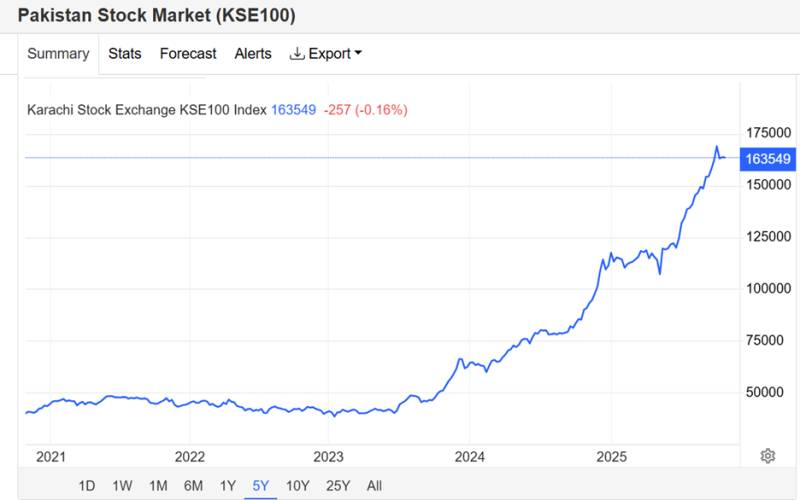
Fahd Rehman: The Pakistan Stock Exchange (PSX) has been going up steadily over the last couple of years. In the last 52 weeks, PSX has almost doubled in value. Stocks are valued highly by investors, who are confident in the earnings being forecast by the companies listed on the stock exchange.
Unfortunately, the stock exchange boom has promoted a boom in luxury consumption. The investors are buying SUVs and other expensive imported items. Even small investors have joined this bandwagon. Those investors who bought shares before this Bull Run can sell them and get decent returns. These small investors, feeling rich, have raised their spending on all kinds of goods and services. Unfortunately, such Bull Runs support import-led consumption, which does not augur well for the economy. What the economy needs is investment in industries that export their products and services.
AF: During our call, you stated that Pakistan suffers from disguised unemployment. Can you elaborate?
FR: The term disguised unemployment was coined by the British economist Joan Robinson. It simply means that workers who have lost employment are forced to take up low productivity jobs to eke out their existence. In the context of Pakistan, garment workers hail from villages. These workers are temporarily hired by the factory owners and managers in the event of pent-up demand. As the demand falters, these workers are thrown out of work. Then they toil on the farmland to earn their livelihood and become peasants. They are called peasant-workers and are out of high productivity jobs and bound to work in a low productivity environment.
"Although the potential of coal, copper and gold is there, yet the progress in extracting them has been slow. Considering the current pace, I would expect the likely impact on the economy would take place around 2040"
In a stagnant economy like Pakistan, there is hardly any system of providing unemployment benefits. If a person loses his job, he or she will only survive by working in an inferior occupation so that essential expenses can be covered. The person may take on two jobs to make ends meet. Therefore, the informal sector acts as a refuge for these workers.
AF: Some experts have argued that Pakistan, like many countries in the Global South, is a victim of “elite capture.” Do you agree?
FR: We need to delve into the economic and political history of Pakistan to understand and answer this significant question. The country experienced a high GDP growth rate during the 1960s, which was touted as a great story world-wide. However, the model of development quickly exploded owing to political unrest. In 1968, a study documented that the 22 families controlled a large chunk of industry, banking and insurance in Pakistan. In 1998, Shahid-ur-Rahman in his intriguing book, Who Owns Pakistan, listed 45 groups with manufacturing assets greater than Rs. 1 billion. Those groups were dominating the industrial and financial sphere at that time. He discussed the politics of patronage in Pakistan that gave them preferential access to banks and the anomalies of the tax system which allowed these groups to gain power.
In 2016, Marc-André Franche, who had served as the United Nations Development Program (UNDP) director for Pakistan since 2013, noted that Pakistan would only realize its full economic potential if the politicians and the wealthy sacrificed their personal and family interests for the long-term benefit of the people.
In 2020, UNDP stated in its report that eight groups dominated the state apparatus in Pakistan. The report quantified that these groups cumulatively appropriated Rs. 2,660 billion- equivalent to 8 % of GDP in FY 2018. These groups appropriated local resources through preferential access, lower taxation and high favourable prices.
Elite capture is a rhetorical and broad concept. In my opinion, a better term is “special interest groups.” The number and size of these groups have increased over the years. A few attempts have been made to quantify the privileges enjoyed by these groups. However, a few questions are still unanswered and are the ongoing subject of research in Pakistan: How do these special interest groups operate? What are the consequences for the people of Pakistan?
AF: There’s a lot of excitement about the role critical minerals can play in transforming Pakistan’s economic fortunes. How big are these deposits? Can they really turn around the nation’s fortunes?
FR: Pakistan is blessed with enormous quantities of mineral wealth. Media commentators, journalists and analysts have been writing on critical minerals and their potential benefits for years. Domestic coal reserves are estimated at around 175 billion tons. These reserves were discovered in 1991 by the Geological Survey of Pakistan (GSP). Coal reserves and gasification of coal occupied the electronic and print pages from 2007 to 2022. The potential of local coal, its extraction and deployment in the power plants, has been discussed at length. However, the power plants are still using imported coal. Now the railway track is being laid down to connect Thar coal reserves to existing railway tracks so that local coal could substitute the imported one.
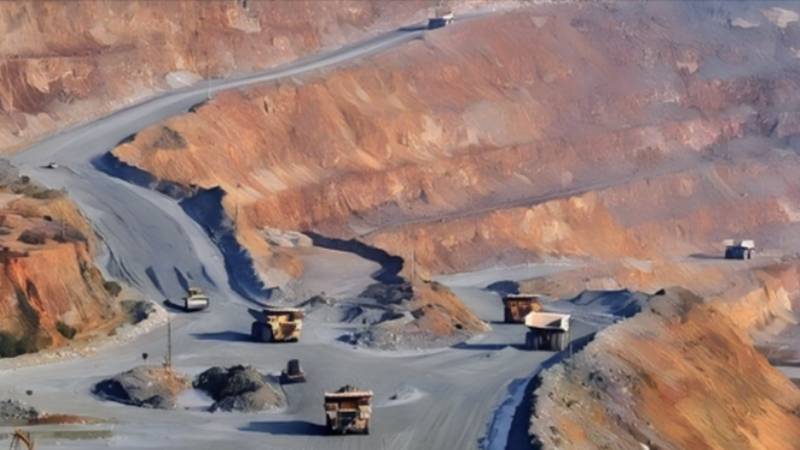
In addition, deposits of copper and gold were discovered at Reko Diq in Balochistan by GSP in 1979. These reserves contain possibly 18 million tons of copper metal and 35 million ounces of gold. They have been in the spotlight since 2022. It is expected that Barrick Mining Corporation would be able to extract these deposits by 2029. Although the potential of coal, copper and gold is there, yet the progress in extracting them has been slow. It is well known that extraction requires long lead times. Considering the current pace, I would expect the likely impact on the economy would take place around 2040.
Coal, copper and gold are highly capital intensive, where billions of dollars are required in the construction, equipment, processing, technology and infrastructure required for extraction. A sustained rise in prices of these metals would justify new investments in these deposits. That is the reason they have not been extracted for a long time. However, these projects are very capital-intensive and they are unlikely to create the millions of jobs the economy needs.