

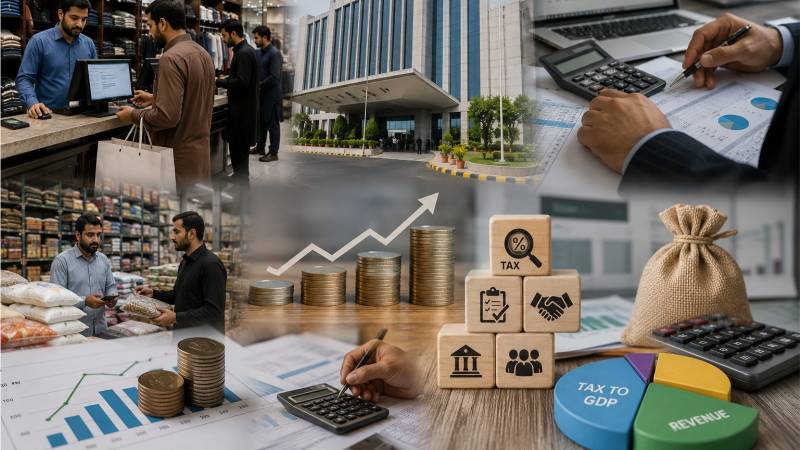
A grocery shop owner in Karachi recently heard that filing income tax returns may no longer be necessary for him. Instead, he could pay one percent of his turnover and be done with it. It sounded almost too easy. But is it actually cheaper? And who does it really benefit? The scheme in question is the Federal Board of Revenue's new fixed-tax option for small retailers, first announced as part of the 2026–27 budget. The draft rules were subsequently issued through SRO 1109(I)/2026.
Under the draft, retailers with an annual turnover of up to Rs200 million can choose to pay a flat one percent tax on their total sales, with a minimum annual payment of Rs25,000, instead of filing detailed returns and being subject to routine tax audits. Participants file a simplified one-page tax return instead of the regular filing process. Those who file under the scheme receive a QR-coded Green Plate for display at their premises, tax officers are barred from entering the premises for tax-related matters, and they are exempt from installing mandatory point-of-sale systems and adopting digital invoicing. The scheme is optional. Nobody is forced into it, and a retailer can still choose to file under the regular system if that works out better for them.
It is also not available to everyone: retailers whose turnover exceeded Rs200 million in any of the past three years, owners of more than one shop, Tier-1 retailers, jewellers, and professionals such as doctors, engineers and lawyers are all excluded. On paper, the government's logic is straightforward. Make compliance simpler and encourage voluntary registration — and in the process, widen the tax net. Pakistan's tax-to-GDP ratio remains among the lowest in the region, hovering close to ten percent, while the IMF has pushed for it to climb toward thirteen.
A large proportion of Pakistan's retailers continue to operate outside the formal tax net. Previous attempts to bring them in, including the widely publicised Tajir Dost scheme, collected far less revenue than expected. This time, officials are betting that a simpler, more predictable option will succeed where enforcement-heavy approaches failed. The more important question, however, is whether this option actually makes financial sense for every retailer. The answer depends on one distinction that many shopkeepers may overlook.
Turnover is not profit. That distinction matters more than it sounds. A one percent tax on sales is not the same as a one percent tax on income.
For a business with healthy margins, paying one percent of turnover can work out to a fraction of what it would otherwise owe on profit. For a business running on thin margins, the same one percent can eat into earnings far more aggressively, sometimes exceeding what the retailer would have paid under normal income tax rules. The rate looks identical on paper. What it actually costs depends entirely on what sits behind the sales figure.
Consider two shopkeepers, both with an annual turnover of Rs100 million. One runs an electronics store with an 18 percent profit margin. For him, one percent of turnover amounts to a small slice of his actual income, and the scheme's audit exemption and simplicity make it genuinely attractive. The other runs a grocery store operating on a three percent margin, common in a business where volume is high and markups are thin. For her, one percent of turnover can consume a third of her actual profit. What looks like a modest tax rate becomes, in practice, a heavy one.
For some retailers, the scheme genuinely simplifies life. Strong margins and straightforward operations make it a natural fit, especially for those with little appetite for bookkeeping. It removes the anxiety of audits and the burden of maintaining detailed records purely for tax purposes, and for many small business owners, that peace of mind alone is worth something.
Others should be more cautious. Retailers with low margins, particularly those in high-volume, low-markup sectors, may end up paying more than they would under regular filing. Businesses that already have tax deducted at source exceeding what they'd owe, or that benefit from input tax adjustments under the sales tax regime, could also lose money by switching. Retailers who already filed returns for tax year 2025 face a further condition: they can only join this scheme if their new payable tax is not lower than what they paid last year, which limits its usefulness for anyone hoping to reduce an existing liability. A retailer with strong existing bookkeeping practices, who already knows their real profit numbers, is often better positioned to calculate the comparison properly rather than guess.
The comparison to Tajir Dost is instructive, and not just as history. That earlier scheme collapsed partly because it tied taxation to shop size and location, criteria that traders viewed as arbitrary and unfair. The new scheme drops that approach entirely, basing everything on turnover instead. Whether that alone is enough to succeed remains to be seen. What the earlier failure does confirm is a simple pattern: tax reforms in Pakistan tend to succeed only when businesses actually experience them as simple and fair — not just when the government insists they are.
A few practical questions tend to come up once retailers start weighing the decision. Can they leave the scheme later? Yes, participation is renewed annually, so a retailer can return to normal filing in a future tax year. What happens if turnover crosses Rs200 million mid-year? The eligibility is generally assessed on a yearly basis, so exceeding the threshold would move a business out of the scheme going forward. Should records still be kept even under the fixed scheme? It's worth doing regardless, since banks, suppliers, and other institutions often still ask for tax filings or financial statements independent of which scheme a retailer has chosen.
There is no universal answer. The right choice depends on profit margins, bookkeeping practices, and the economics of the business — a headline tax rate alone won't tell you. For many shopkeepers, the real question isn't whether one percent sounds small. It's whether paying one percent of sales today will actually cost less than staying in the regular tax system tomorrow. That's a calculation worth doing, not an assumption worth making.