

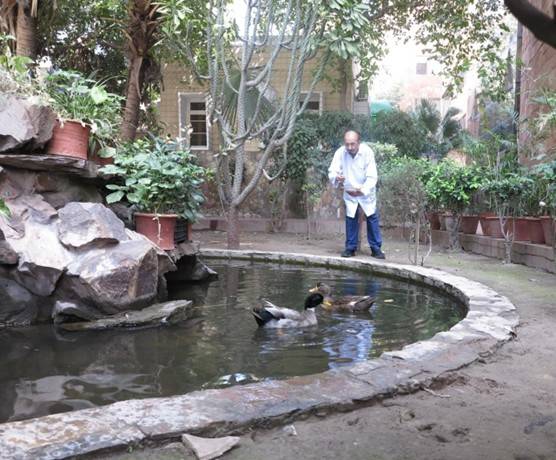
A friend of mine brought a pair of mallard ducks for my hospital pond. These ducks are unique and encompass nature’s unique secrets.
The ducks had travelled all the way from Siberia between their wintering quarters in Siberia (north) and breeding grounds of Chashma wetlands in Pakistan (south). They had covered a 4,500 km perilous journey over Afghanistan by using the Indus Flyway Zone over the Karakoram and Sulaiman mountain ranges to Chashma Lake in Pakistan. They arrive around September/October and leave in February/March.
Pakistan has unparalleled, wondrous landscape beauty, natural resources, and waterways, lagoons which attract hundreds of thousands of migratory birds each year.
Common species of migratory birds in Pakistan include mallard ducks, geese, flamingos, swans, falcons, and waders.
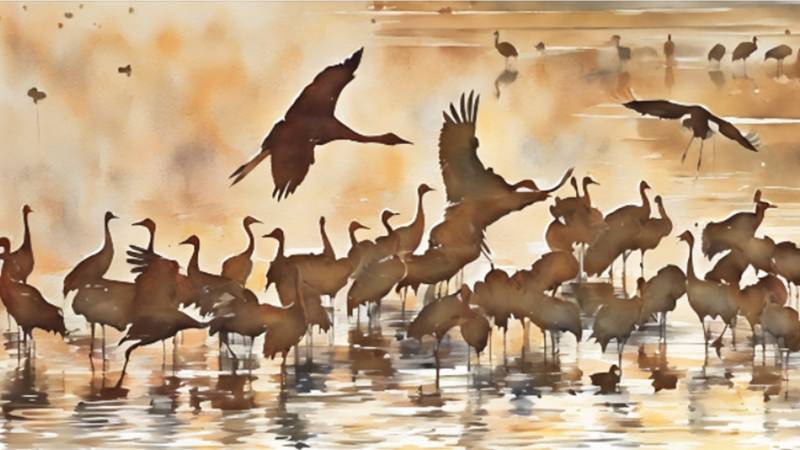
The flight of these migratory birds in the sky is both graceful and mesmerising. I am encouraged multiple times to reflect on the flight of migratory birds and God’s natural world.
Scientific knowledge behind migration
The knowledge of birds’ migration is still shrouded in mystery. Their migration, firstly, in large groups is a deterrence from predators. Secondly, this includes mental maps, olfactory cues, landmarks, gravity, and visual cues.
Inborn and astronomical cues—i.e., the sun, stars, and magnetic compass—have been suggested as well (the magnetic sense was ridiculed earlier by the scientific community). A recent idea is that migratory birds build a map in their brains, where the map develops as birds grow older.
Multiple verses of the Holy Quran highlight the controlled movements of birds, their commitment to a purpose, the community of birds, and their exploratory navigation. Scientists and engineers are in awe at their marvels—i.e., cognitive decision-making, bird flocking, energy efficiency, planning, scheduling, and many others.
When migrating in large groups, the collective behavior and united movement of migratory birds result from simple rules of interaction among individual birds
One of the well-known verses from the Quran states:
“Do they not see the birds held under subjection in the vault of heaven? None keeps them back save Allah. Verily in that are signs for a people who believe.” (16:80)
In another place, the Quran states:
“There is not an animal that crawls in the earth, nor a bird that flies on its two wings, but they are communities like you. We have left out nothing in the Book. Then to their Lord shall they be gathered together.” (6:39)
And yet another place, the Quran states:
“Have they not seen the birds above them, spreading out their wings without moving them and then drawing them in to swoop down upon the prey? None withholds them but the Gracious God—verily He sees all things.” (67:20)
Before the idea of the magnetic compass in birds was accepted, the sun was used as the directional cue.
There are two ways one can use a compass: by referring to its polarity (ie reference to the North Pole and South Pole) or by using the angle of dip or inclination. Birds use magnetic polarity.
Navigation puzzle
Scientists have yet to solve the puzzle of how these birds navigate. It is an unsolved mystery more than a century old.
The sophistication of birds’ navigation is much more intriguing than many of us imagine. Many times, watching a flock of birds flying fluidly and gracefully, in unison together, is an awe-inspiring spectacle.
Subjugation and subservience have been mentioned numerous times in the Quran, just like the subjugation of celestial bodies and clouds.

It is learned that when migrating in large groups, the collective behavior and united movement of migratory birds result from simple rules of interaction among individual birds. The sense of smell helps them navigate unfamiliar routes; they rely on olfaction—in other words, the sense of smell—to traverse unfamiliar territory.
Scientists have marveled at the navigation of birds driving migration. This is extremely sophisticated and portrays a very high cognitive level. Other scientists have also concluded that the sense of smell plays an important role in birds’ navigation. The ever-evolving study of the flight and navigation of birds suggests that there is much to learn from these avian beauties—and much to contemplate regarding the creation of the Creator of All Things in the Universe.
Computer scientists and engineers, by studying how birds navigate together in a flock, formulate nature-inspired metaheuristic algorithms to solve optimisation problems. These techniques are used mainly to address various optimisation challenges, such as energy-efficient design, heat management for electronics, and planning and scheduling.
Migration of Prophets
The Quran speaks of the migration of many prophets prior to Islam, such as Adam, Abraham, Lot, Jonah, Jacob, Moses, and Jesus (may peace be upon them). Migration can take place for many reasons: religious or political persecution, economic necessity, or simply for relocation.
The Quran states:
“Was not Allah’s earth vast enough for you to emigrate therein?” (4:18)
The Quran further states:
“And whoever emigrates from his country in the cause of Allah will find on earth an abundant place of refuge and plentifulness.” (4:101)
This is the phenomenon of migration.
History bears testimony to this—from the unrelenting barbarism of the Egyptian Pharaohs upon the people of Moses (AS) and the brutal cruelties meted out to Jesus (AS) by the Romans and Jews, to the untold malicious mutilation and mauling inflicted upon the followers of the Holy Prophet Muhammad (PBUH). The footprints of time tell a tale of turmoil, endured with miraculous patience and grace by the followers in every era.
The largest and most important migration in the history of the world is the migration of the Holy Prophet (PBUH) from the city of Mecca to the city of Medina. This revolutionised the establishment of peaceful societies based on mutual coexistence.
Historically, stories about refugees who migrated have made the world a better place to live in. Einstein migrated to the US after fleeing Nazi Germany for fear of incarceration. Steve Jobs had a gripping family history, as his father was a Syrian immigrant. And not to forget Dr Abdus Salam, the Nobel Laureate, who had to emigrate from his homeland when he faced academic marginalisation and religious persecution. All these stories highlight the positive impacts of immigration. These spiritual individuals demonstrate to the world positive energy, optimisation, and a beacon of hope.
Blood transfusion or ‘migration’ of blood
A unique and promising way in which “migration” helps save lives is through blood transfusion, or the “migration of blood”—an incredible means of supporting patients and preserving life.
“Migrated” or transfused blood supports many people undergoing cancer surgery. Blood plasma transfusion is lifesaving in cases of immune deficiency and autoimmune disorders. Blood transfusions are lifesaving for those with sickle cell anemia. Blood helps babies in the womb and shortly after birth. It enables people to survive severe infections, organ failure, and organ transplants. Most commonly, blood rescues trauma patients and those suffering from severe bleeding.
Thus, migration is truly a great blessing—be it the birds in this awe-inspiring world, the Prophets of God from times immemorial, spiritual individuals, or the saving of lives through the “migration” or transfusion of blood.
Allah be praised!