

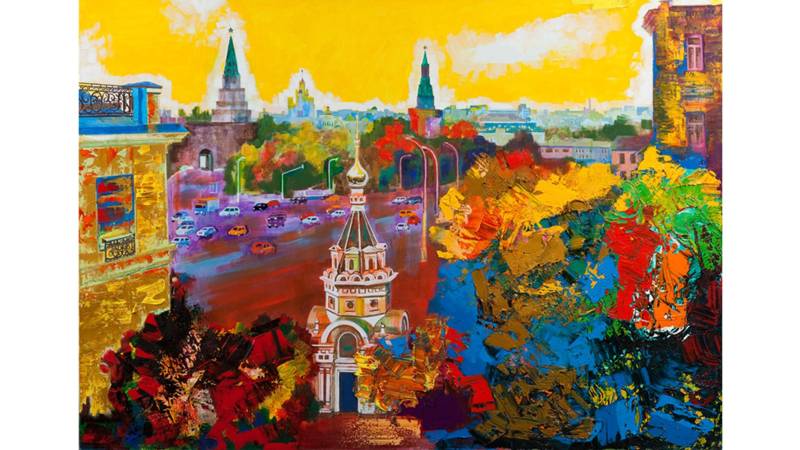
Returning to Moscow after 30 years, I wasn't quite sure if I would remember or feel anything. As we landed at Domodedovo airport, I was all smiles. Aside from the 2½-hour wait for my passport for no reason, and after a few phone calls from the embassy, my spirits remained high. The long drive into town wasn't familiar, but the forests were. The modern urban neighbourhoods were not familiar either, but the architecture was. I already knew Russia had moved forward a generation, or two, or three, since I was here laSt But what would that mean? I was looking forward to finding out.
The last time I was here, McDonalds just had opened there were lines going around a neighbourhood.
Mikhail Gorbachev had 'opened up' Russia, which entailed the good the bad and the ugly, along with the freedoms the human spirit craves. Before and during Perestroika (restructuring) and Glasnost (openness) pain and strife would and were evident in Moscow. That period we witnessed. My father was in the crowds along with all of Moscow when Yeltsin declared a new regime change (and released a besieged Gorbachev from his dacha). The Federation of Russia was born (1991), releasing 15 republics into independence.
Would I find bread? Cafes? Restaurants? All these had been practically absent, or of a quality few could enjoy.
As I was thinking about the past, my eyes saw the cars quietly whizzing by, all modern and regular ones like anywhere else in the world, large billboards advertising a whole lot of everything – indicating Moscow was prospering. Young mothers walking strollers in neighbourhood parks brought a smile. They still had parks and green spaces everywhere. This I remember.
We in Pakistan have much to learn from Russia—and much to share, given our historic-cultural symbiosis, evident in everything from food to architecture. The Soviet experience, frankly, refined and stripped away dead weight, unleashing a potential that frightens the world.
The 'Soviet' architecture was all about functionality, the designs were geometric patterns made from coloured tiles. I remember them grey and boring and depressive. Looking at them today, they looked very distinctive, the exposed concrete and tiles decorating tall and wide buildings triggered nostalgia but also looked lovely.
Memory plays very interesting games on one's emotions.
I have seen this style of architecture in so many Eastern European and Soviet-influenced polities, the connectivity of shared histories is a memory and an acknowledgement of complex pasts. Beautiful art nouveau contrasting the austere Stalinist buildings, displaying the many phases of this city's history are more than the sum of its individual parts.
What has always blown me away is the very grand distinctive orthodox Russian architecture, the gold domes with intricate works on the towers, pillars and walls. The most famous being the St Basil's cathedral in Red Square; but there are so many more such breathtaking buildings in this magical city.
Moscow has a feeling which is difficult to explain; it is not a European city per se and it is not an eastern city, it is Russian.
"Moscow" is on the Moskva River, a Balto-Slavic word, which means wet or marshy. If the Russians aren't European, who are they? Their ancestors (of modern Russians, Ukrainians, and Belarusians), migrated from central Europe to Moscow, Novgorod, and Rostov, around the 6th-7th centuries CE. By the 9th century, the East Slavs had established the state of Kievan Rus, which played a significant role in the development of Russia, Ukraine, and Belarus. The roots may have been from central Europe but the lived experiences over 2,000 years with Mongols, Chinese, Turks and many Central Asian communities, they have developed a unique self-identity which is distinctive and yet mirror the mosaic they are.
Last when I was here, 30 years ago, Russia was transitioning again, from the Soviet Union to Russia.
Today, Russia is in the middle of a conflict with Ukraine. Would I feel it?
I was curious what were the essential self that had remained and what had been shed off.
As we turned into Sadovaya-Povarskaya Street, which was the ancient neighbourhood of the bread makers, into 21 Khlebny lane, I chuckled.
As I walked up the stairs of the Pakistani residence, nostalgia hit me. It was not the home I had lived in, but it was so similar to the residence on Sadova Kudrinskaya.
Zahra Jamali, our envoy's very talented partner, has compiled a history of our current residence in Moscow. This neighbourhood was once the abode of bakers and cooks of the Russian royals up till the 18th century. After the capital moved to St Petersburg, under Peter the Great, this neighbourhood declined, until the merchants moved in and gentrified the homes in the new upcoming modern style.
Mikhail Tarsov was one such merchant. The grand walk-up entrance with very high ceilings, with walnut wood panelling everywhere. All the ceilings in the house are beautifully and intricately painted in soft pastels, depicting various Greek and Roman mythological figures and stories; beautiful Greco bearded figures adorn the walls, stucco and friezes run beneath the cornices. The entrance ceiling is gorgeous with Hermes recusing Dionysus with armed legionaries. Every room and wall in the residence exudes a home which has seen history.
I love stained glass, and some of the doors have stunning panels.
Ignaty Nivinsky, who created the central fresco in this home, also designed Lenin's Mausoleum! He was deeply influenced by Florence and his works reflect this in his works in Moscow.
Zara has filled these Russian rooms with beautiful Pakistani art and books in every room and corner. This blending of both Pakistani and Russian is a wonderful display of friendship and promotion of the two countries.
Our residence in the 1990s was on Sadova Kudrinskaya, owned by a Prince with very similar designs. The Russians then and now, care about heritage buildings and have declared them as protected treasures. Our home in the 1990s overlooked the Anton Chekov residence. Today, the Pakistani residence is also very close to another Anton Chekov Museum. Perhaps a subliminal message?
Building codes in Russia are strict and stringent all new constructions cannot impede, block, harm heritage buildings. I saw an amazing sight where massive stilts were constructed to raise a new shiny commercial building so that it would not block the view of an old building overlooking the Moscow river. Aside from the architectural wonderment, the thought and mindset just amazed me. There are several fibre glass bridges so that people can enjoy the views unimpeded and also enable pedestrians. The new accommodating the old. Blending modern urban needs with conservation and preservation.
Public transport in Moscow remains a wonderment, always amazing, aside from gorgeous underground, metro systems, it has expanded so dramatically. There are three metro stations in some places for a location! The inter connectivity for Moscovites is incredible. Today I could get to Ismailova on a metro in 15 minutes, when it used to take us 30-45 minutes by car when we lived here.
I was so happy to see Ismailova, the weekend open market, still in full bloom, though I must admit it has become so built up now that the open-air feel has completely vanished. The handmade, unique home-based products have largely been replaced by mass-produced tourist goods. The art, once hidden from the authorities—treasures passed down through families—has given way to generic commercial offerings. Still, a few Soviet-era mementos remain, evoking nostalgia and preserving a sense of uniqueness.
The underground metros remain an eighth wonder of human creativity. Each station, built in 1935, reflects the utopian ideals of its time—farmers, factory workers from across the Soviet republics, athletes, scientists, and the marvels of industry all gloriously depicted from floor to ceiling. A wise observer once called these metro stations “the underground palaces of the people.”
Right across from the Pakistani residence stands St Nicholas Church and Anton Chekhov’s home (now a museum). Stepping inside felt like walking into a dream. In the mornings, the rhythmic tolling of church bells stirs the senses. As I entered, the deep, resonant chants of the priests filled the air. Russian Orthodox churches have no benches or seating—prayer is conducted standing. From floor to ceiling, golden icons gleam, depicting saints, martyrs, the Virgin Mary, and Christ in mesmerising detail.
Khleb Nasushchnyy bakery, the Museum of Bread in the Zamoskvorechye district, celebrates the history of Russian bread. I was overjoyed by the triumphant return of Russia’s incredible black bread—I absolutely love it. Every corner boasts exquisite patisseries, chocolate shops, and cafés.
When I last visited, food was… a challenge. As a foodie, I remember bread (khleb) being rock-hard and often unavailable. Today, Moscow boasts 69 Michelin restaurants. Though Western sanctions (their loss) have stripped them of their Michelin status, these eateries remain a testament to how far gastronomy has advanced in thirty years. I recall once having a Georgian red wine and a meal in a humble dive—a mere glimpse of its potential. Now, in 2025, Georgian restaurants and cafés dot every neighborhood, and Russia has cultivated a thriving wine industry of its own. I was fortunate to sample extraordinary cuisine at Dr Zhivago, Beluga, and Pushkin. Yes, Russian food—amazing and yummy. Game, fish, beef—beef stroganoff in velvety mash, marinated in an unusual yet wonderful sauce, with melt-in-your-mouth strips of meat. Caviar comes in countless varieties (and price points). I tried it on toast, in dumplings, and as part of a sauce—and developed a newfound appreciation for it.
Near Belorusskaya station stands DEPO, a charming old bus station transformed into a sprawling food hall. Live cooking stations, bars, and restaurants serve every imaginable Russian delicacy. By night, it morphs into a lively music and dance venue where people gather for drinks and bites. Amazing!
Wherever I went, local ingredients astonished me. Russia, the world’s largest country, naturally possesses an incredible variety. Sea buckthorn berries, abundant in our northern regions, are brewed into a delicious warm drink. I was stunned—why haven’t we done this in Pakistan? Mixed with warm orange juice (or other fruit juices) and honey, it’s a fabulous superfood beverage. Kvass, another quintessentially Russian drink, is a fermented grain-based cider-like brew, immensely popular. I discovered so many regional drinks and dishes that expanded my culinary horizons. Do we truly taste local flavours when we travel? Do locals celebrate their uniqueness? The Russians certainly do.
The only hint that Russia was at war came when my GPS faltered while navigating Moscow’s beautiful streets. When I asked why, someone shrugged and said, “Ah, a drone must have been caught—jammers disrupt the signal.” Beyond that, the war has had no visible impact on Muscovites’ quality of life. Yes, international credit cards don’t work, and global brands have rebranded under Russian names to skirt sanctions—but the real losers aren’t the Russians.
As a Pakistani, I see a colossal missed opportunity if we fail to deepen and broaden our ties with Russia in every sphere. We have much to learn from them—and much to share, given our historic cultural symbiosis, evident in everything from food to architecture. The Soviet experience, frankly, refined and stripped away dead weight, unleashing a potential that frightens the world.
As I absorbed the blend of old and new Moscow, I felt a powerful urge to visit the grave of my hero, Mikhail Gorbachev. He lies in Novodevichy Cemetery, a place that speaks volumes about a nation. Upon arrival, we were given a map marking the resting places of luminaries. Since 1898, poets, writers, artists, and politicians have been buried here alongside ordinary citizens. I wanted to pay respects to Gorbachev, who had passed away after we left Russia. He rests beside his beloved wife—a simple grave.
Unlike most others here—many adorned with plaques (likely cremated remains), photos, statues, artificial flowers, coins, and mementos that breathe life into memory—his was understated. Anton Chekhov and Gogol are also buried here. I paused before the photo of a young World War I pilot and countless others lost in the world wars—generations of youthful faces. We forget Russia sacrificed 20 to 30 million souls in those wars alone.
This museum of memories exuded serenity. There was no erasure—Tsarist aristocrats lay beside Soviet communists, artists, writers, scientists, and politicians. The devout rest alongside staunch atheists, united in eternal peace. Today’s Russia has chosen to preserve and honour them all.