

Sindh has, over the years, produced individuals who not only stood firm against tyranny but also courageously resisted every form of injustice and inequality prevailing in society. Mai Jindho, also known across Sindh as Amma Jindho, is one of those prominent figures whose struggle for justice has been cited as an inspiring example in recent times.
Mai Jindho became associated with the horrifying incident of Tando Bahawal, which took place on the intervening night of 5th and 6th June 1992 within the limits of Jamshoro Police Station, District Dadu. On that night, a team of military personnel led by Major Arshad Jameel kidnapped nine villagers and later gunned them down on the bank of the River Indus, falsely claiming that those killed were terrorists.
Two of the nine villagers were sons of Mai Jindho, while one was her son-in-law. The victims were initially portrayed as dacoits; however, the press later exposed the true nature of the incident. As a result, Major Jameel and more than a dozen jawans and civilians involved in the crime were arrested. The personnel of the security forces were tried by a military court, while a separate charge sheet against the civilian accused was submitted before the Anti-Terrorism Court.
As the cases proceeded at a snail’s pace, two daughters of Mai Jindho—Hakimzadi and Zaibun Nisa—committed self-immolation outside the Anti-Terrorism Court on September 11, 1996, which was a public holiday. Major Jameel was awarded the death sentence by the military court, which was carried out on October 28, 1996, and the jawans were sentenced to life imprisonment.
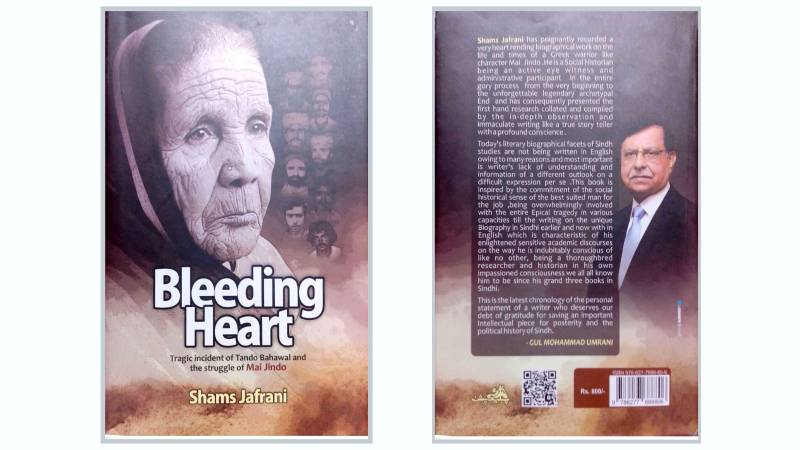
The tale of Mai Jindho’s courage has been discussed on different platforms over the past two decades, but the imprints of her struggle were never compiled in the form of a book until Shams Jaffrani—a former bureaucrat, researcher, and ardent supporter of social justice—came forward. He encapsulated his experiences in the book Bleeding Heart: The Tragic Incident of Tando Bahawal and the Struggle of Mai Jindho. The book covers the aftermath of the incident, which he witnessed as an Assistant Commissioner-cum-Judicial Magistrate, public reaction to the incident, the state version, and the role of the media.
Jaffrani’s book Bleeding Heart specifically contains the response of Pakistani media—especially Sindhi and English media—about the gruesome incident, as well as the apathy of Urdu media, which never gave due importance to the incident, the subsequent trial, the struggle of the legal heirs, and public reaction. On page 11 of the book, the author clearly mentions:
“It is regretted that the shameful incident of Tando Bahawal was not given any importance in the Urdu newspapers, which are called the so-called national press. Only a two-column news item could find space in the Urdu press.”
The book opens with a preface containing the author’s ambition to write a book earlier. He had previously written a Sindhi book on the incident titled Andgar Jini Add (“The Inner Pain of Those Left Behind”), but following a massive public response—and in order to make the story of Mai Jindho known across the world—the author decided to write a detailed book on the saga of this brave lady.
The author, being the Assistant Commissioner of Jamshoro at the time, witnessed post-incident proceedings and recorded statements of the accused. He also helped the kinsmen of the victims receive compensation from the government. He narrates his personal meetings with the iconic lady, her views about the country’s judicial system, and her unshaken courage, which finally made justice possible—something that had seemed a cumbersome task at the beginning.
Bleeding Heart is also a tribute to free and independent journalism that never bowed before power and stood firm with the victims of lawlessness and tyranny without fear. The author has quoted editorials and opinions published by famous English and Sindhi dailies of that time, including Dawn, The News, Kawish, Awami Awaz, Jago, Ibrat, and Hilal-e-Pakistan.
Initially, a press release was issued immediately after the incident claiming that nine dacoits had been shot dead, but government officials of that time, despite all odds, conducted a transparent probe into the matter and declared that the press release was devoid of truth. The inquiry revealed the real facts associated with the incident.
The author of this book, Shams Jaffrani, was born in the village of Ghulam Muhammad Hingorjo, Taluka Jati, District Sujawal. Before this, he had authored his autobiography titled Katiyam Sab Jamar. He completed his early education up to matriculation in Sujawal, pursued higher secondary studies at D. J. Science College, Karachi, and later earned an LL.B. degree from the University of Sindh.
Shams Jaffrani began his professional journey in journalism, working as a reporter for various newspapers and serving as Sub-Editor of the daily Mehran. He later joined the Department of Information as an Information Officer and, for a time, also served as Protocol Officer to the Chief Minister of Sindh. After passing the Sindh Public Service Commission examination, he held several key administrative positions, including Deputy Commissioner of various districts, Chairman of the Malir Development Authority, Secretary of the Sindh Public Service Commission, and Secretary of the Department of Culture and Tourism, among others.