

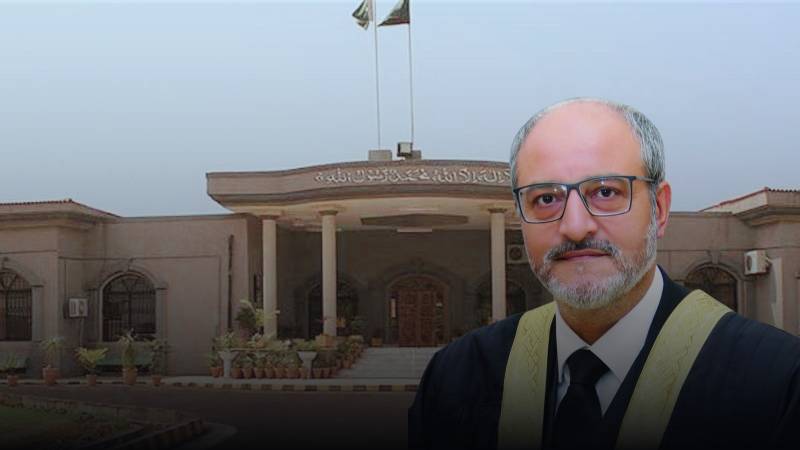
The Islamabad High Court on Thursday suspended its earlier order to form a judicial commission to investigate the “blasphemy business” case. A two-member bench comprising Justice Khadim Hussain M. Shaikh and Justice Azam Khan set aside the July 15 ruling issued by Justice Sardar Ejaz Ishaq Khan, effectively halting the formation of the commission until further notice. The suspension came in response to an appeal challenging the original decision.
The original case, presided over by Justice Sardar Ejaz Ishaq Khan, stemmed from alarming revelations that individuals were being trapped through doctored digital content, coerced into confessions, or falsely accused of blasphemy to extract money or settle personal scores. Justice Khan had condemned the exploitation of religion for profit and warned that the misuse of such sensitive laws posed a serious threat to justice and public safety.
In his now-suspended order, the Islamabad High Court had directed the federal government to form a four-member commission within 30 days—comprising a retired judge, a senior FIA officer, a respected religious scholar, and a cybercrime expert. The commission was to submit a comprehensive report within four months, and all proceedings were to be broadcast live to ensure transparency.
However, the court’s move sparked immediate backlash. Several hardline clerics and religious groups openly rejected the commission, labelling it “un-Islamic” and attempting to stir public sentiment against the judiciary. Through sermons, social media campaigns, and public statements, they urged followers to challenge the court’s authority, portraying the initiative as an attack on Islamic values and warning the government against implementing the decision.
That pressure and legal appeals led to the suspension of Justice Khan’s ruling by a two-member division bench, which halted the commission’s formation pending further proceedings.
حمودالرحمن کمیشن / پاکستان توڑنے سے آج تک کمیشنز کا جواب کِس نے دینا ہے؟؟ pic.twitter.com/ZgQtwx7ICo
— Hafiz Saad Hussain Rizvi (@Saad_RizviTLP) July 22, 2025
Hafiz Saad Rizvi, Emir of Pakistan’s largest religious party, Tehreek-e-Labbaik Pakistan (TLP), can be seen openly criticising the Islamabad High Court’s ruling. In his remarks, he invoked past high-profile cases such as that of Mumtaz Qadri to stir public sentiment and rally opposition against the formation of the judicial commission.
ہائیکورٹ جج کو پیغام۔۔ pic.twitter.com/rNoobh5oPX
— Hafiz Saad Hussain Rizvi (@Saad_RizviTLP) July 21, 2025
There was a growing concerns that some religious factions may attempt to infiltrate protests with violence or intimidate judicial authorities. Security agencies remain on alert.
Maulana Fazlur Rehman has publicly opposed the court’s decision and reportedly threatened Justice Sardar Ejaz Ishaq Khan to withdraw the order, warning of severe consequences if it is not reversed.
As expected, Blasphemy Gang has find a sanctuary in a religious political party.
— Fakhr-e-Alam (@FakhreAlamBooni) July 18, 2025
Shame on @MoulanaOfficial for gambling with the lives of over 400 innocent youth entrapped by the #BlasphemyGang for political gains.@AdvHadiali @fawadchaudhry @ImaanZHazir @Ahmad_Noorani pic.twitter.com/4sbozMhaxI
Not only was the court’s judgment criticised, but the lawyer defending the accused, Imaan Mazari, also faced public backlash. A prominent Islamic scholar and social media personality, Qaiser Ahmed Raja—known for his anti-liberal and anti-feminist views—was among those who harshly criticised her.
Criminal Minded? pic.twitter.com/fxF8OLdVEL
— Qaiser Ahmed Raja (@qaiseraraja) July 17, 2025
While the majority of religious scholars have opposed the court’s decision, a few have spoken out against the misuse of blasphemy allegations and the trend of false accusations.
???? حقیقت کیا ہے...؟
— Voice of the Victims of Blasphemy Business Group (@VictimsofB_Gang) July 18, 2025
کیسے لوگوں کی زندگیوں کے ساتھ کھیلا جارہا ہے #JusticeFor400 #StopBlasphemyBusiness pic.twitter.com/DT9f5GmOx0
With the suspension of the commission order, the future course of the case remains uncertain. The matter will now proceed through further legal review following the division bench's ruling. The case has raised questions about the use of blasphemy laws, judicial authority, and the role of religious influence in legal processes. The next steps will depend on how the courts and government respond to the appeal and whether the commission is revived or formally set aside.