

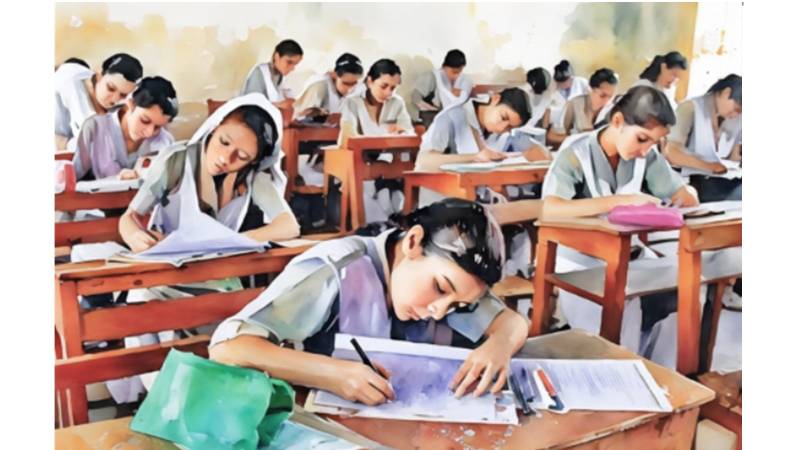
Every year, millions of Pakistani students walk into examination halls with trembling hands, clutching admit cards and borrowed pens, praying for fairness in a system that has long abandoned the very idea of it. The board examination system—whether matriculation or intermediate—stands as one of the most outdated, opaque, and inequitable institutions in the country. It determines the academic fate of an entire generation, yet it is riddled with systemic corruption, incompetence, and the complete absence of regulatory oversight. What should have been a test of intellect and learning has become a test of endurance against chaos, nepotism, and mismanagement.
The problems are not hidden; they are painfully visible in every exam season. Papers are leaked hours before examinations; answer scripts are mishandled or even lost, and grading standards swing wildly between leniency and cruelty. Students who spend months studying are often outperformed by those who can afford to buy leaked papers or influence the marking process. This is not merely an administrative failure—it is a moral crisis. When merit itself is compromised, what future can a country claim to build?
Worse still, the rot runs deeper into the very ethics of evaluation. Students are often failed by unfair means—sometimes deliberately, sometimes through gross negligence. Answer sheets are marked with visible bias, grace marks are awarded selectively, and rechecking—supposedly a safeguard for justice—exists largely as a cruel formality. Under the guise of “rechecking,” countless students return home defeated, carrying not only the trauma of rejection but the weight of a system that never cared to listen. Parents watch their children spiral into despair, not because they lacked ability, but because they were victims of arbitrary grading. In a country where a single mark can decide on admission into a medical or engineering university, such injustice is not just academic—it is psychological warfare.
Adding insult to injury, the entire rechecking and supplementary exam process has become a money-mining operation. The more students are failed or unfairly marked, the more revenue the boards earn through rechecking fees and supplementary exam forms. It is an open secret that the system benefits from its own inefficiency. Each “failed” student is another source of income, each “rechecking” another financial transaction. This perverse incentive ensures that fairness is never profitable, and injustice never punished. In Pakistan, failure has become a business model—and the victims are children.
The system doesn't produce thinkers, only 'rattu tottay'—crammers trained to memorize in a game where even memory isn't enough to win.
But corruption does not end in the marking rooms; it seeps right into the examination halls. Cheating, bribery, and collusion with invigilators have become disturbingly common. For the right price or connection, students can smuggle answer keys, receive whispered help, or even have papers replaced. In some centers, bribes are paid to ensure lenient invigilation or to allow open cheating, while honest students are left to struggle in silence. The so-called practical examinations—meant to assess real understanding—are perhaps the biggest mockery of merit. Marks are seldom awarded for performance; instead, they hinge on references, connections, and recommendations. Those with “tagri sifarish” or the right envelopes find themselves graded generously, while those relying solely on hard work are conveniently forgotten. It is an unspoken truth every student knows but no one dares to challenge.
The board system, as it exists, does not produce thinkers or innovators. It produces what students themselves bitterly call “rattu tottay” crammers trained to memorize and regurgitate, not to understand or question. Critical thinking, creativity, and analysis—the true pillars of education—have been systematically replaced by rote learning, selective guess papers, and mechanical repetition. The tragedy is that even within this narrow, memory-driven model, fairness is still elusive. A student may memorize flawlessly yet lose everything to careless checking or a clerical error that no one will ever correct.
At the heart of this dysfunction lies a deeper legal and institutional vacuum. Despite being a critical pillar of public education, Pakistan’s examination boards operate in a largely unregulated space. There is no uniform national law that governs their conduct, no independent body that monitors fairness, and no legal mechanism that holds officials accountable for malpractice. Each province maintains its own boards—BISE Lahore, BISE Karachi, BISE Peshawar, and others—but all function with near-total autonomy and minimal transparency. Their bylaws, often decades old, fail to meet modern standards of academic integrity or digital oversight. In other words, the system is designed to protect the institution, not the student.
The absence of accountability becomes glaring when examination scandals erupt—and then vanish just as quickly. When a paper leak is exposed, inquiries are announced with dramatic press conferences, only to dissolve into silence weeks later. Rarely does anyone face disciplinary action; even more rarely is compensation offered to the students whose results and futures are affected. Under Pakistan’s current legal framework, there is virtually no recourse for a student wronged by a board’s negligence. Unlike university-level disputes—which sometimes reach the courts—matric and intermediate students are left helpless, without any formal complaint mechanism or judicial protection.
This void has devastating consequences. It reinforces a culture of resignation among students, parents, and even teachers, who have grown accustomed to the idea that the board system is inherently corrupt and beyond reform. Meanwhile, the state’s silence has allowed a parallel economy to thrive—private schools and tuition centers that promise “exam success” through leaked papers or insider marking tips. For students who cannot afford these, the promise of equal opportunity becomes a cruel illusion.
Legislatively, the situation is even bleaker. Pakistan’s federal and provincial governments have shown almost no initiative in overhauling examination laws or introducing education reform bills that specifically address transparency and standardization. The education sector is split between federal and provincial authorities under the 18th Amendment, yet both remain content to pass the buck. The result is an overlapping maze of bureaucratic control with no real reform. While Parliament debates constitutional amendments and budget allocations, the most basic questions—Who ensures fair grading? Who regulates paper settings? Who audits exam boards? —go unanswered.
Contrast this with other countries in the region. India’s Central Board of Secondary Education (CBSE) has a structured system for handling paper leaks and result appeals, complete with digital safeguards and public reporting. Bangladesh has introduced biometric invigilation and digitized exam paper evaluation to reduce manipulation. In Pakistan, even the simplest reforms—like anonymized marking, CCTV-monitored centers, or online rechecking requests—are implemented sporadically or not at all.
The human toll of this negligence cannot be overstated. Students whose papers are misgraded lose admission opportunities. Those caught in board errors often spend months in legal or administrative limbo. Mental health crises among youth spike every exam season, with reports of anxiety, depression, and even suicides linked to academic injustice. Yet, these tragedies are treated as isolated incidents rather than symptoms of a decaying system.
What Pakistan needs is not another ad hoc inquiry or “modernisation initiative” that ends in a glossy report. It needs legislative reform—an Education Examination Accountability Act, or at the very least, a uniform regulatory authority empowered to monitor all provincial boards. Such a body must mandate digital systems for paper distribution, anonymised grading, and enforceable penalties for malpractice. It must also provide a legal mechanism for students to file complaints, and appeal results without bureaucratic obstruction. Without legal teeth, any talk of “education reform” remains in hollow rhetoric.
The education ministers, rather than delivering speeches on national television, should take concrete action—now, not later. The future of Pakistan’s youth cannot wait for political promises. The ministry must ensure that systems of accountability are implemented; reforms are enforced, and those who manipulate grades, leak papers, or exploit students financially are held responsible. Only then will the children who deserve success find their rightful place, and only then can the nation claim to be investing in a just and educated future.
Education is the foundation of justice, and justice begins with fairness. If the examination system itself is corrupt, then every degree, every merit list, and every scholarship built on it stands compromised. Pakistan cannot hope to reform its universities, uplift its economy, or compete globally when the first step in its educational ladder—the board exam—is rotten from within.
The time for complacency is over. A nation that fails to test its students fairly will be tested by its own failures. The future of Pakistan’s youth deserves more than an obsolete, unaccountable system—it deserves a law that guarantees fairness, transparency, and the dignity of honest effort.