

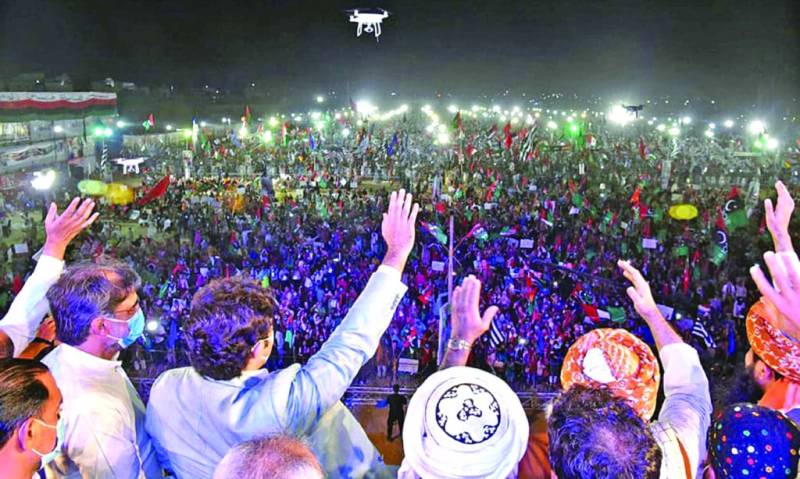
In the past week, Pakistan’s politics has been a cluster-foxtrot even by its own unenviable standards. The government and the opposition, a motley collection of parties, are locked in a conflict with no discernible exit. What’s on display would be hilariously farcical if its consequences weren’t so dire, both in terms of internal stability and external messaging.
Let’s try and unpack the situation.
There’s nothing secret about how Imran Khan’s Pakistan Tehreek-e-Insaf (PTI) has come to be in power. In and of itself, that might not have been a problem if Khan had understood his limitations. If you are perceived to have finagled your way to the top, it is best to let others in the game play too, even if only on the margins. Loss aversion tells us that people make decisions based on the potential gains or losses relative to their specific situation — i.e., they are reference-dependent. But that only works when they have the space. To reiterate a point made recently by my friend Mosharraf Zaidi, the most dangerous man is the one who thinks he has nothing left to lose.
The opposition did not arrive overnight at its current point of desperation. Taking a snapshot view of the present situation would therefore be a mistake. Instead, one has to study the trajectory of the past four years. Our hybrid system, comprising the selectors and the selected, required some sort of accommodation with those who had been pushed out. And this accommodation was required not for the sake of those outside the halls of power, but for Khan’s own sake.
To prove that he was better at governance, Khan had to be better than the traditional parties. That required him to provide space to his adversaries because that was the only way for the PTI to have the opportunity to make a difference.

That, as we know, did not happen. Khan used state institutions and the government’s long reach to hound the opposition. One doesn’t need to go into details because they are known. But it bears repeating that it is Khan’s obsession with corruption, his idée fixe that has led to the current impasse. Banging on about corruption was all right as a campaign slogan and to galvanise followers. But to make it the bedrock of all policies and reducing the complexity of economic activity to a single mantra was never going to work. And, it didn’t.
Worse, Khan’s insistence on kicking away the chessboard and playing solitaire has shrunk the political space for the PTI. Further, one look at the detritus Khan has around him and the term corruption becomes a bad joke. In fairness to the selectors, they have tried to nudge Khan into understanding the risks involved in taking an absolutist position, but to no avail. Those observing the developments know this and I shall leave it at that.
The opposition, for its part, tried hard to make a deal. But every time they worked out something with the selectors, Khan would throw a spanner in the works. Over a period of time, the pro-deal moderates began to lose out to the hardliners.
Now we have a situation in which the opposition has decided to name and shame and state in public rallies that which is normally only whispered in drawing rooms. This has put the selectors in a quandary; double down, ignore or make Khan understand that a balance must be restored.
One casualty of this mess is our messaging to the external world. All the work Pakistan did through its diplomatic offensive in the last one year has suffered a major setback. But that’s another topic, albeit a tragic one.
The other problem, internally, is the nature of this war. The opposition says they want respect for votes — i.e., that their mandate has been stolen and that the selectors need to be purged from the system. Khan has fired back by claiming that “I am democracy.” The problem is that democracy is not just about elections and a vote; it requires constitutionalism for the vote to be effective and for democracy to be liberal.
Political scientist, David Fellman, defined it thus: “Constitutionalism is descriptive of a complicated concept, deeply embedded in historical experience, which subjects the officials who exercise governmental powers to the limitations of a higher law. Constitutionalism proclaims the desirability of the rule of law as opposed to rule by the arbitrary judgment or mere fiat of public officials….”
Twenty-three years ago, in an article for Foreign Affairs, Fareed Zakaria, distinguished between liberal and illiberal democracies. Democracy is about the vote and choosing leaders. It says nothing about how a state is governed and whether individual rights are protected against excesses by the state and tyrannical majorities. A fabulous example of an illiberal democracy is India under Narendra Modi and the BJP. Modi has won big twice though the popular vote. But does that mean India has liberal constitutionalism? The answer is no.
Ditto for political parties here. Vote ko izzat dau (respect the vote) is a necessary but insufficient condition for a liberal democracy. In fact, the very constitution that guides the affairs of this state is full of illiberal acts and clauses. One could perhaps easier sell refrigerators to Eskimos than expect Maulana Fazlur Rehman, the leading light of Pakistan Democratic Movement, to accept the idea of constitutionalism.
In the same way, while it is important to get the military to stop interfering in politics, that in and of itself is not going to give us liberal democracy.
This is where we come full circle on our misery, partisans notwithstanding. The clamour is about space, political space. It’s not really about ideas. Governance shall remain what it has always been, though one is constrained to say that even monkeys would do better than the current bunch. To go back to where I began, if Khan had not been mulish in his treatment of the opposition, things would not have reached this pass.
Even now, the salvo delivered by Nawaz Sharif is less about storming the Bastille and more about finding space.
In which case, and because no one is agitating for liberal democracy, let’s share the spoils and move on.
The writer is a former News Editor of The Friday Times and reluctantly tweets @ejazhaider
Let’s try and unpack the situation.
There’s nothing secret about how Imran Khan’s Pakistan Tehreek-e-Insaf (PTI) has come to be in power. In and of itself, that might not have been a problem if Khan had understood his limitations. If you are perceived to have finagled your way to the top, it is best to let others in the game play too, even if only on the margins. Loss aversion tells us that people make decisions based on the potential gains or losses relative to their specific situation — i.e., they are reference-dependent. But that only works when they have the space. To reiterate a point made recently by my friend Mosharraf Zaidi, the most dangerous man is the one who thinks he has nothing left to lose.
The opposition did not arrive overnight at its current point of desperation. Taking a snapshot view of the present situation would therefore be a mistake. Instead, one has to study the trajectory of the past four years. Our hybrid system, comprising the selectors and the selected, required some sort of accommodation with those who had been pushed out. And this accommodation was required not for the sake of those outside the halls of power, but for Khan’s own sake.
To prove that he was better at governance, Khan had to be better than the traditional parties. That required him to provide space to his adversaries because that was the only way for the PTI to have the opportunity to make a difference.
That, as we know, did not happen. Khan used state institutions and the government’s long reach to hound the opposition. One doesn’t need to go into details because they are known. But it bears repeating that it is Khan’s obsession with corruption, his idée fixe that has led to the current impasse. Banging on about corruption was all right as a campaign slogan and to galvanise followers. But to make it the bedrock of all policies and reducing the complexity of economic activity to a single mantra was never going to work. And, it didn’t.
Worse, Khan’s insistence on kicking away the chessboard and playing solitaire has shrunk the political space for the PTI. Further, one look at the detritus Khan has around him and the term corruption becomes a bad joke. In fairness to the selectors, they have tried to nudge Khan into understanding the risks involved in taking an absolutist position, but to no avail. Those observing the developments know this and I shall leave it at that.
The opposition, for its part, tried hard to make a deal. But every time they worked out something with the selectors, Khan would throw a spanner in the works. Over a period of time, the pro-deal moderates began to lose out to the hardliners.
Now we have a situation in which the opposition has decided to name and shame and state in public rallies that which is normally only whispered in drawing rooms. This has put the selectors in a quandary; double down, ignore or make Khan understand that a balance must be restored.
One casualty of this mess is our messaging to the external world. All the work Pakistan did through its diplomatic offensive in the last one year has suffered a major setback. But that’s another topic, albeit a tragic one.
The other problem, internally, is the nature of this war. The opposition says they want respect for votes — i.e., that their mandate has been stolen and that the selectors need to be purged from the system. Khan has fired back by claiming that “I am democracy.” The problem is that democracy is not just about elections and a vote; it requires constitutionalism for the vote to be effective and for democracy to be liberal.
Political scientist, David Fellman, defined it thus: “Constitutionalism is descriptive of a complicated concept, deeply embedded in historical experience, which subjects the officials who exercise governmental powers to the limitations of a higher law. Constitutionalism proclaims the desirability of the rule of law as opposed to rule by the arbitrary judgment or mere fiat of public officials….”
Twenty-three years ago, in an article for Foreign Affairs, Fareed Zakaria, distinguished between liberal and illiberal democracies. Democracy is about the vote and choosing leaders. It says nothing about how a state is governed and whether individual rights are protected against excesses by the state and tyrannical majorities. A fabulous example of an illiberal democracy is India under Narendra Modi and the BJP. Modi has won big twice though the popular vote. But does that mean India has liberal constitutionalism? The answer is no.
Ditto for political parties here. Vote ko izzat dau (respect the vote) is a necessary but insufficient condition for a liberal democracy. In fact, the very constitution that guides the affairs of this state is full of illiberal acts and clauses. One could perhaps easier sell refrigerators to Eskimos than expect Maulana Fazlur Rehman, the leading light of Pakistan Democratic Movement, to accept the idea of constitutionalism.
In the same way, while it is important to get the military to stop interfering in politics, that in and of itself is not going to give us liberal democracy.
This is where we come full circle on our misery, partisans notwithstanding. The clamour is about space, political space. It’s not really about ideas. Governance shall remain what it has always been, though one is constrained to say that even monkeys would do better than the current bunch. To go back to where I began, if Khan had not been mulish in his treatment of the opposition, things would not have reached this pass.
Even now, the salvo delivered by Nawaz Sharif is less about storming the Bastille and more about finding space.
In which case, and because no one is agitating for liberal democracy, let’s share the spoils and move on.
The writer is a former News Editor of The Friday Times and reluctantly tweets @ejazhaider