

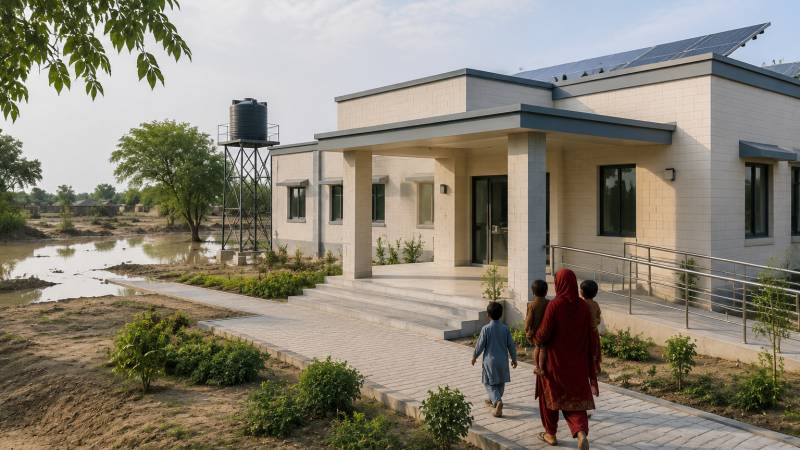
The devastating floods of 2022 left an indelible mark on Pakistan, exposing the country's vulnerability to climate-induced disasters. Across Sindh, swollen rivers and torrential rains destroyed homes, schools, roads, water supply systems and healthcare facilities, disrupting the lives of millions. In District Umerkot, where scattered rural settlements already faced limited access to essential services, the floods dealt a severe blow to primary healthcare, forcing many families to travel long distances for medical treatment.
Nearly four years later, signs of recovery are emerging. More importantly, the focus has shifted from merely rebuilding damaged infrastructure to creating facilities that are stronger, more sustainable and better equipped to withstand future climate shocks. This approach often described as "building back better" is transforming the way disaster recovery is undertaken in vulnerable regions. One such example can be found in Umerkot, where the Pakistan Poverty Alleviation Fund (PPAF), through its Rehabilitation of Social Services & Climate Resilience (RSS&CR) Project, has supported the restoration and upgradation of four Government Dispensaries. Implemented by the Association for Water, Applied Education & Renewable Energy (AWARE) in collaboration with the Sindh Health Department, the initiative has restored quality primary healthcare services for more than 31,000 people living in remote rural communities. Although Umerkot is widely recognized as the gateway to the Thar Desert, the district is also highly vulnerable to flooding. Much of its land lies in low-lying areas where seasonal rainwater accumulates during the monsoon. The floods of 2022 damaged public infrastructure on a massive scale, including schools, healthcare facilities, water supply schemes and community assets, leaving already underserved communities with even fewer essential services.
The district faces another challenge that often receives less attention. Nearly 56 per cent of Umerkot's geographical area falls within the Thar Desert, where scattered settlements, extreme temperatures and long travel distances make infrastructure development costly and difficult. Rehabilitating damaged public facilities across such a vast landscape requires substantial financial resources, technical expertise and close coordination among government institutions and development partners. Recognizing these realities, PPAF designed the RSS&CR Project not only to restore damaged infrastructure but also to improve its resilience against future disasters. Rather than reconstructing facilities exactly as they were before, the project integrated climate-resilient features that improve service delivery while reducing vulnerability to climate-related risks.
Under the initiative, Government Dispensaries at Babu Fakir Karna Mori, Ghamori Kori Paro, Ghulam Hussain Mangrio and Noor Mohammad Palli have been transformed into safer and more efficient healthcare facilities. Each dispensary now benefits from solar-powered electricity systems, safe drinking water facilities, improved sanitation infrastructure, upgraded medical furniture, proper clinical waste management systems and other essential improvements designed to enhance healthcare services. These investments may appear simple, but they have a profound impact on the daily lives of patients and healthcare workers. In many rural health facilities, unreliable electricity has long interrupted medical services, particularly during the scorching summer months. Solar energy now provides a dependable source of power, ensuring that essential healthcare services can continue even during electricity outages.

Similarly, improved water supply and sanitation facilities contribute to infection prevention and create a cleaner environment for patients, healthcare providers and visitors. Proper clinical waste management also reduces environmental contamination and improves overall public health standards. For thousands of villagers, the rehabilitated dispensaries mean shorter travel distances, reduced transportation costs and quicker access to treatment. Pregnant women, children, elderly patients and people suffering from common illnesses can now receive timely medical care closer to their homes. The project also reflects a broader understanding that climate resilience extends beyond constructing stronger buildings. It involves ensuring that public services continue functioning during emergencies, protecting vulnerable populations and strengthening the capacity of institutions to respond effectively to future disasters.
The devastating floods of 2022 left an indelible mark on Pakistan, exposing the country's vulnerability to climate-induced disasters.
Pakistan remains among the countries most vulnerable to climate change. Rising temperatures, erratic rainfall, prolonged droughts and increasingly frequent floods continue to threaten livelihoods, infrastructure and public services. Rural districts such as Umerkot, where poverty and limited infrastructure already pose significant development challenges, are particularly exposed to these risks. Against this backdrop, climate-resilient public infrastructure is becoming an essential investment rather than an optional one. Every reconstructed school, healthcare facility or water supply scheme provides an opportunity to reduce future disaster risks while improving the quality of life for local communities.
The RSS&CR Project also contributes directly to Pakistan's commitment towards achieving the United Nations Sustainable Development Goals (SDGs). By strengthening healthcare services, promoting clean water and sanitation, expanding renewable energy solutions, supporting climate adaptation and encouraging partnerships.
Mr. Rajab Ali of AWARE said the project demonstrates how resilient infrastructure can respond to the priorities of local communities while addressing the growing impacts of climate change.
"The Pakistan Poverty Alleviation Fund deserves appreciation for designing a programme that not only restores damaged public facilities but also strengthens their capacity to withstand future climate challenges," he said. He added that PPAF's continued confidence in indigenous organisations has enabled institutions like AWARE to implement sustainable, community-driven interventions that respond to local needs.
"Under the leadership of Mr. Nadir Gul Barech, PPAF's support for local civil society organisations is helping build stronger, more resilient communities across Pakistan. The successful rehabilitation of these health facilities shows what can be achieved when government institutions, development partners and local organisations work together with a shared commitment to improving people's lives," he said.

The RSS&CR Project extends well beyond the health sector. Across Umerkot, it includes the rehabilitation of schools, climate-resilient water supply systems, community infrastructure, disaster risk reduction measures and institutional strengthening. Collectively, these investments are helping restore essential public services while preparing communities to face future environmental challenges with greater confidence. The story of these four dispensaries is about much more than renovated buildings. It is about restoring dignity to communities that endured one of Pakistan's worst natural disasters. It is about ensuring that mothers can safely access healthcare, children can receive treatment close to home and frontline health workers can serve their communities in safer and better-equipped facilities. As climate change continues to reshape Pakistan's development landscape, rebuilding cannot simply mean replacing what has been lost. It must mean creating stronger institutions, safer infrastructure and more resilient communities. The restored health facilities in Umerkot demonstrate that with thoughtful planning, strong partnerships and sustained investment, disaster recovery can become an opportunity to build a healthier and more secure future.
Dr. Muhammad Ali, District Health Officer Umerkot, appreciated the initiative and said that the rehabilitation of Government Health Facilities by AWARE, with financial support from the Pakistan Poverty Alleviation Fund (PPAF), has significantly improved the quality of healthcare services in remote rural areas.
"The renovation of these health facilities has created a safer and more functional environment for both patients and healthcare providers," he said. The upgraded infrastructure, improved sanitation, access to safe drinking water, solar energy systems, and better medical facilities have strengthened the capacity of our primary healthcare system. We are grateful to PPAF and AWARE for their valuable partnership in helping restore essential health services and improving the well-being of thousands of people in District Umerkot. The journey from flood devastation to climate resilience is far from over, but for thousands of families in rural Umerkot, these health facilities stand as a powerful reminder that recovery is not only possible, it can lay the foundation for a stronger tomorrow.