

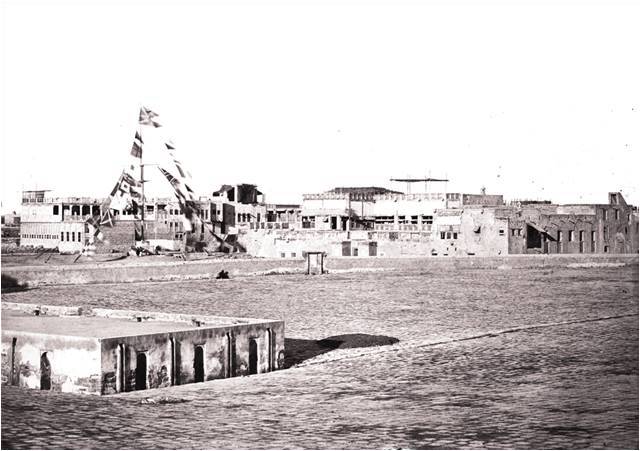
This photograph offers a general view of the Bushire Residency and surrounding buildings, looking across a paved area. A low wall from left to right across the centre of the image divides the paved area from the Residency.
To the left of the image is a low-ceilinged flat-roofed structure which occupies much of the foreground.
A string of flags to the left of the scene in front of the building may indicate an official function or visit. A number of figures can be seen standing at the base of the flag-staff.
From the early days of its existence, the East India Company sought a secure base, known as a factory, from which to conduct trade with Persia. In 1763, it established Bushire, a base which would provide some continuity to its operations on the northeast coast of the Gulf, which during the eighteenth century developed into the most important port in Persia. It was well-positioned, being close to one of the two main routes from the coast into the interior of the country.
The Company concluded an agreement with Shaikh Sa’don, the governor of Bushire in April 1763 and was granted a license three months later in which the company was given a monopoly on the import of woolen goods into Persia. The agreement – subsequently approved personally by the ruler of Persia, Karim Khan Zand – gave the Company favourable conditions for trade in the form of exemptions from export and import duties and protection for Company personnel and property.
The Resident at Bushire was immediately responsible to the Agent and Council at Basra through whom the whole of his correspondence with the Governor and Council at Bombay was normally channeled. This arrangement lasted until 1778 after which date the status of Basra was reduced from Agency to Residency, and the Resident at Bushire reported directly to Bombay. However, from 1807 onwards, the Resident sometimes also corresponded with the central Government at Calcutta or even with the Home Government in London.
By the 1820s, the diplomatic role of the Residency had been taken over by the British Envoy at Tehran and the function of commercial relations with Persia had become of secondary importance. The Residency acted chiefly as an agency dealing with political relations with the Arab littoral.
The Resident was forbidden to interfere in Persian politics but his first priority was the maintenance of maritime peace in the Gulf waters. This anomalous position led to administrative complexities. The Residency was made intermittently responsible to the Envoy at Tehran, to the Government of India or to the Government of Bombay.
During the nineteenth century, Bushire became a less convenient base given that the Residency was becoming increasingly involved with the affairs of the Arabian coast. Lewis Pelly, Political Resident in the Gulf, first raised the matter in 1863 but it was only in 1946 that the Residency was transferred to Bahrain. The old Residency building at Bushire was passed to the Persians to use as a sanatorium.
Despite temporary confusions, Bombay continued to be chiefly responsible for the Residency until 1873. During this time it kept the Home Government informed about Gulf affairs and forwarded copies of its correspondence with the Resident and other Gulf officials to London in two ways – either in the form of proceedings or as enclosures to letters. During this period, the Foreign Office and India Office took an increasing interest in the politics of the Gulf.
In 1873, control of the Gulf territories was transferred to the Government of India. This arrangement persisted until 1920 when a whole new set of political motives and assumptions made some sort of re-organisation urgently necessary. The First World War highlighted the importance of the Middle East in the context of British imperial policy as well as the disastrous effect of the complex administrative arrangements in the area.
In 1918, there were as many as 18 different British authorities involved in the area and between them were divided the huge responsibilities of the administration of Mesopotamia, the conduct of relations with the increasingly powerful house of Sa’ud and the settlement of political arrangements in the Hijaz and near Eastern territories, as well as relations with the Gulf States.
To the left of the image is a low-ceilinged flat-roofed structure which occupies much of the foreground.
A string of flags to the left of the scene in front of the building may indicate an official function or visit. A number of figures can be seen standing at the base of the flag-staff.
From the early days of its existence, the East India Company sought a secure base, known as a factory, from which to conduct trade with Persia. In 1763, it established Bushire, a base which would provide some continuity to its operations on the northeast coast of the Gulf, which during the eighteenth century developed into the most important port in Persia. It was well-positioned, being close to one of the two main routes from the coast into the interior of the country.
The Company concluded an agreement with Shaikh Sa’don, the governor of Bushire in April 1763 and was granted a license three months later in which the company was given a monopoly on the import of woolen goods into Persia. The agreement – subsequently approved personally by the ruler of Persia, Karim Khan Zand – gave the Company favourable conditions for trade in the form of exemptions from export and import duties and protection for Company personnel and property.
The Resident at Bushire was immediately responsible to the Agent and Council at Basra through whom the whole of his correspondence with the Governor and Council at Bombay was normally channeled. This arrangement lasted until 1778 after which date the status of Basra was reduced from Agency to Residency, and the Resident at Bushire reported directly to Bombay. However, from 1807 onwards, the Resident sometimes also corresponded with the central Government at Calcutta or even with the Home Government in London.
By the 1820s, the diplomatic role of the Residency had been taken over by the British Envoy at Tehran and the function of commercial relations with Persia had become of secondary importance. The Residency acted chiefly as an agency dealing with political relations with the Arab littoral.
The Resident was forbidden to interfere in Persian politics but his first priority was the maintenance of maritime peace in the Gulf waters. This anomalous position led to administrative complexities. The Residency was made intermittently responsible to the Envoy at Tehran, to the Government of India or to the Government of Bombay.
During the nineteenth century, Bushire became a less convenient base given that the Residency was becoming increasingly involved with the affairs of the Arabian coast. Lewis Pelly, Political Resident in the Gulf, first raised the matter in 1863 but it was only in 1946 that the Residency was transferred to Bahrain. The old Residency building at Bushire was passed to the Persians to use as a sanatorium.
Despite temporary confusions, Bombay continued to be chiefly responsible for the Residency until 1873. During this time it kept the Home Government informed about Gulf affairs and forwarded copies of its correspondence with the Resident and other Gulf officials to London in two ways – either in the form of proceedings or as enclosures to letters. During this period, the Foreign Office and India Office took an increasing interest in the politics of the Gulf.
In 1873, control of the Gulf territories was transferred to the Government of India. This arrangement persisted until 1920 when a whole new set of political motives and assumptions made some sort of re-organisation urgently necessary. The First World War highlighted the importance of the Middle East in the context of British imperial policy as well as the disastrous effect of the complex administrative arrangements in the area.
In 1918, there were as many as 18 different British authorities involved in the area and between them were divided the huge responsibilities of the administration of Mesopotamia, the conduct of relations with the increasingly powerful house of Sa’ud and the settlement of political arrangements in the Hijaz and near Eastern territories, as well as relations with the Gulf States.