

In this sprawling city of 20 million officially, and closer to 30 million in reality, there's certainly no shortage of non-governmental organisations (NGOs). While most people are too busy to even connect with their neighbors, every community and area has a few insightful individuals who dedicate themselves to organised social welfare efforts. This is a unique city where someone genuinely trying to help themselves won't go hungry. Feeding the needy is the most common act of kindness here, in this city that appears joyful but holds a lot of underlying sorrow. Life is expensive, and unexpected troubles—mobile snatchings, brief kidnappings or honey traps, bike thefts, or random road accidents—are an everyday reality. Although not proportionally representative of its large population, Karachi has a considerable number of activists of all kinds, except for one particular type, which is a serious concern.
A common observation within Karachi's civil society is the unwelcoming attitude of those who, despite years of effort without significant success, rely solely on their longevity to assert influence. This isn't a reference to individuals who made the ultimate sacrifice, like Parveen Rehman and Sabeen Mehmood, but rather to the second and even third tier of leadership in Karachi. While these individuals often contribute positively to areas such as education, poverty alleviation, and civil rights, many who claim to be climate activists have yet to demonstrate any real impact in that field.
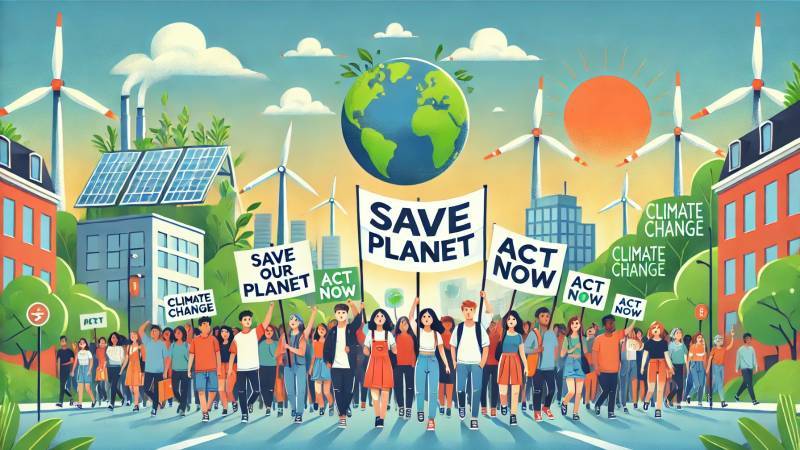
During an environmental theater event, a veteran of the regional newspaper business astutely observed that if civil society mobilises a massive number of people for a climate march, who will ignore them? Many will certainly think twice about breaking environmental laws given such a strong show of public concern. Conversely, if only a small group of young climate leaders in the city organise a procession of just a few hundred people and label it a climate march, it will reassure those who violate environmental regulations that they don't need to worry about any insignificant protest – one that doesn't even represent 0.1 percent of the city's total population.
In contrast to Karachi, volunteerism is rapidly increasing in the northern areas and the federal capital. These volunteers are effectively utilising social media and digital technology to promote their activities
There's a quiet discussion about why climate-focused civil society in Karachi isn't as impactful as it is in other social areas. However, none of these discussions address developing a strategy to overcome the shortcomings that prevent people from following them. Their consistent approach over the past three years has been to organise small processions, walking considerable distances, seemingly forgetting that older individuals can't manage such long walks. This highlights their lack of vision in engaging all age groups and diverse individuals in the cause of climate awareness and advocacy. While they are undoubtedly sincere, their rhetoric does raise some valid concerns.
Each small group organisation under any form of civil society has one most active person, but actually, he is the only person else who is just on paper or attends an event as if it’s an event of their mandatory attendance; devoid of any zeal and gusto. They don’t realise that if they at least develop an understanding of why they, despite a long time in this field, haven’t developed a following of at least 100 people each, then things can improve a lot. This one-person battalion multiplies to a few persons as and when they have a project, from which they hire a few people, and then instead of roaming alone, a few members of their staff escort that one person. It means voluntarism is nowhere in the climate side of the civil society of Karachi, and this is the main reason why people don’t take this issue seriously.
In contrast to Karachi, volunteerism is rapidly increasing in the northern areas and the federal capital. These volunteers are effectively utilising social media and digital technology to promote their activities. Interestingly, Islamabad has a higher absolute number of climate activists than Karachi, even without considering the difference in population size. However, these activists in Islamabad seem less inclined to organise climate marches, perhaps recognising that a small gathering, while technically a procession, might not have the impact of a significant demonstration. Similarly, the situation in the northern areas is quite positive. People there are motivated to work on climate issues in their local communities without expecting personal gain.
In Karachi, while it's true that transportation to distant locations requires resources and some people feel they should receive at least a travel allowance, many are willing to use expensive ride-sharing services or public transport to attend events, even though they often use more affordable transportation for their daily commutes.
Another significant concern in Karachi involves a division within the climate-related civil society. One faction positions itself as the ultimate authority on principles, almost like a modern-day Socrates. The other group argues that tackling climate change demands collective action, requiring us to engage everyone to achieve meaningful impact.
The first group, generally younger and often unpredictable despite their positive intentions, lacks demonstrable achievements. Despite having access to resources, they typically struggle to attract significant numbers to their events. The second group, which is quite active and sometimes adopts a more flexible approach, has a broader reach and can communicate with a wider range of people.
To consider in this climate emergency, where nothing is business as usual, the crucial question is which approach is more effective in engaging all types of people and garnering greater support. Otherwise, small gatherings will continue to embolden those who disregard climate action, allowing the worsening impacts of climate change to eventually devastate us all collectively.