

New York: The United Nations has acknowledged receiving formal communications from three major powers regarding Iran’s stance on the expiration of Security Council Resolution 2231 and mounting tensions around the country’s nuclear commitments. Stephane Dujarric, Spokesperson for the UN Secretary-General, confirmed the development during Monday’s press briefing and reiterated the Secretary-General’s call for diplomacy.
“The Secretary-General has received letters from the Russian Federation, the Islamic Republic of Iran and China on Resolution 2231,” Dujarric said, adding that the Secretary-General continues to urge all involved states not to abandon dialogue.
“The Secretary-General continues to call upon the parties to demonstrate renewed political will towards meaningful negotiations and to explore all avenues for the continued diplomatic engagements on the Iran nuclear issue.”
Dujarric’s remarks come amid growing uncertainty after Iran announced that it has scrapped a key cooperation agreement with the International Atomic Energy Agency (IAEA) and formally informed the United Nations that it considers Resolution 2231, the framework underpinning the 2015 Joint Comprehensive Plan of Action (JCPOA), to have fully expired.
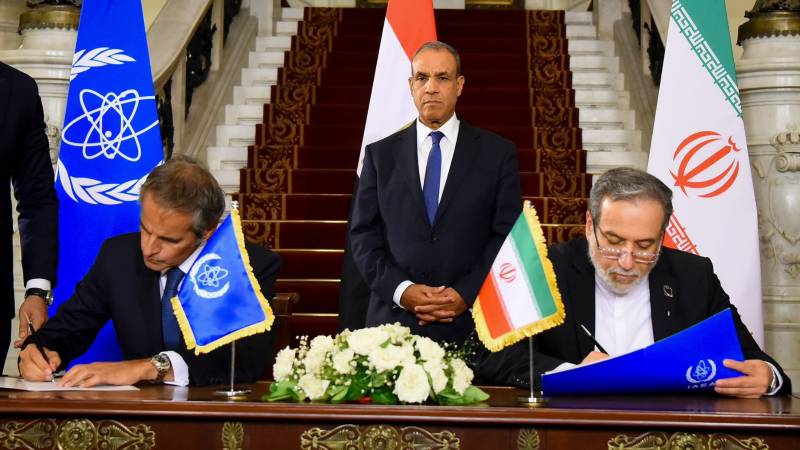
The diplomatic rupture deepened when Ali Larijani, Secretary of Iran’s Supreme National Security Council, confirmed that Tehran has canceled the cooperation arrangement it signed with the IAEA in September. Speaking during a meeting with his Iraqi counterpart in Tehran, Larijani said, “the agreement has been cancelled.” He noted that if the IAEA submits proposals, “we will review it in the secretariat,” but made clear that Iran no longer considers itself bound by the previous terms.
The agreement had allowed the UN nuclear watchdog to resume inspections of Iranian nuclear facilities after months of limited access. Its cancelation follows public warnings issued weeks earlier by Iran’s Foreign Minister Abbas Araqchi, who said the deal would be terminated if Western governments attempted to reimpose UN sanctions.
The move is seen as a major blow to the IAEA’s efforts to rebuild oversight, particularly after the June attacks attributed to Israel and the United States that targeted Iranian nuclear infrastructure.
In parallel to abandoning the IAEA arrangement, Iranian officials have declared that the entire legal and political framework established by UN Security Council Resolution 2231 has lapsed.
Foreign Ministry spokesman Esmail Baghaei announced that, effective October 18, the resolution “has officially terminated.” In a press briefing, he stated: “With the end of Resolution 2231 on October 18, its provisions have officially terminated. The rights gained under this resolution, such as enrichment and the expansion of peaceful nuclear activities, continue to stand.”
He emphasized that Iran now sees the JCPOA as only “a temporary and conditional understanding” and insisted that the country’s right to enrich uranium and pursue nuclear research remains valid. Baghaei blamed the United States for violating international law by withdrawing from the deal in 2018 and accused European governments of failing to fulfill their commitments.
Foreign Minister Abbas Araghchi communicated the same position in writing to the United Nations, stating in letters to the Secretary-General and the President of the Security Council that “Resolution 2231 had expired in full accordance with its explicit provisions” and that UN oversight of Iran’s nuclear activities has come to an end.
In his letter, Araghchi wrote: “Iran had implemented the JCPOA in good faith and with full precision, while the United States had grossly violated international law by reimposing unilateral sanctions.”
Iran’s stance has received backing from Russia and China, permanent Security Council members that oppose attempts by France, the United Kingdom and Germany to trigger a snapback of sanctions. According to Baghaei, “Moscow and Beijing both made clear that the European powers lacked the legal standing to use the mechanism, since they had already violated the JCPOA.”
He claimed that the support from Russia and China reflected “months of sustained diplomatic engagement,” referencing talks in New York and what he described as an understanding reached in Cairo with the IAEA.
Iran maintains that the political environment surrounding the JCPOA has been irreparably damaged by Western actions, and any future dialogue would require recognition of its nuclear rights.
Addressing speculation about engagement with Washington, Baghaei acknowledged that there have been communications through intermediaries, but stressed that these “do not signify the start of official negotiations.” He cited Egypt among the countries attempting to ease tensions. “Real dialogue can only occur when both sides reach a shared understanding based on mutual respect,” he said.
UN officials have previously warned that without some form of structured engagement, the collapse of Resolution 2231 could accelerate regional instability.