

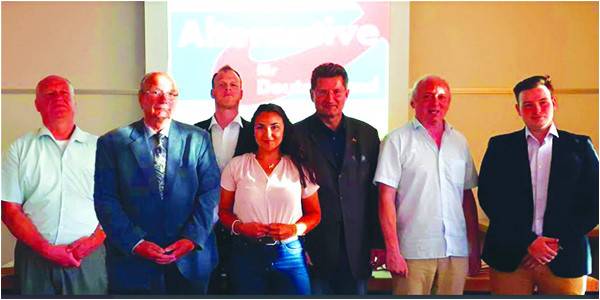
Sometime in 2015, Konrad Adam, the founder of the Alternative for Germany (AfD), the country’s right-wing, populist party, met Zahid Khan. He wanted to learn about Islam, and Khan, who was originally from Pakistan and settled in Frankfurt, was well-known in Germany as a critic of fundamentalism. The meeting was an eye-opener for Zahid’s young daughter Mary. Until then, she had been convinced that it was a party akin to that of the Nazis. It was a few months later, however, when the refugee crisis in Germany peaked, that she changed her mind.
“I went to a dinner meeting of AfD members in Frankfurt and I said hello, I am Mary Khan. They looked at me funny and were surprised an Indian-looking woman with a Muslim surname had come,” said Khan, who left that evening, convinced she would join. “They were all so welcoming and were only concerned about the betterment of the country.” Today, she is the chairperson of the party in Rodgau, a town southeast of Frankfurt. She also heads the branch of AfD’s youth wing called Young Alternative in the state of Hessen.
What makes Khan’s entry into this party surprising is that her own father came to Germany in 1989 from Lahore as a refugee fearing persecution in Pakistan. Nearly three decades later, his daughter believes that it is important to vet refugees. “Many of the refugees are young men who are emotional about religion. We cannot bring everyone to Germany, there is no capacity. Chancellor Angela Merkel’s welcoming policy is just not working,” she said. “We will help those who really need help. But if they bring religion over our law, it’s dangerous.”
The AfD, a Eurosceptic party that calls for a crackdown on immigration from Muslim countries and asks for rigorous border control, was founded in 2013. It has more than 23,000 members and is is represented in the parliaments of 13 out of 16 of Germany’s federal states, winning sometimes with more than 20% of the vote. In the throes of the refugee crisis, which saw the entry of thousands of asylum seekers from war-torn countries such as Syria, Afghanistan, Eritrea and Iraq, the party experienced a surge in popularity, doing well in a series of local elections.
In a poll in May, though, nearly three-quarters of German voters dismissed the party as “anti-democratic”. However, the party’s presence has nonetheless brought to the national stage a debate about and expression of what some people describe as xenophobic and bigoted sentiments. The AfD has always had an anti-immigrant tone to its rhetoric. Not so long ago, AfD leader Frauke Petry came under fire for saying that border police should have the right to shoot at illegal immigrants. They “must prevent illegal border crossings and even use firearms if necessary,” she said. After their party conference last year, their party’s draft policy caused a storm. Saying Islam is not a part of Germany, the party called for a ban on mosques, headscarves in schools, full-face veils for women and calls to prayer. Many saw this as an attack to the secular German Constitution. The population of Muslims in Germany is 4,760,000 or 5.8% of the country, according to Pew Research data from 2016.
So what was it about the party that drew Khan to it? “The media have been portraying us as racist, as Nazis. But the party is only trying to instil patriotism which doesn’t exist in our country at the moment,” said Khan. “Nobody is able to say they are proud of being German. Young people are frustrated about this.” German’s hesitation to ‘take pride’ in the country since WWII can be attributed in part to sheer experience. It knows only too well what overzealous nationalism can lead to. But for young people like Khan, the time for apology is over. “Our nation should not be defined by the 12 years that the Nazis were in power,” she said. “There are philosophers, writers and so on, and we should be able to celebrate our country.”
For Khan, thus, the AfD is the only party in the current political climate that speaks to her. “Germany is in need of a very strong integration law. There are neighbourhoods, for instance, like Turkish ones, that haven’t properly integrated into German society,” she claimed. “There are parallel societies with only Turkish markets, haircuts, doctors etc.”
Ironically, Khan, who is a student of political science and religion, credits her father for making her aware of socio-political issues. “He was always outspoken and involved in politics and social issues in his country,” she explained. “He was critical of fundamentalism and spoke out against it. He was the founder of the students’ movement, Students Separate Religion, at the University of Punjab.” Even after coming to Germany, he spoke about a need for reforming Islam in Europe, she added.
Khan, whose mother is German, grew up in Frankfurt with a mixed upbringing. “My father wanted to raise me as a modern German girl. When I turned 12, it became a problem with his side of the family in Pakistan who wanted me to move there. My father then cut ties with them,” she said.
Khan’s decision to join the AfD has surprised many of close to her. Her mother, for instance, is a supporter of the progressive, left-leaning Social Democratic Party. Her friends, with a migration background, are shocked at her views. The solution? She says they don’t talk about politics when they meet.
Sukhada Tatke is a freelance journalist.
She tweets at @ASuitableGirl
“I went to a dinner meeting of AfD members in Frankfurt and I said hello, I am Mary Khan. They looked at me funny and were surprised an Indian-looking woman with a Muslim surname had come,” said Khan, who left that evening, convinced she would join. “They were all so welcoming and were only concerned about the betterment of the country.” Today, she is the chairperson of the party in Rodgau, a town southeast of Frankfurt. She also heads the branch of AfD’s youth wing called Young Alternative in the state of Hessen.
What makes Khan’s entry into this party surprising is that her own father came to Germany in 1989 from Lahore as a refugee fearing persecution in Pakistan. Nearly three decades later, his daughter believes that it is important to vet refugees. “Many of the refugees are young men who are emotional about religion. We cannot bring everyone to Germany, there is no capacity. Chancellor Angela Merkel’s welcoming policy is just not working,” she said. “We will help those who really need help. But if they bring religion over our law, it’s dangerous.”
What makes Khan's entry into this party surprising is that her own father came to Germany in 1989 from Lahore as a refugee fearing persecution in Pakistan. Nearly three decades later, his daughter believes that it is important to vet refugees
The AfD, a Eurosceptic party that calls for a crackdown on immigration from Muslim countries and asks for rigorous border control, was founded in 2013. It has more than 23,000 members and is is represented in the parliaments of 13 out of 16 of Germany’s federal states, winning sometimes with more than 20% of the vote. In the throes of the refugee crisis, which saw the entry of thousands of asylum seekers from war-torn countries such as Syria, Afghanistan, Eritrea and Iraq, the party experienced a surge in popularity, doing well in a series of local elections.
In a poll in May, though, nearly three-quarters of German voters dismissed the party as “anti-democratic”. However, the party’s presence has nonetheless brought to the national stage a debate about and expression of what some people describe as xenophobic and bigoted sentiments. The AfD has always had an anti-immigrant tone to its rhetoric. Not so long ago, AfD leader Frauke Petry came under fire for saying that border police should have the right to shoot at illegal immigrants. They “must prevent illegal border crossings and even use firearms if necessary,” she said. After their party conference last year, their party’s draft policy caused a storm. Saying Islam is not a part of Germany, the party called for a ban on mosques, headscarves in schools, full-face veils for women and calls to prayer. Many saw this as an attack to the secular German Constitution. The population of Muslims in Germany is 4,760,000 or 5.8% of the country, according to Pew Research data from 2016.
So what was it about the party that drew Khan to it? “The media have been portraying us as racist, as Nazis. But the party is only trying to instil patriotism which doesn’t exist in our country at the moment,” said Khan. “Nobody is able to say they are proud of being German. Young people are frustrated about this.” German’s hesitation to ‘take pride’ in the country since WWII can be attributed in part to sheer experience. It knows only too well what overzealous nationalism can lead to. But for young people like Khan, the time for apology is over. “Our nation should not be defined by the 12 years that the Nazis were in power,” she said. “There are philosophers, writers and so on, and we should be able to celebrate our country.”
For Khan, thus, the AfD is the only party in the current political climate that speaks to her. “Germany is in need of a very strong integration law. There are neighbourhoods, for instance, like Turkish ones, that haven’t properly integrated into German society,” she claimed. “There are parallel societies with only Turkish markets, haircuts, doctors etc.”
Ironically, Khan, who is a student of political science and religion, credits her father for making her aware of socio-political issues. “He was always outspoken and involved in politics and social issues in his country,” she explained. “He was critical of fundamentalism and spoke out against it. He was the founder of the students’ movement, Students Separate Religion, at the University of Punjab.” Even after coming to Germany, he spoke about a need for reforming Islam in Europe, she added.
Khan, whose mother is German, grew up in Frankfurt with a mixed upbringing. “My father wanted to raise me as a modern German girl. When I turned 12, it became a problem with his side of the family in Pakistan who wanted me to move there. My father then cut ties with them,” she said.
Khan’s decision to join the AfD has surprised many of close to her. Her mother, for instance, is a supporter of the progressive, left-leaning Social Democratic Party. Her friends, with a migration background, are shocked at her views. The solution? She says they don’t talk about politics when they meet.
Sukhada Tatke is a freelance journalist.
She tweets at @ASuitableGirl