

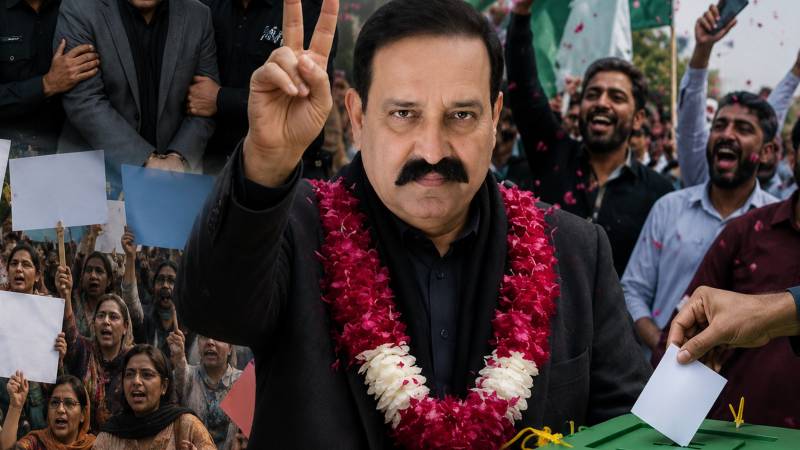
Voters in Mirpur-IV, in Pakistan-administered Kashmir, have just re-elected Chaudhry Rukhsar Ahmed, 62, with 22,376 votes, defeating the Pakistan Peoples Party's Sohaib Arshad, who took 15,851 votes. At the same time, Ahmed is the subject of an active Greater Manchester Police investigation into allegations of child rape and trafficking. Ahmed, however, "categorically" denied all these allegations, saying that he would “address these matters through the appropriate forums.” He has not been charged, and under UK law he is presumed innocent unless a court finds otherwise. But the sequence around his return to office is hard to look past: an arrest, release on bail, a public campaign, a missed bail appointment, and a decisive win on the ruling party's ticket. None of that settles his guilt or innocence. All of it raises questions about the people who put him on the ballot.
Ahmed is a longtime figure in Manchester's Pakistani community, once the owner of the Gujjar Palace restaurant near the city's Curry Mile, a business that has stood boarded up and empty since at least 2009, though Ahmed remains its sole listed company director. He was arrested at Manchester Airport on 18 July 2024, over allegations initially reported by The Guardian and carried since by other outlets that he raped and trafficked at least two women when they were children in care homes in Rusholme, Manchester, in the early 1990s, when he was in his late twenties. Police wanted a bail condition barring Ahmed from leaving the country, but a judge declined to impose one in July 2024.
Last month, Ahmed was due to answer bail at a Manchester police station; he did not appear, saying he was too unwell to fly, even as photographs showed him campaigning at rallies in Mirpur. He now faces a further bail date, and police have warned that continued non-appearance could prompt a warrant for his arrest or extradition proceedings, a step that could strain relations between London and Islamabad. None of this has been tested in court, and that distinction matters throughout this account. But it does not make the case irrelevant to an election, or to the party that ran him.
The case sits at the meeting point of three things that matter here: a survivor's right to be heard and taken seriously, an accused person's right to due process, and a voter's right to know who they are electing. If the allegations are true, they describe some of the worst forms of gender-based violence, the rape and trafficking of children, compounded by the same pattern of institutional failure that has surfaced again and again in Greater Manchester's grooming-gang cases, across care homes, policing, and social services.
That history shapes how the wider inquiry, Ahmed's case among it, is now understood. A legislature that re-elects a man under this kind of investigation is not making a neutral choice; it is sending a signal, whether intended or not, about whose credibility counts. When there is no visible party review, no apparent cost to his standing, and associates still describing him warmly, this signal women exactly where they rank. PML-N, Prime Minister Shehbaz Sharif's party, gave Ahmed its ticket while knowing, or being in a position to know, about the UK investigation. One senior PML-N figure noted that he had known Ahmed for two decades but had only heard that he "was part of some groups in Manchester in the 1990s," and said he had not known how serious the allegations were.
That is the problem in miniature: a candidate under live investigation for sexual violence, a party willing to run him regardless, and vague, evasive answers once questions were raised, a governance failure that stands on its own, independent of whatever a British court eventually decides. Institutional credibility on this kind of issue is not established by legal outcomes alone; it is built through how seriously the people with power to act- police, immigration and extradition authorities, political parties choosing who to endorse- treat allegations like these. When a party's response to rape and trafficking allegations is silence, it sends its own message: that women's safety is a line item that can be managed around an election calendar.
The case sits at the meeting point of three things that matter here: a survivor’s right to be heard and taken seriously, an accused person’s right to due process, and a voter’s right to know who they are electing.
There is a cross-border dimension too. Ahmed kept his political career alive in Pakistan-administered Kashmir while UK bail obligations went unmet, which points to a real structural vulnerability: distance and jurisdictional friction can let an accused person delay accountability while using elected office to reinforce his standing at home. For the women who came forward, watching this play out from abroad is likely to reinforce a familiar and corrosive lesson: that institutions move faster to protect political convenience than to protect them.
This extends well beyond one case. The wider Greater Manchester inquiry into 1990s-era grooming networks has already produced convictions elsewhere. In a separate Rochdale case, involving different defendants, seven men, Mohammed Zahid, Mushtaq Ahmed, Kasir Bashir, Mohammed Shahzad, Naheem Akram, Nisar Hussain, and Roheez Khan, were convicted in June 2025, with sentencing following on 2 October 2025; ringleader Mohammed Zahid received 35 years, and the others received 12 years or more. Ahmed's case sits within that same landscape of historic institutional failure, though it is a separate matter with no reported connection between the two. The larger question it poses is whether accountability for gender-based violence can survive contact with electoral politics and cross-border legal friction, or whether elected office quietly becomes a kind of informal shield.
None of this requires presuming Ahmed's guilt. It requires transparency proportionate to what is being alleged: parties disclosing what they knew and when before handing out a ticket, election authorities setting clear standards for candidates under investigation for serious violent or sexual offences, and UK-Pakistan diplomatic and law-enforcement channels operating without any appearance of deference to a sitting legislator's convenience. None of those measures would prejudge Ahmed's guilt or innocence. All of them would signal, to the women whose allegations opened this investigation and to the wider public, that credibility and safety are not negotiable items on a campaign calendar. Ahmed remains, in the eyes of the law, an innocent man facing serious allegations he denies. He is also, as of this month, an elected legislator, back in the assembly after five years out of office. Holding both facts at once, without minimising either, is the task his party and the institutions around him have so far declined to take up. That failure is as much a part of this story as the allegations themselves.