

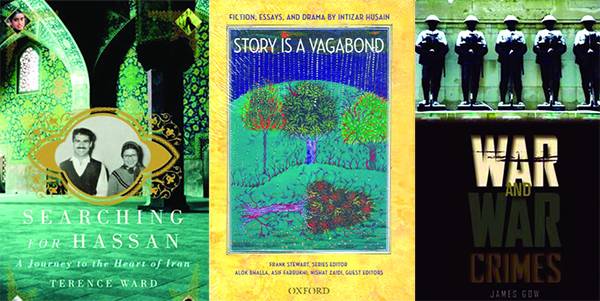
Searching for Hassan: A Journey to the Heart of Iran
Terence Ward
Anchor Books (paperback), 2003
PRs 1858
The unique culture of Iran and the sweep of its history are revealed in this evocative travelogue of an American family searching for a lost friend in the country of their youth.
Growing up in Tehran in the 1960s, Terence Ward and his brothers were watched over by Hassan, the family’s cook, housekeeper, and cultural guide. After an absence of forty years, Ward embarked on a pilgrimage with his family in search of Hassan. Taking us across the landscape of Iran, he plumbs its unimaginably rich past, explores its deep conflicts with its Arab neighbors, and anticipates the new “Great Game” now being played out in central Asia. Insightful, informative, and moving, Searching for Hassan enhances our understanding of the Middle East with the story of a family who came to love and admire Iran through their deep affection for its people.
Islamophobia, Victimisation, and the Veil
Irene Zempi and Neil Chakraborti
Palgrave Pivot (hardcover), 2014
PRs 8955
This book examines the experiences of veiled Muslim women as victims of Islamophobia, and the impact of this victimisation upon women, their families and wider Muslim communities. It proposes a more effective approach to engaging with these victims; one which recognises their multiple vulnerabilities and their distinct cultural and religious needs.
Reviews
“Since 9/11 acts of hate directed at Muslim communities have become one of contemporary society’s most significant social issues. Drawing upon their own ground-breaking research, renowned experts Zempi and Chakraborti have produced a superb work that details the harms caused by Islamophobic faith hate targeted against veiled women. Their findings, brilliantly outlined here, offer new and important insights into the nature and impact of gendered aspects of Islamophobia and exemplify why Islamophobia, Victimisation and the Veil will become the key text for scholars and practitioners working in this area.” - Jon Garland, University of Surrey, UK
“Zempi and Chakraborti have produced a timely, insightful and authoritative analysis of the nexus between Islamophobia, visibility, victimisation and discourses of the veil. By interrogating the veil as a marker of Muslim ‘otherness’ they expose how popular stereotypes contribute to intolerance towards veiled Muslim women but also to global relations between Islam and the West. They skillfully blend cutting-edge empirical research with larger critiques of vulnerability and identity to offer a much-needed, accessible and unique analysis of the gendered dimension of Islamophobic victimisation.” - Gail Mason, University of Sydney, Australia
Story is a Vagabond
Intizar Husain
Oxford (hardcover), 2015
PRs 1995
One of Pakistan’s most distinguished writers, Intizar Husain was born in India in 1923 and immigrated to Pakistan during the Partition. An internationally acclaimed writer, critic, and translator, he has published seven volumes of short stories, four novels, and a novella, as well as travelogues, memoirs, and critical essays. Despite his importance to world literature for over six decades, Husain’s writing is little known in English translation. Story Is a Vagabond is the first collection in English to show the breadth of his thoughtful, innovative, and compassionate work.
Intizar Husain’s numerous honors include the Yatra Award, Pride of Performance, Kamal-i-Fun Award, Adabi Award, ARY Gold Award, Pakistan’s Sitara-e-Imtiaz, Lifetime Achievement Award from the Lahore Literary Festival, and France’s Ordre des Arts et des Lettres. In 2013, he was short-listed for the prestigious Man Book Prize in Fiction.
War and War Crimes
James Gow
Hurst (paperback), 2013
PRs 3680
The laws of war have always been concerned with issues of necessity and proportionality, but how are these principles applied in modern warfare? What are the pressures on practitioners where an increasing emphasis on legality is the norm? Where do such boundaries lie in the contexts, means and methods of contemporary war? What is wrong, or right, in the view of military-political practitioners, in how those concepts relate to today’s means and methods of war? These are among the issues addressed by James Gow in his compelling analysis of war and war crimes, which draws upon research conducted over many years with defence professionals from all over the world. Today more than ever, military strategy has to embrace justice and law, with both being deemed essential prerequisites for achieving success on the battlefield. And in a context where legitimacy defines success in warfare, but is a fragile and contested concept, no group has a greater interest in responding to these pressures and changes positively than the military. It is they who have the greatest need and desire to foster legitimacy in war by getting the politics-law-strategy nexus right, as well as developing a clear understanding of the relationship between war and war crimes, and calibrating where war becomes a war crime.
Turning Points
APJ Abdul Kalam
Harper Collins (paperback), 2012
PRs 500
It was like any other day on the Anna University campus in Chennai. I had delivered a lecture ‘Vision to Mission’ and the session got extended from one hour to two. I had lunch with a group of research students and went back to class. As I was returning to my rooms in the evening the vice-chancellor, Prof. A. Kalanidhi, fell in step with me. Someone had been frantically trying to get in touch with me through the day, he said. Indeed, the phone was ringing when I entered the room. When I answered, a voice at the other end said, ‘The prime minister wants to talk with you...’ Some months earlier, I had left my post as principal scientific adviser to the government of India, a Cabinet-level post, to return to teaching. Now, as I spoke to the PM, Atal Bihari Vajpayee, my life was set for an unexpected change. Turning Points takes up the incredible Kalam story from where Wings of Fire left off. It brings together details from his career and presidency that are not generally known as he speaks out for the first time on certain points of controversy. It offers insight not only into an extraordinary personality but also a vision of how a country with a great heritage can become great in accomplishment, skills and abilities through effort, perseverance and confidence. It is a continuing saga, above all, of a journey, individual and collective, that will take India to 2020 and beyond as a developed nation.