

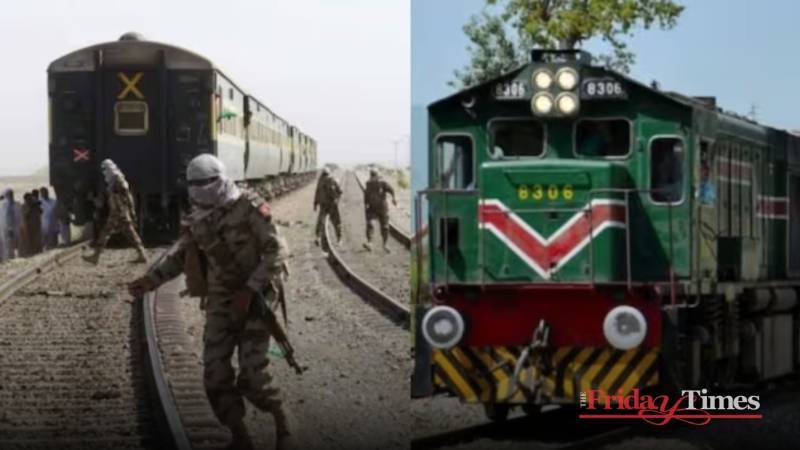
A heated debate continues across the country over the unprecedented and daring attack on the Jaffar Express by the Baloch separatist group. Meanwhile, government and security officials have expressed concerns over social media narratives that allegedly malign the authorities. However, less attention is being given to the inconsistencies in official reporting, which raise serious questions about transparency and accountability.
From the very first day, the reported figures of passengers, security personnel, and attackers have remained inconsistent. On March 12, 2025, a press report stated that railway officials had reported around 750 passengers booked for the Jaffar Express, but the train left Quetta with around 450 people onboard. The same report, citing sources, mentioned that over 200 security personnel were also traveling on the train. It also quoted Imran Hayat, the Railways Divisional Superintendent in Quetta, as saying that at least ten people—including the locomotive driver and eight security personnel—had lost their lives, while 104 hostages were reported as rescued.
On March 13, 2025, the DG ISPR announced that all remaining Jaffar Express hostages had been rescued, with 33 attackers killed. He stated that 21 passengers and four FC soldiers had been martyred, creating the impression that all 21 fatalities were civilians. However, two days later, another report revised these figures, revealing that a total of 26 hostages had lost their lives, including 18 military and Frontier Corps personnel, three railway employees, and five civilians. The number of rescued passengers was also updated to 354.
On March 18, 2025, yet another report surfaced, claiming that, in addition to the 18 security personnel previously reported as martyred, five more had lost their lives during the operation. However, in the military briefing to the assembly on the same day, officials reiterated that only 18 military personnel were among the victims, further deepening the inconsistencies in the official figures.
The ultimate responsibility of the government and security officials is to ensure an accurate count of all victims, leaving no room for discrepancies. Failing to do so would rightfully give the victims' families the right to question the competence of those in charge
During the operation, where innocent lives were at stake and attackers had suicide bombers positioned among the passengers, some level of misreporting was inevitable. However, once the operation ended and hostages were rescued, it became crucial to provide an accurate tally of all individuals involved. Initial reports stated that the train carried 450 passengers and 200 security personnel, yet no subsequent official reports have accounted for these 200 security personnel. Since the original figures came from the Railway Department, the possibility of an error seems unlikely. If the numbers were incorrect, it was the responsibility of the authorities to clarify them—yet no such clarification has been issued.
The idea that over a hundred army personnel traveling home would have been left unprotected in an insurgency-hit region seems improbable. Given the daily attacks on security forces in Balochistan, it is highly unlikely that a train carrying a large number of military personnel would have been allowed to travel without proper security coverage.
Tallying the figures provided by DG ISPR, a total of 387 individuals have been accounted for, comprising 354 rescued and 33 martyred. However, official briefings stated that 440 passengers were onboard, leaving 53 passengers unaccounted for. Furthermore, if the previously reported 200 security personnel are included, the total number of missing individuals rises to 253. These numbers also exclude essential train personnel, such as the train driver and assistant, railway guards, kitchen staff, and vendors, which could add at least 20 more unaccounted individuals. This raises serious concerns about the completeness and accuracy of the official reports.
Adding to this mystery, a report from the Baloch Liberation Army (BLA) claimed they had taken 214 passengers hostage and warned of executions if their demands were not met within 48 hours. While this claim has not been independently verified, the missing details in the DG ISPR’s report raise serious concerns about the exact number of rescued or martyred passengers.
These inconsistencies raise pressing questions about whether any passengers remain unaccounted for, whether casualties are yet to be officially acknowledged, or whether there was an error in the reported numbers. The shifting narratives surrounding the number of passengers, hostages, and missing individuals create confusion and undermine trust in official statements. If security personnel were indeed present on the train, their role and response during the crisis also need scrutiny. Were they adequately equipped and trained to handle such a situation? Did they have intelligence regarding potential threats along the route?
A recent report reveals that DG Balochistan Levies, Abdul Ghaffar Magsi, has issued a strict directive against negligence and cowardice among Levies personnel in response to recent terrorist attacks. At the same time, another report states that the Balochistan government has established a counter-terror wing within the Levies Force, where officials will receive specialised counterterrorism training and modern weaponry.
These reports raise an important assumptive question: were the 200 security personnel assigned to the Jaffar Express actually from the Levies Force, as some might assume? If so, this raises serious concerns about the decision-making of top security officials. Deploying an ill-equipped and inadequately trained force to protect a train that was a predictable target for insurgents—who, according to repeated claims by the government and security agencies, now possess advanced U.S. weaponry left behind in Afghanistan—reflects a critical lapse in risk assessment. This highlights a fundamental flaw in the security agencies' risk evaluation process and underscores the urgent need for comprehensive training across the entire security apparatus, not just the Levies Force.
Beyond these observations, the ultimate responsibility of the government and security officials is to ensure an accurate count of all victims, leaving no room for discrepancies. Failing to do so would rightfully give the victims' families the right to question the competence of those in charge. A crisis of this magnitude demands not only answers but also accountability.