

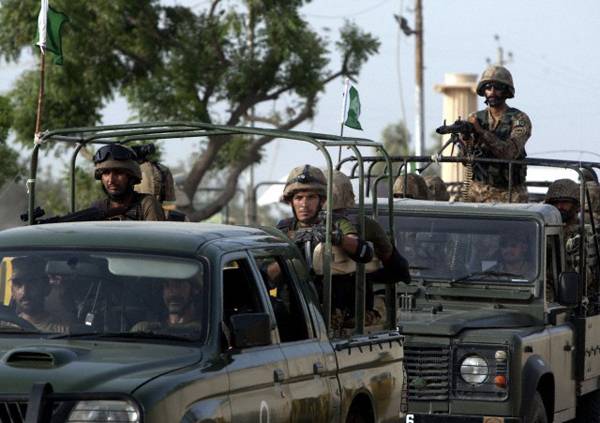
Operation "Zarb-e-Azb", a concentrated campaign by the Pakistan armed forces against the militant threat present in the tribal belt, specifically North Waziristan, officially began last weekend. The term literally means a strike from the weapon of the Holy Prophet Muhammad (PBUH), and sets a very specific tone about the state's belief in its own righteousness, justice and rectitude. It is also a marked departure from the nomenclature used in the previous operations, respectively "Rah-e-Raast" or "The Right Path", and "Rah-e-Nijaat" or "The Path to Deliverance". The message is clear: this is the Lord's work, and the terrorists will be struck down by the same sword of justice that eradicated the oppressors nearly 15 centuries ago. It is a clever public relations move, one that draws a very precise line, and provides a strong front to the operation.
In fact, this rhetoric seems deeply embedded in both political and military quarters. The new religious idiom is further reinforced by a shift in operational tone, and endgame objectives. While the previous two operations were conducted to clear the militants out of specific areas, both the political leadership and the armed forces high brass claims this operation is to categorically and surgically remove this existential threat from Pakistan.
Chief of the Army Staff General Raheel Sharif, a man entrusted with the enviable task of protecting Pakistan against this elusive, cunning, ruthless threat, as man who also has a family legacy to preserve and honor, did not mince his words on Monday. "We will rid the country of terrorists", he said stone-faced and unflinching, addressing participants of the National Security and War Course at the National Defense University.
On the same day, Prime Minister Nawaz Sharif addressed lawmakers gathered in the National Assembly and the Senate, echoing the sentiments of the COAS. Emotionally charged and cautiously worded, Sharif's speech established three distinct points. First, that the operation "will not end until all terrorists are eliminated". Second, that the operation was being conducted with the consultation of the armed forces. And third, that the government had now been forced to take action, as their attempts to negotiate had not been reciprocated.
Most notably, despite a clamor from other political parties about not being taken into confidence about the operation, the vast majority, including the firebrand PTI, supported the decision. "No compromises should be made," said Leader of Opposition Khurshid Shah. "We are with our military leadership." The thrust is undeniable. Criticism notwithstanding, politicians and soldiers stand united, ready for the fight that they will take to the enemy, and ready for the fight that militants have sworn will be brought to their streets.
Inevitably, the media machine on the other side is also in full swing, the spin doctors feverishly, strenuously endeavoring to build some momentum for their cause. They have accused the Pakistani government of killing innocent women and children with their bombardments, they have threatened that the federal capital of Islamabad, and the provincial capital of Lahore will burn, they have warned foreign investors to leave Pakistan. “We’re in a state of war,” Shahidullah Shahid, a spokesman for the Tehrik-e-Taliban Pakistan ( TTP) said in a statement on Sunday. “Foreign investors, airlines, and multinational companies should cut off business with Pakistan immediately and leave the country or else they will be responsible for their damage themselves.”
The board is set. The pieces are in place. The operation is in full swing, with both sides engaging in all out warfare. It is an existential struggle. For the militants it is the possibility of complete eradication. For the government, a failure to bring peace will wreck their credibility, and paint them unable to provide that most basic tenant of the social contract: provide security for its citizens.
The most important question that needs to be asked at this stage is what happens after the operation? Even if the military is successful in completely eliminating the physical presence of the TTP and other foreign groups, the idea behind these groups cannot be eliminated by sheer force, or force of will. These groups operate in our main cities, walking among us as ordinary citizens, indistinguishable faces in the crowd. Phase one, the operation, sounds good on paper, provides a rallying cry for politicians, the military, media, the general public, and provides a romanticized metaphor for the fight between good and evil. But what is phase two? How do we build a sense of moral righteousness in the long term? How do we root out extremism, not just as fleeing fighters, but as an idea? How so we inculcate tolerance and acceptance into the larger Pakistani society? How do we ensure that today's sacrifices are not considered in vain retrospectively, ten years from now, when the status quo remains the same?
We are at a strange tipping point. All stakeholders seem to be very keen and very clear on what needs to be done now, but no clear discourse, let alone consensus, exists on not what needs to be done after what needs to be done now. The answer to this question, holds the key for a peaceful Pakistan.
The author is a journalist and a development professional, and holds a Master’s degree in strategic communications from Ithaca College, New York.
Email: zeeshan[dot]salahuddin[at]gmail[dot]com
Twitter: @zeesalahuddin
In fact, this rhetoric seems deeply embedded in both political and military quarters. The new religious idiom is further reinforced by a shift in operational tone, and endgame objectives. While the previous two operations were conducted to clear the militants out of specific areas, both the political leadership and the armed forces high brass claims this operation is to categorically and surgically remove this existential threat from Pakistan.
Chief of the Army Staff General Raheel Sharif, a man entrusted with the enviable task of protecting Pakistan against this elusive, cunning, ruthless threat, as man who also has a family legacy to preserve and honor, did not mince his words on Monday. "We will rid the country of terrorists", he said stone-faced and unflinching, addressing participants of the National Security and War Course at the National Defense University.
On the same day, Prime Minister Nawaz Sharif addressed lawmakers gathered in the National Assembly and the Senate, echoing the sentiments of the COAS. Emotionally charged and cautiously worded, Sharif's speech established three distinct points. First, that the operation "will not end until all terrorists are eliminated". Second, that the operation was being conducted with the consultation of the armed forces. And third, that the government had now been forced to take action, as their attempts to negotiate had not been reciprocated.
Most notably, despite a clamor from other political parties about not being taken into confidence about the operation, the vast majority, including the firebrand PTI, supported the decision. "No compromises should be made," said Leader of Opposition Khurshid Shah. "We are with our military leadership." The thrust is undeniable. Criticism notwithstanding, politicians and soldiers stand united, ready for the fight that they will take to the enemy, and ready for the fight that militants have sworn will be brought to their streets.
Inevitably, the media machine on the other side is also in full swing, the spin doctors feverishly, strenuously endeavoring to build some momentum for their cause. They have accused the Pakistani government of killing innocent women and children with their bombardments, they have threatened that the federal capital of Islamabad, and the provincial capital of Lahore will burn, they have warned foreign investors to leave Pakistan. “We’re in a state of war,” Shahidullah Shahid, a spokesman for the Tehrik-e-Taliban Pakistan ( TTP) said in a statement on Sunday. “Foreign investors, airlines, and multinational companies should cut off business with Pakistan immediately and leave the country or else they will be responsible for their damage themselves.”
The board is set. The pieces are in place. The operation is in full swing, with both sides engaging in all out warfare. It is an existential struggle. For the militants it is the possibility of complete eradication. For the government, a failure to bring peace will wreck their credibility, and paint them unable to provide that most basic tenant of the social contract: provide security for its citizens.
The most important question that needs to be asked at this stage is what happens after the operation? Even if the military is successful in completely eliminating the physical presence of the TTP and other foreign groups, the idea behind these groups cannot be eliminated by sheer force, or force of will. These groups operate in our main cities, walking among us as ordinary citizens, indistinguishable faces in the crowd. Phase one, the operation, sounds good on paper, provides a rallying cry for politicians, the military, media, the general public, and provides a romanticized metaphor for the fight between good and evil. But what is phase two? How do we build a sense of moral righteousness in the long term? How do we root out extremism, not just as fleeing fighters, but as an idea? How so we inculcate tolerance and acceptance into the larger Pakistani society? How do we ensure that today's sacrifices are not considered in vain retrospectively, ten years from now, when the status quo remains the same?
We are at a strange tipping point. All stakeholders seem to be very keen and very clear on what needs to be done now, but no clear discourse, let alone consensus, exists on not what needs to be done after what needs to be done now. The answer to this question, holds the key for a peaceful Pakistan.
The author is a journalist and a development professional, and holds a Master’s degree in strategic communications from Ithaca College, New York.
Email: zeeshan[dot]salahuddin[at]gmail[dot]com
Twitter: @zeesalahuddin