

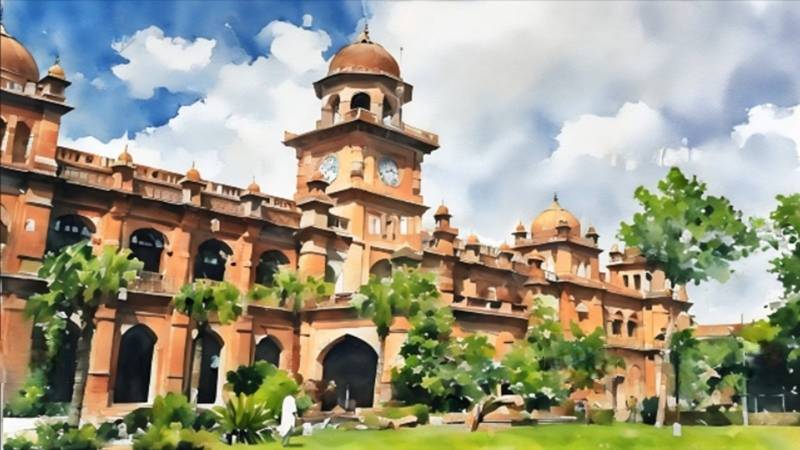
Lieutenant General Arshad Mehmood was born in August 1940 in Kotli, Azad Kashmir. After receiving formal education at Faiz-ul-Islam high school in Rawalpindi and Government College Lahore, he went on to earn two master’s degrees from Quaid-e-Azam University, Islamabad. His first master’s degree was in Military Policy & Operational Strategy and his second master’s degree was in Defence Studies & National Policy. Lt Gen (R) Arshad Mahmood has a distinguished career in both military and academic leadership. He has Served in various command and staff appointments in the Pakistan Army until his retirement in 2015. He has then served as the Vice Chancellor of the University of the Punjab, where he was recognized for his administrative and intellectual contributions. (c 1999 – 2007). He is a recipient of the Hilal-i-Imtiaz (Military) and Sitara-e-Jurat.
Title: Legacy Beyond Leadership: The role of moral authority in creating sustainable change
Author: Lt Gen (R) Arshad Mahmood, HI (M), SJ
Publisher: University of Punjab, April 2025
He authored the book Legacy Beyond Leadership to explore the role that moral authority creates in sustainable change. The book was formally launched in October 2025 through a series of ceremonies at major academic institutions in Pakistan including UET and the University of the Punjab.
In his book he has outlined the 4Hs of leadership values which according to him enable leaders to provide surplus value to an organization. According to the author these are Honesty, which represents a leader’s integrity and transparency in managing people and processes, fostering trust. Hard work which sets an example of commitment to results and continuous effort toward excellence. Humility, often underestimated, however a humble leader maintains an open-door policy, recognizes others contributions and promotes a positive work atmosphere. Finally, Honor, exhibited through upholding moral and ethical standards creates surplus value by instilling principled moral values throughout the organization. His 4Cs of leadership – Character, Capacity and Competence – provide a framework for assessing leadership effectively while his 7Ps for Leadership – Purpose, Principles, Practices, People, Politics, Processes and Progress – offer a structed approach to official change. His insights are not just relevant for administrators and policymakers but are meaningful for young students and leaders who wish to bring about change.
After a decorated career in the Pakistan Army, he applied his disciplined approach to the academic sector as a university administrator
In his book, Lt Gen Arshad Mahmood emphasizes that true leadership is not derived from positional power or authority, but from: Character and Ethics: The foundation for inspiring others. Moral Authority: Utilizing ethical standards to drive long-term, sustainable institutional and social change. Legacy and Mentorship: The importance of building a legacy that extends beyond one's tenure, particularly through the development of future leaders. Lt Gen (R) Arshad Mahmood’s legacy is defined by his transition from a high-ranking military commander to a transformative academic leader. His book, Legacy Beyond Leadership, synthesizes these experiences into a philosophy focused on moral authority. The book argues that enduring leadership is built on internal character rather than external rank.
Key principles include:
- Moral Authority over Positional Power: Real influence comes from earning the respect of followers through ethical consistency, not just exercising legal authority.
- Character and Ethics as Foundations: Effective leadership is rooted in the “ability to inspire positive change” through personal integrity.
- Sustainable Institutional Change: The goal of a leader should be to create systems that outlast their tenure, driven by shared values rather than temporary directives.
- Knowledge as Action: The author believes the purpose of education and leadership is to “act upon knowledge in real life” rather than just possessing degrees or titles.
Lt Gen (R) Arshad Mahmood served as the Vice Chancellor (VC) of the University of the Punjab for approximately eight years (c. 1999–2007). His tenure was marked by rapid expansion and modernization: He established several new specialized colleges and departments, including the Punjab University College of Information Technology (PUCIT), the College of Banking and Finance, and the Institute of Environmental Sciences. He is credited with launching four-year BS (Hons) programs across various departments and integrating national philosophies, such as the works of Allama Iqbal, into the curriculum. He increased university revenue significantly by introducing self-finance programs, though this move faced criticism from some faculty groups who favored traditional research focuses over commercialization. Known for a disciplined approach, his tenure also saw a record number of “anticipatory orders” to bypass bureaucratic delays, which remains debatable to date in the university's history.
The book includes a great many Allama Iqbal poems and quotations from the Holy Quran which the author uses to get his point across to the audience, and they are all very apt. It makes sense to intertwine his message with quotes from Holy Scripture and poetry. As the author says, and I quote: “To me leading a purpose-driven life and pursuing our professions with a sense of purpose is more sustainable and fulfilling than solely seeking material gains.” I couldn’t agree more with Lt Gen (R) Arshad Mehmood. One should always enjoy one’s work and have a purpose in life, only then can one achieve true happiness, especially if that purpose involves helping others, as the author has done his entire life. I found the book a bit tedious to read at places but overall, it is a great book to read to learn about life and how it should be led, as an example from the front. I would recommend it to others if they have time on their hands because it is a thick book with numerous photos as well.