

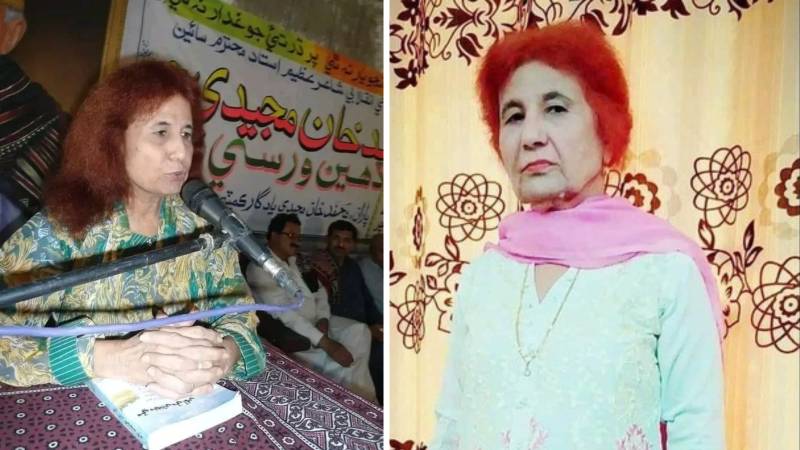
Sindhi literature lost one of its most devoted voices on Monday morning when eminent poetess, writer, historian, columnist, and educationist Apa Mariyam Majeedi passed away after a brief illness at a private hospital in Hyderabad. She was 80.
The daughter of seasoned Sindhi poet Muhammad Khan Majeedi, Mariyam Majeedi was widely regarded as the custodian of her father’s poetic legacy. Yet she was far more than a keeper of memory—she was a creator in her own right, whose relentless contribution to Sindhi literature spanned genres, generations, and causes.
Born on 15 June 1946 in the village of Qaisar Khan Jatoi, Taluka Mirpur Bathoro, District Sujawal, she grew up steeped in the literary traditions her father nurtured. After completing her early education in Darro and Sujawal town, she moved to Hyderabad, where she earned her graduation in Education and a Master’s degree in Sindhi literature from the old campus of Sindh University.
In 1964, she entered the noble profession of teaching, a path she walked for over four decades. As a teacher and head teacher in schools across Sindh, she educated thousands of students, with a particular focus on girls’ education. Her classrooms became spaces where language, culture, and confidence took root.
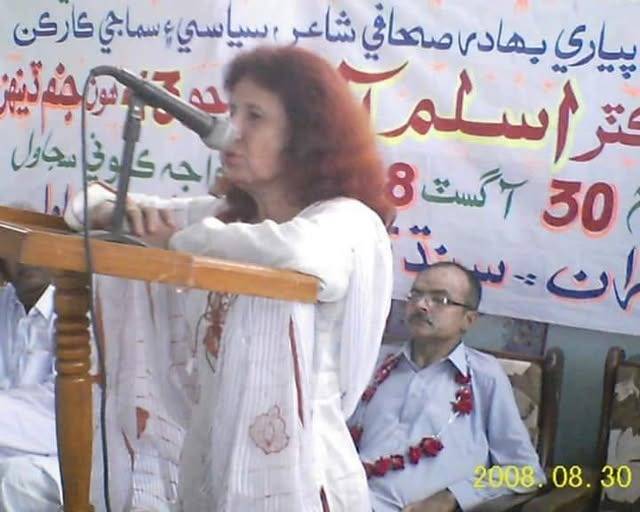
Her literary journey began in 1975 when she started writing for Sindh Daily Barsat, and her first poem appeared that same year. Four years later, her voice reached a wider audience with the publication of her first poetry collection, Srom Dukham Dukham, in 1986. The book won several awards for best poetry collection and established Majeedi as a household name in Sindhi poetry. Recognition followed steadily: the Sindhi Adabi Sangat Lifetime Achievement Award, Mirza Qaleech Baig Award, Shah Latif Shield, Noori Jam Tamachi Award, and Sarvech Sujawali Award, among others. Her second collection, NERANA HI NEN, published in 2012, earned unparalleled recognition among literary critics.
The octogenarian poetess mastered nearly every form of poetry—nazm, wai, ghazal, triolet, terza rima, quartet, pentastich, and baits—giving voice to both the struggles of Sindh and its people and the tender currents of romance. Her work lives on in two published collections, Sarom Dukham Dukham and Nerana Ee Nein. Beyond poetry, she was also an accomplished essayist and columnist, with her book of articles, Man Barchi Man Ghao, adding another dimension to her literary legacy.
She also authored articles apropos to literary criticism for various Sindhi dailies, including Daily Kawish, Sindh Express, and Awami Awaz, among others. In her poetry and prose alike, she consistently highlighted the social and traditional issues of Sindh, while vehemently advocating Sindh’s fundamental rights, much like her father Muhammad Khan Majeedi before her.
Her commitment to principle carried a price. For opposing local government laws in 2012, she was booked in a terror case by the state—a testament, supporters say, to the sharpness of her pen and the courage of her convictions.
News of her passing drew an outpouring of grief from across Sindh’s literary community. Noted figures including Dr. Muhammad Ali Manjhi, Ayaz Ammar Sheikh, Zubair Aziz Jaffrani, Ahmed Baran, and Sajan Surahi expressed deep sorrow at her demise. PPP Senator Sassui Palijo, MPA Rehana Laghari, Heer Suho, and others also sent condolence messages to the bereaved family.
With her passing, Sindh loses not only a poet and educator but a voice that spoke unflinchingly for its language, its people, and its rights.