

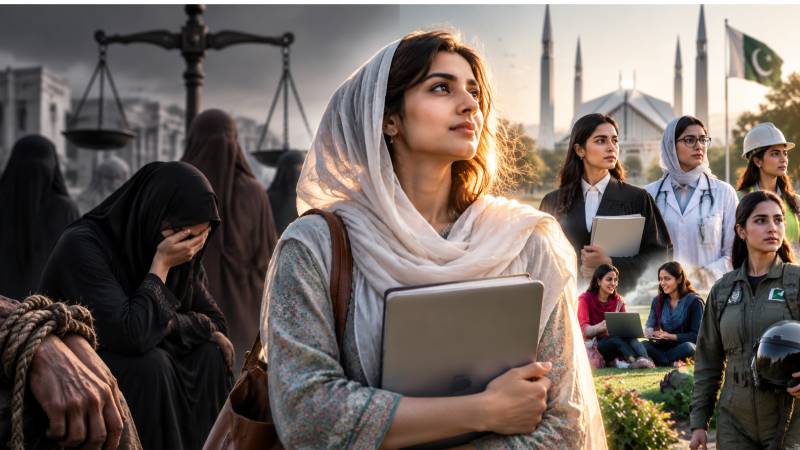
Women's rights remain one of the most significant legal and social issues both nationally and internationally. The protection of these rights is essential not only for safeguarding human dignity but also for promoting economic development and social progress. Discrimination, harassment, and unequal treatment prevent many women from participating fully in society and the workforce. In Pakistan, women continue to face numerous obstacles in exercising their rights due to cultural, social, economic, and political barriers. Consequently, a critical legal analysis of women's rights and the effectiveness of existing protections is necessary to identify shortcomings and propose meaningful reforms.
Women constitute nearly half of Pakistan's population, and their insecurity directly affects the country's social and economic development. When women are unable to work, study, or participate freely in public life due to fear of harassment and discrimination, the nation loses a substantial portion of its human capital. Recognizing these concerns, Pakistan has enacted various laws to protect women, particularly in the workplace and the general sphere. Among the most significant is the Protection Against Harassment of Women at the Workplace Act, 2010 (“PHWPA 2010”), which established a legal framework enabling women to lodge complaints and imposed a duty upon employers to provide a safe working environment. In addition, provisions of the Pakistan Penal Code (“PPC”) provide criminal sanctions against conduct that threatens women's safety and dignity.
The effectiveness of the PHWPA 2010 is evident in several cases. A notable example is the PASSCO Officials Harassment Case, in which the Federal Ombudsperson Secretariat for Protection Against Harassment (“FOSPAH”) upheld the dismissal of three senior officials for victimizing female employees, spreading false rumours, and misusing CCTV surveillance. The decision reinforced the principle that workplace harassment extends beyond physical misconduct and includes behaviour that creates a hostile and degrading work environment. Such cases demonstrate the potential of the law when properly implemented.
One major weakness lies in the failure of many organizations to establish or maintain functional Inquiry Committees as required by law. These committees serve as the first line of response to workplace harassment complaints, yet many institutions either neglect to establish them or allow them to operate ineffectively. To strengthen implementation, organizations should be required to submit periodic compliance reports to relevant regulatory bodies, while committee members should receive regular training to ensure impartiality, accountability, and professional competence. Enhanced monitoring mechanisms would significantly improve confidence in the complaint process and help reduce workplace harassment.
Another limitation arises from the narrow judicial interpretation sometimes adopted by courts. In several instances, harassment has been treated primarily as sexual misconduct rather than as a broader category encompassing bullying, intimidation, humiliation, and gender-based mistreatment. Such restrictive interpretations undermine the legislative objective of ensuring dignity and equality in the workplace. Harassment should be understood as any conduct that creates an intimidating, hostile, or offensive environment for women, regardless of whether the conduct is explicitly sexual in nature. A broader interpretation would better reflect the purpose of the legislation and strengthen protection for victims.
One major weakness lies in the failure of many organizations to establish or maintain functional Inquiry Committees as required by law.
The effectiveness of harassment laws is also closely linked to the quality and independence of the judiciary. Greater female representation within the judiciary can contribute to a more diverse and inclusive legal system while increasing public confidence among victims seeking justice. Equally important is judicial independence, which ensures that decisions are based solely on law and evidence rather than the influence of powerful employers or institutions. A judiciary that is both diverse and independent is better positioned to deliver fair outcomes in sensitive harassment cases.
A significant concern remain regarding the sustainability and effectiveness of these programmes initiated by the Punjab Government recently. Limited financial resources, inadequate technological infrastructure, and shortages of trained personnel may undermine long-term success. Digital complaint systems, for example, can only be effective if citizens possess reliable internet access and the necessary digital literacy skills. To ensure lasting impact, governments must invest in infrastructure, monitoring systems, public awareness campaigns, and regular staff training. Expanding access to services in rural areas and increasing the recruitment of female police officers and investigators would further strengthen women's confidence in reporting harassment and seeking assistance.
Despite legal reforms, harassment remains widespread, while reporting rates often remain low due to social stigma, fear of retaliation, and limited trust in institutions. These challenges weaken the justice system, reduce women's workforce participation, and perpetuate gender inequality. In response to concerns regarding public safety, some law-enforcement bodies have adopted aggressive enforcement strategies. However, measures that compromise due process, the presumption of innocence, or the right to a fair trial cannot provide a sustainable solution. The protection of women's rights must occur within the framework of constitutional safeguards and the rule of law. Long-term success requires stronger investigation procedures, efficient prosecution, and effective judicial enforcement rather than reliance on extraordinary or extra-legal measures.
Addressing harassment also requires a deeper examination of its social and cultural causes. Legal remedies alone cannot eliminate behaviour rooted in social attitudes and gender stereotypes. Educational programmes promoting respect, equality, and responsible conduct should be introduced at an early age. Schools should encourage meaningful interaction between boys and girls through curricular and co-curricular activities, fostering mutual respect and normalizing women's participation in all areas of society. Such initiatives can help challenge discriminatory attitudes before they become deeply entrenched.
Women's economic participation is equally important. History demonstrates that societies experiencing significant economic and social advancement often benefit from strong female participation in education, business, public service, and professional careers. Men and women should be viewed as equal contributors to national development. Expanding opportunities for women in both traditional and non-traditional professions can reduce gender stereotypes and promote greater acceptance of women in the workplace.
Encouraging women to enter fields traditionally dominated by men can further contribute to social transformation. Pakistan has already witnessed the success of pioneering women such as Ayesha Farooq, one of the country's first female fighter pilots, Sana Mir, former captain of the national women's cricket team, and Shehrbano Naqvi, a police officer serving in a profession traditionally viewed as male-dominated. Their achievements demonstrate that women can excel in any field when provided with equal opportunities. Similar opportunities should be extended to women at all levels of society, including occupations such as mechanics, carpenters, office staff, drivers, entrepreneurs, and digital content creators.
Workplace safety measures should accompany these opportunities. Employers should adopt practical safeguards such as surveillance systems, transparent complaint mechanisms, secure working environments, and gender-sensitive policies. Such measures can reduce risks while encouraging greater female participation across sectors. When women are provided with the resources, training, and protection necessary to develop their skills, the benefits extend far beyond individual empowerment. Society as a whole gains through increased productivity, economic growth, and social stability.
In conclusion, Pakistan has made important progress in protecting women's rights through legislative reforms, institutional mechanisms, and policy initiatives. However, significant challenges remain in enforcement, judicial interpretation, institutional capacity, and societal attitudes. Sustainable progress requires more than punitive measures; it demands comprehensive legal enforcement, educational reform, cultural transformation, and meaningful economic inclusion. By strengthening institutions, promoting gender equality, and ensuring that women can participate safely and freely in all aspects of life, Pakistan can move from a culture of fear to freedom, dignity, and opportunity for all women.