

Bilal arrived soaked to the bone, his clothes heavy with rainwater, hair dripping. He had ridden from Ghauri Town to F-7 private theatre space . the only venue available for the performance. The downpour that drenched him was a reminder of the unpredictability that working-class artists face. Yet, as the organiser and director, Bilal was the first to arrive, steadfast in his commitment to guide the group.
The space had been rented at a steep rate: 5,000 rupees an hour, for two hours. These are the everyday realities for independent artists in Pakistan, who play a quintessential role in shaping the country’s cultural landscape. Bilal, organiser of the Lok Manch Collective, is one of them. More than a theatre troupe, Lok Manch is an educational platform that engages with urgent social questions, enabling those on the margins to speak and perform before the public. The collective’s influence is difficult to measure, but impossible to ignore.
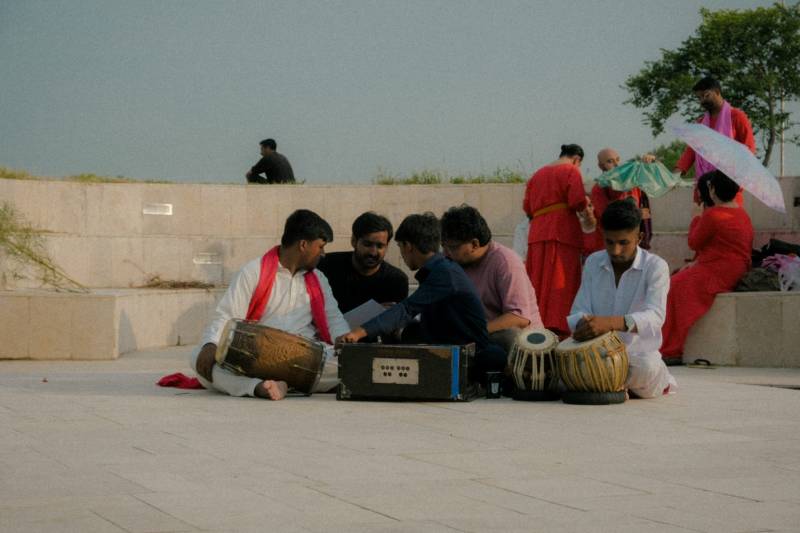
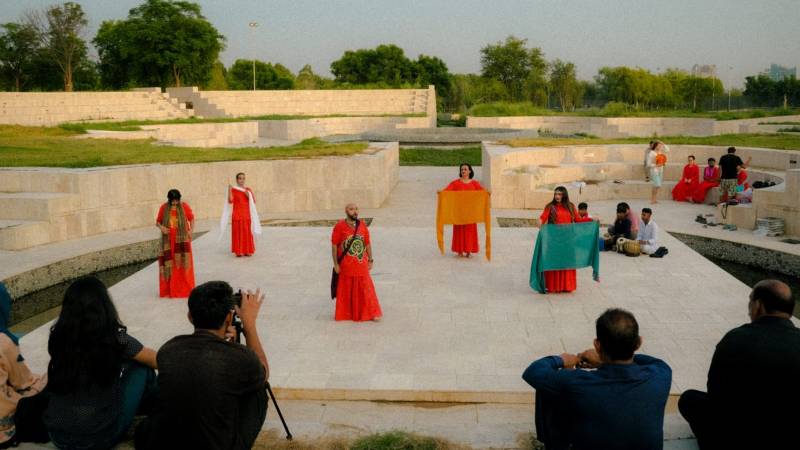
Last weekend at the F-9 Park Amphitheatre, The Lok Manch Collective staged Hun Main Kaun Kahawan Ga (Now Who Shall I Say I Am), inspired by Bulleh Shah’s poetry
Bilal’s journey reflects the larger reality for creative artists in Pakistan: economic hardship, lack of performance spaces, and hostility from those threatened by art that questions power. While the corporate drama industry expands, it sidesteps the most urgent questions. Where are the plays that ask why transgender burn victims die untreated in hospitals? Who profits when glaciers melt and peasants starve? Why do those building homes for others remain without shelter themselves? Extremists target theatre precisely because it disrupts the status quo. In contrast, mainstream television saturates audiences with endless family sagas that avoid confronting systemic injustices.
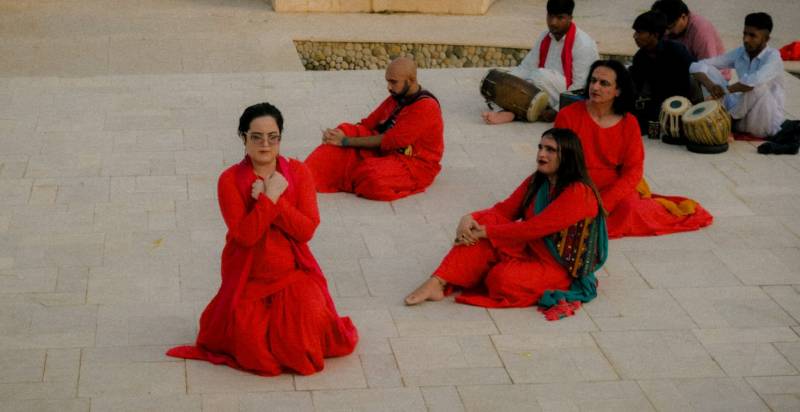
Last weekend at the F-9 Park Amphitheatre, The Lok Manch Collective staged Hun Main Kaun Kahawan Ga (Now Who Shall I Say I Am), inspired by Bulleh Shah’s poetry. The play, created collaboratively without a pre-existing script, explored identity crises and the politics of gender. The production confronted gender discrimination and violence against the transgender community: an issue that cuts across Pakistan’s cities and villages. Through monologues woven with humour, pain, and unflinching honesty, the performers gave voice to real-life experiences of marginalisation and resilience.
The ensemble of thirteen, including three musicians, brought raw emotional depth to the stage. One monologue moved the audience to tears; the performer’s mother wept openly in the crowd. Each story was an act of refusal; a rejection of the rigid categories society imposes and an assertion of the right to exist beyond its narrow definitions.
Drawing from Jerzy Grotowski’s “Poor Theatre” and Augusto Boal’s “Theatre of the Oppressed,” Lok Manch prioritises minimalism, physicality, emotional truth, and audience engagement to push for social and political change. In recent years, the collective has staged performances on climate justice, urban destruction, labour rights, political oppression, and the fight against extremism. These have included works such as Letters to the City, a critique of Islamabad’s rapid commercialisation and loss of heritage; Ahao Haad Kharain (Come, Let’s Pledge), condemning capitalist exploitation of the earth; Tu Zinda Hai (You Are Alive), highlighting the struggles of sanitation workers and residents of katchi abadis; and Aman, Zameen, Roti (Bread, Land, and Peace), a Labour Day production addressing water scarcity and climate injustice. Other works have included Kal to Sooraj Nikley Ga (Tomorrow the Sun Will Rise) on Palestine, the street play Kya Hai Azadi? in Mehrabadi interrogating the meaning of freedom, and the Mashal Day performance in F-6 Markaz countering religious extremism.
After 9/11, extremists intensified attacks on cultural spaces, branding them “un-Islamic.” In 2008, the Rafi Peer World Performing Arts Festival was bombed, injuring twelve and forcing its permanent closure. Yet, theatre has a long history of defying such repression. Groups like Ajoka Theatre, Punjab Lok Rehas, and Tehrik-e-Niswan continued their work under Zia’s martial law, even when public spaces were shut to them and commercial sponsorship evaporated.
For theatre to survive and grow, the state must move beyond neglect. The Ministry of Art and Culture should fund and protect independent artists, facilitate cultural exchanges, and create spaces for performance. Provincial governments must allocate dedicated portions of their arts budgets to support independent troupes, and theatre should be treated as critical cultural infrastructure, safeguarded rather than sidelined. Educational institutions should teach theatre studies and invest in preserving folk performance traditions.
Theatre is not dying; it is locked in a battle of imagination against erasure. Supporting it should not be thought of as charity. It is a defence of Pakistan’s cultural and political future, and an investment in countering extremist thought not only through force, but through art.