

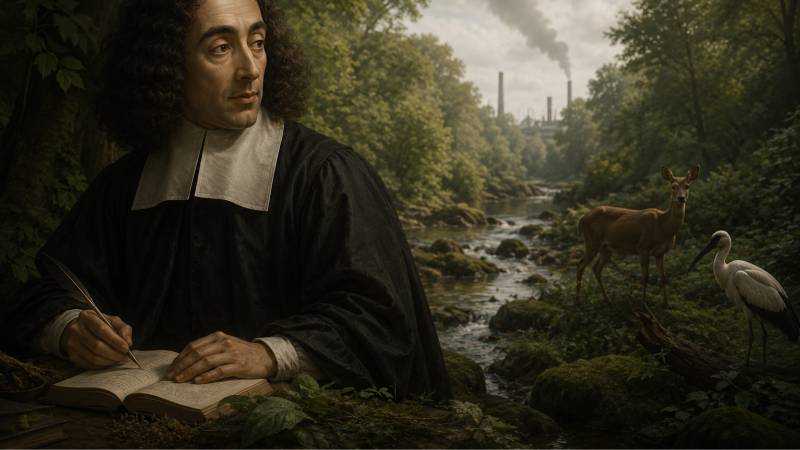
Although Baruch Spinoza’s pantheism, which claims that God is the universe, is a refreshing view for present day environmental ethics. The sense of natural unity that underwrites his notion of the integrated cosmos directly opposes the subject-object split when it comes to the human relationship with nature. In today’s environmental ethic this view is exemplified by ecocentrism and biocentrism which posits that nature should be protected because it is valuable in its own right and that human beings ought to act in ways that are right for the environment. Such a view of the understanding that people are a part of nature, not outside of it, allied with the notion of human prosperity linked to the well-being of the natural context, dari Spinoza.
The major themes of the modern post-cosmic environmental ethics include nature’s inherent worth besides its value to people. This is well underlined by Spinoza’s pantheism in which all manifestations of the material world are instancing the divine substance whether they refer to livings or non-livings. This is one way of doing away with anthropocentric ethics that put so much trust in human beings than in other animals. Thus, pantheistic vision of the world that Spinoza offers is useful in the sense that it provides a kind of philosophical foundation for environmentalism, and thus for policies and practices that would save ecosystems and species, not just because they are useful to people. Spinoza's thought here straddles the gap that is assumed in much current debate on environmental ethics between 'instrumental', 'man-centered' values and 'intrinsic values'. Spinoza cannot say: 'Things (such as butterflies, whales, rain forests) are good, or have value, or have rights, independently of man.
Besides, the positive appreciation of the inherent value of nature inherent in pantheism, Spinoza’s work also points to the integration of all entities, which has become an important issue of modern environmentalism, including such problems as climate change and removal of species. Spinoza being an advocate of the monistic principle thought that everything that exits in the nature makes an interconnected whole. This perception is demonstrated in the postmodern environmental ethic because ecosystems are identified as complicated and interconnected, the present ethos focuses on the effects of decision-making processes on ecological systems over a long period.
Same to contemporary environmental ethics, specifically stewardship model, Spinoza’s rejection on the dualistic thinking that regard humans as exclusive from nature is pertinent. The contemporary Anglo-American environmental ethics have also moved towards stewardship bringing forward approaches that discourage exploitation of the environment. This change Spinoza’s philosophy fosters; one which calls for people to become responsible not only for themselves but for the whole of nature. This is in tandem with the call for environmental justice with aims at ensuring that cost or/and benefit for protection of the environment is fairly shared.
It is undeniable to say that the one and only principle of Spinoza’ whole philosophy of thought is the doctrine of the unity of substance, and he baptized this substance as “God or Nature” (Deus sive Natura). This monistic interpretation denies dualism in the style of Descartes, that is there is only one substance and everything in the world human and non-human is a mode of this substance. This idea is closely connected to Deep Ecology which was initiated by Arne Naess – an organization raising ethical concern in relation to natural objects regardless of their relevance to people.
Deep Ecologist explain how people should interact with the natural world based on the view that the natural world is worth it in its own regard due to the metaphysics of Spinoza.
According to Spinoza monism, all things in the universe, material or animate are interrelated as different attributes of God. This integrated view is most consistent with the Deep Ecology principle pointing to the worth of entities per se and irrespective of their usefulness to man. Deep Ecologist explain how people should interact with the natural world based on the view that the natural world is worth it in its own regard due to the metaphysics of Spinoza
Present human interference with the non-human world is excessive, but the situation is rapidly worsening. Another major influence of Spinoza which has hit Ecological thought, especially Biocentrism is the difficult notion of “conatus”, the tendency of all entities toward their continuation of existence. As it was pointed out by Spinoza in his Ethics all objects of this world tend to exist and this tendency is equal to the definition of all living creatures. As for Spinoza, such striving is not an egotistical desire or instinct, but rather the tendency of an object as part of the universe connected and inherent spontaneity for beings’ sake and happiness. Biocentrism, which avows that basic value inheres in living things, has used Spinoza’s conatus to claim that everything from bacteria and slime molds to people have a basic ethical status. According to Biocentric environmental ethics, human beings’ goodness and well-being are intimately linked to goodness and well-being of the rest of the biosphere
Eco feminism that examines connection between feminine oppression and environmentalism is also in harmony with Spinoza rejection of anthropocentrism. His concept of integrated bodies that inform a promethean system means that mankind is a part of the environment connecting him with the Ecofeminist view that nature and women are similar in that they are dominated by a patriarchal system. According to ecofeminists, domination of nature and women is similar and it is for this reason that Spinoza’s philosophy offers a way out. His atheistic, non-sentimental conception of God or Nature allows for the development of an ethics which are based upon the recognition of equal importance of humans, women, and, objects in the Natural’s world. Ecofeminism bases this on an androcentric worldview that seeks to encourage a more decent and compass approach to the environment and people on the periphery.
Another area related to Earth Justice, a movement that seeks to give legal voice to natural entities and ecosystems, is also bound by the same influence from Spinoza. His idea of God or Nature immersed in all things thus has it that nature has a natural right. Earth Justice, an organization that wants the law to place the earth as an aggrieved party in civil law imagines nature as a system in which every particle of creation from the atom to the ecology is perfect, equal and valuable.
The concept of immanence erases the dichotomy between animate and inanimate objects and inculcates a different ethical viewpoint by which nature is not an object to be utilized but instead makes definite an active existence that is encompassed under the same upon substance as humankind. Such a viewpoint fosters legal and moral frameworks that acknowledge the rights of nature as the divine substance not only within its usefulness to humankind, but also as an end
Some of today’s environmentalist movements, based on Spinoza’s work and thought process like, Legal Personhood for Nature like of Whanganui River of New Zealand is an example of it. This phenomenon can be attributed as one of the most prominent examples of the natural entitled worldview inspired by Spinoza’s vision of nature as collections of individual entities. In New Zealand the Whanganui River has been recognized as a legal person in 2017, which means it has rights. This move can be seen as adhering to what Spinoza called Immanence, where nature and everything within it are viewed as substance.
Global climate activism such as the Fridays for Future led by Greta Thunberg is representative of activism that lies on connections of humans with nature, which is also a principle from Spinoza. The movement focuses on the apocalyptic argument that climate change requires immediate action because climate and human rights are inseparable. The backbone of the message is consistent with Spinoza’s view on concomitance between the welfare of people and the health of the environment.