

Master musicians of classical music, the Ustads and Pandits, whether vocalists or instrumentalists, often look down on ghazal and geet singers. While they might not admit it in public, they never miss a chance to poke fun at them in private circles.
When someone once asked Bade Ghulam Ali Khan to sing a ghazal, he remarked mid-performance, “A classical listener doesn’t settle for a ghazal!” On the flip side, the undisputed king of ghazal, Mehdi Hassan, perhaps the only one to give them a taste of their own medicine, quipped that the nuances of ghazal singing are simply beyond the reach of classical vocalists.
But what would you say if classical maestros started playing or singing film songs and ghazals? Naturally, you would be taken aback. Some might even be curious to know which maestros these were and whose songs they chose to perform.
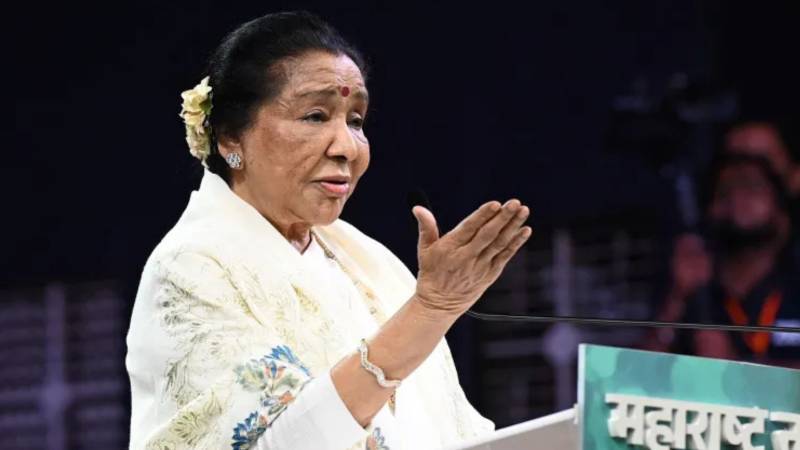
There are many, but today we talk about Asha Bhosle, who has now departed from this world. On April 12, she passed away, leaving the world of music forever.
India’s renowned sitar maestro, Ustad Shahid Parvez, who has been a close personal friend of mine for twenty years, always makes it a point to play the songs of three legends on his sitar during his practice sessions: Mohammed Rafi, Lata Mangeshkar, and Asha Bhosle.
It would not surprise me if he were playing a composition by Ustad Amir Khan, Bade Ghulam Ali Khan, Ustad Salamat Ali Khan, or Pandit C. R. Vyas. But a maestro of his stature playing film tunes?
About 35 years ago, while speaking with Ustad Salamat Ali Khan, he suddenly remarked, “We sing ragas; we do not sing folk tunes like ‘Sada Chiryan Da Chamba’.” This was a dig at Tufail Niazi (both have now left us).
Shahid Parvez Sahab once mentioned that filling the shoes of Asha Bhosle is as difficult as mastering a classical style. Take a look at this piece. See how beautifully Shahid Bhai brought out Asha Ji’s “Salona Sa Sajan Hai” on the sitar. He even noted at the end that others fail to recreate it and simply brush it off as “frivolous” to hide their own limitations.
To truly grasp the difference between Lata Mangeshkar and Asha Bhosle, one needs a solid understanding of classical music. To the untrained ear, their voices might sound the same.
Generations have passed without witnessing their equal, and perhaps generations more will pass the same way. Will there ever be another like them?
I am no expert, just a student of tabla and classical singing, but during my own practice, I try to dig deep into their vocal delivery.
This has led me to the realisation that Asha Ji’s range was often “half a note” higher than Lata Ji’s. In music, half a note is a whole world in itself.
Moreover, her voice had a distinct crispness and a powerful “khatka” (vocal ornamentation).
It might be a bold claim, but whenever Lata Ji sang with Rafi Sahab, it felt like a mismatch, like a lion against a lamb. Lata Ji would hit the notes beautifully, but as soon as Rafi Sahab joined in, his presence would drown out her impact.
Asha Ji, however, could hold her own against Rafi Sahab with full force. Part of this was also due to the strained relations Lata Ji had with both Rafi Sahab and Asha Ji.
One day, while discussing their singing with Wajahat Masood, editor of “Hum Sub”, he took the words right out of my mouth.
He said that Asha’s voice carries a sensual allure, whereas Lata’s voice is defined by innocence and purity.
I will not go over the biographical details of Asha Ji that are already all over the internet; that would only make this piece unnecessarily long.
I have a friend in Mumbai, Pandit Naveen Gandharv, who plays the Belabahar, a unique instrument that is a cross between a sarangi and a violin, with a very melodious sound.
He attended Asha Ji’s funeral and mentioned that a sea of people had gathered, all deeply saddened.
Naveen Bhai believes that replicating Asha Ji’s songs on an instrument is actually tougher than playing a classical raga.
A similar sentiment was shared by the brilliant violinist Pandit Pravin Sheolikar, who noted that Asha Ji had mastered every genre.
He said that while most artists spend a lifetime trying to get a handle on one thing, Asha Ji was a true all-rounder.
She had command over classical music, a firm grip on ghazal, and film music was like second nature to her.
Those who have heard “Jhoote Naina Bole” from the film Lekin and understand ragas can tell you it is pure raga, Bilaskhani Todi.
Asha Ji once performed it live in a classical style and stole the show, showcasing the entire world of Bilaskhani in her “Aakaar.”
Now listen to this song of Asha, which is pure raga, Lalit. I find it one of the finest renditions of Lalit. I only wish it were longer!
A friend of mine for over thirty-five years, Hasan Azad, a mathematician with a doctorate and a sitar student of the late Ustad Sharif Khan Poonchwale, recently shared a memory from sixty years ago.
He recalled a conversation with the legendary composer Feroz Nizami, during which Nizami Sahab stated flatly that Asha Bhosle was a far superior singer to Lata Mangeshkar.
Honestly, the facts back him up.
Master composers like O. P. Nayyar, S. D. Burman, and R. D. Burman, who understood the nuances of classical music as deeply as any Ustad or Pandit, consistently turned to Asha for their most intricate and demanding compositions.
They knew she was the only one who could truly do them justice. The so-called “gods” of the film industry did not really do justice to Asha Ji. They put Lata Ji on a pedestal and gave her a free hand.
Lata Ji left no stone unturned in trying to wind down Rafi Sahab’s career, though she did not succeed.
I will not go into details as that history is well documented.
Asha Ji was paid significantly less than Lata.
To make a name for yourself while Lata was around was like trying to establish yourself in tabla while Ahmed Jan Thirakwa was still active, or in ghazal during the era of Ghulam Ali and Mehdi Hassan.
Asha pulled it off, much like Zakir Hussain did in tabla, Jagjit Singh in ghazal, or how Shahid Parvez proved his mettle in sitar alongside Vilayat Khan and Ravi Shankar.
Similarly, Amjad Ali Khan took the sarod to heights that even Ali Akbar Khan could not have imagined.
It has been 234 years since Wolfgang Amadeus Mozart, 57 years since Bade Ghulam Ali Khan, 52 years since Ustad Amir Khan, and 45 years since Mohammad Rafi left this world, yet time has failed to bring another like them.
They have become immortal.
Generations have passed without witnessing their equal, and perhaps generations more will pass the same way. Will there ever be another like them?
It did not happen in the lives of many before us, and it may not happen in ours.
I will end this with Asha Ji’s unique ghazal: “Kabhi Neki Bhi Uske Ji Mein Gar Aa Jaye.”